


LinkedIn is one of the leading channels for B2B lead generation, but there’s long been a debate around the best way to approach LinkedIn outreach. Should businesses manage conversations manually, or use LinkedIn automation to reach more prospects in less time?
It’s a question that has become even more relevant in 2026. LinkedIn has made a number of changes to how activity is managed across the platform, while the growing use of automation has led many B2B businesses to reconsider how they prospect, start conversations, and generate B2B leads without sacrificing quality.
At StraightIn, we see both sides of the debate first-hand. As a full-service LinkedIn marketing agency, we’ve supported more than 7,000 B2B businesses and generated over 500,000 leads globally. Our team runs both fully Manual outreach campaigns and hybrid Automated outreach campaigns, giving us direct experience of where each approach works well, where it falls short, and when one may make more sense than the other.
In this guide, we’ll compare Manual outreach vs Automated outreach, explain how each approach works, look at the advantages and disadvantages, and help you decide which model is better suited to your LinkedIn lead generation strategy.
Contents
- What Is Manual LinkedIn Outreach?
- What Are the Pros and Cons of Manual Outreach?
- What Is Automated LinkedIn Outreach?
- What Are the Pros and Cons of Automated Outreach?
- Which Approach Generates Better B2B Leads?
- Choosing the Right LinkedIn Outreach Strategy for Lead Generation
- Key Takeaways
- Frequently Asked Questions
What Is Manual LinkedIn Outreach?
Manual LinkedIn outreach is the process of finding, contacting and engaging potential customers on LinkedIn without relying on automation software to carry out the outreach. A person manages the campaign directly, from deciding who to contact and sending connection requests through to writing messages, responding to prospects and following up.
In practice, that means there’s a human behind each stage of the campaign.
Rather than automatically working through a list of prospects, an account manager can review individual profiles before making contact, consider whether someone is genuinely relevant, and adapt the messaging where necessary. Once a prospect responds, the conversation is managed by a person who can interpret the reply and decide what should happen next.
A typical manual LinkedIn outreach campaign can involve:
- Using LinkedIn Sales Navigator to identify prospects that match the client’s Ideal Customer Profile (ICP).
- Reviewing profiles and accounts before making contact.
- Sending connection requests manually.
- Personalising outreach based on the prospect, their role, business or other relevant information.
- Monitoring responses and managing conversations.
- Following up with prospects at appropriate points rather than relying entirely on predetermined automated sequences.
- Identifying genuine sales opportunities and handing qualified B2B leads over to the client.
The main difference is the level of human judgement involved. Two prospects may have the same job title and work for similar businesses, but that doesn’t necessarily mean they should receive exactly the same approach. Their responsibilities may differ, their company may be dealing with different challenges, or something on their profile might provide a much more natural reason to start a conversation.
That level of judgement is difficult to reproduce when outreach is being carried out at scale.
How Does StraightIn’s Manual LinkedIn Outreach Work?
StraightIn’s fully manual LinkedIn outreach campaigns are managed by people throughout the process. Our team handles prospecting, outreach, inbox conversations and follow-ups on behalf of clients, with dedicated account managers overseeing campaign activity and making adjustments based on how prospects respond.
It’s an approach that goes back to the beginning of StraightIn.
We began as a fully manual LinkedIn lead generation agency (before later adding content marketing and LinkedIn advertising to our services), when LinkedIn wasn’t being used for B2B lead generation in quite the same way it is today.
Businesses were certainly prospecting on the platform, but LinkedIn had yet to become such an established part of the sales and marketing mix for many B2B businesses.
Being relatively early to the space gave us a chance to see how people responded to LinkedIn outreach before prospect inboxes became as busy as they are now. One thing became apparent very quickly: taking the time to make outreach feel personal could make a significant difference to the conversations that followed.
As our CEO, Zac Hancox explains…
“When I started StraightIn around eight years ago, LinkedIn wasn’t as established as a lead generation channel as it is now, and we were fairly early in seeing what it could do for B2B businesses. What worked for us was keeping the outreach personal. We had real people researching prospects, writing messages and having conversations, and prospects responded well to that. The platform has changed a lot since then, but that human element is still a big part of what makes good outreach work.”
Of course, having people manage every part of a campaign comes with a trade-off. Manual outreach gives account managers more control over who they contact, what they say and how they handle individual conversations, but there are only so many prospects a person can realistically research and contact in a working day.
And as LinkedIn became a more established lead generation channel, that question of scale became increasingly difficult to ignore.
If managing prospecting, messaging and follow-ups manually is taking up too much of your team’s time, outsourcing could be worth considering. We explore when it makes sense and what to expect in our guide:
What Are the Pros and Cons of Manual Outreach?
Manual LinkedIn outreach gives businesses more control over who they contact, how messages are personalised and how conversations develop. The trade-off is that this level of human involvement takes time and naturally limits how many prospects can be reached.
As Zac explains, we’re now seeing the pendulum begin to swing back towards manual outreach: “We’re definitely seeing more interest in manual outreach again. There’s so much automated activity on LinkedIn now that genuinely personalised, human-led outreach can stand out. At the same time, LinkedIn is becoming more conscious of automated activity on the platform, which is making businesses think more carefully about how they approach outreach. For the right campaign, that’s making manual outreach an increasingly attractive option again.”
Of course, that doesn’t mean manual outreach is the right fit for every campaign, and much depends on the size of the audience a business is trying to reach.
For B2B businesses targeting a relatively focused group of high-value prospects, these limitations may be a reasonable trade-off for greater control and personalisation. For businesses with a much larger addressable market, however, reaching enough of that audience manually can become difficult.
That challenge is one of the main reasons LinkedIn automation became attractive in the first place.
What Is Automated LinkedIn Outreach?
Automated LinkedIn outreach uses software to carry out parts of the prospecting and outreach process that would otherwise need to be completed manually. Depending on the tool and campaign setup, this can include finding prospects, sending connection requests, delivering messages and scheduling follow-ups.
The main attraction is scale. Instead of an account manager carrying out every repetitive action individually, LinkedIn automation can handle selected tasks across a larger pool of prospects, reducing the amount of manual work involved in running a campaign.
However, there is an important distinction to make. Automated outreach doesn’t necessarily mean handing an entire LinkedIn campaign over to software.
At one end of the spectrum, businesses can use automation tools to send large volumes of connection requests and templated messages with relatively little human involvement. At the other end, automation can support selected parts of a campaign while people remain responsible for the targeting, messaging, campaign management, and conversations that ultimately determine the quality of the outreach.
How Does StraightIn’s Automated LinkedIn Outreach Work?
At StraightIn, we take the latter approach.
Our hybrid LinkedIn outreach campaigns combine automation with dedicated account management. Technology helps us manage appropriate parts of the outreach process and reach a larger pool of prospects, while experienced account managers oversee the campaign and remain involved in the areas where human judgement matters.
This means automation supports the people managing the campaign rather than replacing them.
Our approach wasn’t always structured this way. Having originally built StraightIn around fully manual LinkedIn outreach, we began exploring automation several years later as the platform matured and the potential audience available to B2B businesses continued to grow.
We could see the obvious advantage. Used carefully, automation could reduce some of the repetitive work involved in outreach and allow campaigns to reach more relevant prospects. But we didn’t want that additional capacity to come at the expense of the personalisation and human involvement that had worked so well in our manual campaigns.
As our Head of Operations, Shannon Townsend, explains:
“When we started introducing automation, the aim was never to replace the people managing our campaigns. We saw it as a way to take some of the repetitive work off their hands and give them more time to focus on targeting, messaging and conversations. It was about combining smart technology with smarter people. Automation can help you reach more prospects and manage campaigns more efficiently, but you still need experienced people making decisions and keeping the outreach relevant. If you take that human oversight away and focus purely on volume, the quality of the campaign can suffer.”
This distinction has become particularly relevant in 2026. LinkedIn automation tools have become more sophisticated, but LinkedIn has also taken steps to address automated, artificial and low-quality activity across the platform.
For B2B businesses, the question is therefore less about whether automation can increase outreach capacity. It can.
The more important consideration is how that automation is being used, where people remain involved and whether increasing activity actually translates into more qualified B2B leads.
The Elephant in the Room? LinkedIn Automation and Account Restrictions
Before getting into the pros and cons of automated outreach, we need to address the elephant in the room.
LinkedIn automation has always come with an element of risk. LinkedIn places restrictions on the use of third-party software that automates activity on the platform, and accounts that breach its rules can face temporary or permanent restrictions.
LinkedIn’s stance on automated activity has always been fairly clear: it doesn’t allow third-party software or browser extensions that scrape data, modify the appearance of the platform or automate activity on LinkedIn.
As the use of automation has increased, however, LinkedIn appears to be taking a more active approach to identifying and limiting automated, artificial and low-quality activity across the platform.
One of the most notable recent examples involved LinkedIn automation platform HeyReach. On 25 March 2026, the company’s LinkedIn page was removed, alongside the personal profiles of its CTO, CRO and CMO.
LinkedIn doesn’t appear to have publicly explained the specific reasoning behind the action, and HeyReach said its clients weren’t affected. So, we can’t conclude that the profiles were restricted simply because HeyReach provides automation software, nor does the incident mean businesses using LinkedIn automation will automatically face account restrictions.
BUT what it does do is bring the risks surrounding third-party automation back into focus, particularly when viewed alongside some of the other steps LinkedIn has been taking.
LinkedIn VP of Product Management Gyanda Sachdeva has confirmed that the platform is taking action against automated comments submitted through third-party tools, scripts and browser extensions without a person manually posting them.
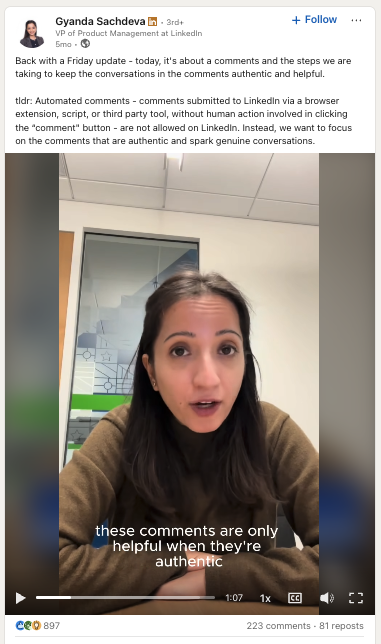
LinkedIn has said detected automated comments can be removed from the “Most Relevant” view, have their distribution limited and, in more serious cases, contribute to account restrictions. The platform has also been targeting engagement pods and other methods used to artificially increase activity.
And it isn’t only automation software attracting attention.
More recently, LinkedIn introduced a “Seems like AI slop” feedback option that allows members to flag posts they believe contain low-quality or overly AI-generated content. LinkedIn has said this feedback will help improve the systems it uses to identify and reduce low-quality content in people’s feeds.
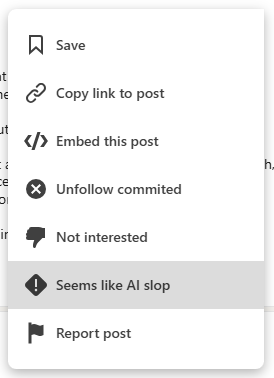
Taken together, these developments point towards a wider direction of travel. LinkedIn wants activity on the platform to feel authentic and useful, and it’s becoming more active in addressing behaviour that appears artificial, automated or designed primarily to manipulate engagement.
For businesses using LinkedIn for lead generation, that doesn’t mean all automation should suddenly be abandoned. It does mean there is a growing case for being selective about what you automate, understanding how third-party tools operate and keeping people closely involved in the process.
In some ways, it also brings the conversation back to where this article started. As LinkedIn puts greater emphasis on authentic human interaction, the personalisation, judgement and one-to-one conversations associated with manual outreach could become even more valuable.
So, back to the question at hand. With the potential risks of LinkedIn automation in mind, how do its practical advantages and disadvantages compare with a fully manual approach?
What Are the Pros and Cons of Automated Outreach?
Automated LinkedIn outreach can help B2B businesses reach a larger pool of prospects without requiring someone to carry out every action manually. That makes it particularly useful when the target market is too large to prospect effectively through manual outreach alone.
However, increasing outreach capacity doesn’t automatically mean generating more B2B leads. The results depend heavily on how the automation is set up, the quality of the targeting and messaging, and how much human oversight remains throughout the campaign.
As Shannon explains, some of those limitations only become obvious when you see automation working across thousands of different LinkedIn profiles.
“Automation is very good at following rules, but it doesn’t always understand the context behind the information it’s given. You might have someone working for Domino’s where their company is listed as ‘Domino’s UK’ or ‘Domino’s Pizza France’, and the automation can treat that as the actual company name and drop the whole thing into a message. You see similar issues with names. In some regions, people might have ‘Eng.’ in front of their name to indicate that they’re an engineer, but an automated system can interpret that as their first name and address them as ‘Eng.’
They’re small details, but they’re exactly the kind of details that can make an automated message immediately feel automated. And when you’re doing that at scale, a small mistake can be repeated hundreds of times. That’s why we still think human oversight is so important. Automation can make outreach more efficient, but you need people checking the targeting, the data and the messaging rather than assuming the technology will get every prospect right.”
These disadvantages don’t mean automated LinkedIn outreach is inherently ineffective. There is a significant difference between using automation to support a carefully managed campaign and relying on software to send as much activity as possible with little human involvement.
Which Approach Generates Better B2B Leads?
So, which approach actually generates more B2B leads?
There isn’t a universal answer. We’ve seen strong results from both manual and automated outreach, and performance can vary depending on the audience, offer, messaging, sector, size of the available market and how the campaign is managed.
However, we recently reviewed the performance of 10 StraightIn client accounts that had periods of automated/hybrid outreach and periods of fully manual outreach.
Across the periods included in our comparison, the automated/hybrid approach generated 80 leads, while manual outreach generated 113.
Manual outreach generated more leads in six of the 10 accounts, while automated/hybrid outreach generated more in four.
You can find a full breakdown below:
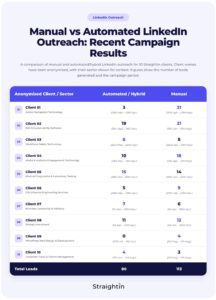
These are anonymised examples from 10 recent StraightIn client accounts. The figures compare periods of automated/hybrid and fully manual outreach on the same accounts. The reporting periods aren’t identical in length, so the totals shouldn’t be interpreted as a controlled test or an industry benchmark.
At first glance, the figures make a strong case for manual outreach. Across the periods reviewed, it generated 33 more leads and produced the higher lead total on six of the 10 accounts.
But we need to be careful about what we take from the data.
The reporting periods aren’t identical, and these weren’t controlled experiments where every other element of the campaign remained unchanged. Targeting, audience size, messaging, timing and other campaign variables can all affect the number of leads generated.
For that reason, it wouldn’t be accurate to say that manual outreach generates 41% more B2B leads based on these figures alone.
What we can say is that moving away from automation didn’t prevent these accounts from generating leads at scale. In fact, across the periods we reviewed, the manual approach produced the higher overall lead total and outperformed automated/hybrid outreach on six of the 10 accounts.
That’s particularly interesting because one of the main arguments in favour of automated outreach is its ability to reach more people.
Our results provide a useful reminder that more outreach doesn’t necessarily mean more leads.
More Outreach Doesn’t Necessarily Mean Better Leads
The ability to contact more people is useful, but outreach volume is only one part of the equation. For most B2B businesses, the real measure of a LinkedIn outreach campaign isn’t how many connection requests or messages it sends. It’s how many of those interactions turn into relevant conversations, qualified opportunities and, eventually, new business.
This is where manual outreach can have an advantage.
Because an account manager has greater control over individual prospects, they can spend more time deciding who is genuinely worth contacting and how best to approach them. They can also adapt conversations and follow-ups based on what a prospect actually says rather than relying on a predetermined sequence.
That additional attention can be particularly valuable when you’re targeting senior decision-makers, working with a relatively small prospect pool or selling a high-value service where a single opportunity could be worth considerably more than dozens of less relevant responses.
Automated outreach approaches the problem differently.
Its strength is coverage. If there are thousands of relevant prospects within your target market, automation can help you reach more of them without requiring someone to carry out every action manually. For the right campaign, that additional reach can create opportunities that simply wouldn’t have been possible at the same pace through manual prospecting.
The danger comes when volume becomes the objective rather than a means of reaching the right people.
Sending twice as many messages doesn’t make a campaign twice as effective. If the additional prospects aren’t relevant, the messaging doesn’t resonate, or responses aren’t handled properly, increasing activity can simply create more noise.
Lead Quality vs Lead Quantity
This is why we think the manual vs automated outreach debate needs to go beyond the number of messages sent or even the number of leads generated.
Ten relevant conversations with decision-makers who closely match your Ideal Customer Profile could be considerably more valuable than 20 leads with little chance of progressing. Equally, a well-managed automated campaign that reaches a larger relevant audience could generate both the quantity and quality of opportunities a business needs.
The distinction matters because not every B2B lead carries the same commercial value.
A useful comparison should therefore look beyond activity and consider:
- Lead relevance: Are you speaking to people and businesses that genuinely match your Ideal Customer Profile?
- Conversation quality: Are prospects showing genuine interest, or are responses largely polite rejections and low-intent enquiries?
- Sales progression: How many leads move into meetings, proposals and genuine sales opportunities?
- Pipeline value: What is the potential commercial value of the opportunities being created?
- Conversion: How many LinkedIn leads ultimately become customers?
Looking at campaign performance this way changes the question.
Instead of asking, “Which approach lets us contact the most people?”, it becomes, “Which approach gives us the best chance of generating commercially valuable opportunities from our target market?”
And the answer won’t always be the same.
Our own results demonstrate that manual outreach can remain highly competitive even as automation becomes more sophisticated. Across the 10 accounts we reviewed, manual outreach produced the higher lead total in six and generated more leads overall during the periods compared.
At the same time, automated/hybrid outreach performed better on four accounts. That matters too. If manual outreach were inherently superior in every situation, we wouldn’t expect to see automation outperform it at all.
What we’re seeing instead reflects our experience of running both types of campaign: there is no universal winner.
A smaller, highly specific audience may benefit from the additional attention of manual outreach. A business with a much larger pool of relevant prospects may benefit from the additional reach of a hybrid approach. In other cases, factors such as the offer, sector, sales cycle and available resources may have a greater influence on results than the outreach method itself.
The better question, then, isn’t whether manual or automated LinkedIn outreach is best overall. It’s which approach makes the most sense for the campaign you’re trying to run.
Choosing the Right LinkedIn Outreach Strategy for Lead Generation
Choosing between manual and automated LinkedIn outreach should start with your target market and commercial objectives rather than the technology.
Before deciding, consider the size of your audience, the value of an individual opportunity, how much personalisation your outreach requires and the resources available to manage the campaign.
These aren’t hard rules.
A large target market doesn’t automatically mean you should automate your outreach, just as a high-value service doesn’t automatically mean every part of the campaign needs to be carried out manually.
There is also a middle ground. A hybrid campaign can use automation where it makes sense while retaining human oversight of targeting, messaging and conversations. For some B2B businesses, that balance provides the additional reach they’re looking for without handing the entire lead generation process over to software.
Ultimately, the right LinkedIn outreach strategy is the one that produces the right opportunities for your business at a level you can manage consistently.
Manual outreach gives you greater control and individual attention. Automated outreach gives you greater capacity. A well-managed hybrid approach attempts to find a balance between the two.
Which of those matters most will depend on who you’re trying to reach, what you’re selling and what you need your LinkedIn lead generation campaign to achieve.
If you decide to outsource your LinkedIn outreach, choosing the right approach is only part of the decision. The agency managing it matters just as much. Look for a partner that can explain how your campaign will be run, how much human involvement there will be, how they define a qualified lead and how they’ll measure performance.
We cover what to look for (and some of the red flags to avoid) in our guide:
Key Takeaways
If you’re deciding between manual and automated LinkedIn outreach, these are the main points to remember:
- Manual outreach offers greater control and personalisation, making it particularly well suited to smaller, highly targeted audiences and high-value prospects.
- Automated outreach can help businesses reach more prospects, reduce repetitive work and maintain consistent activity across larger target markets.
- More outreach doesn’t automatically mean more B2B leads. Targeting, messaging, personalisation and conversation quality all influence campaign performance.
- Our recent campaign data favoured manual outreach overall, with manual generating more leads in six of the 10 accounts reviewed, although automated/hybrid outreach performed better in four.
- LinkedIn automation carries additional considerations, particularly around third-party tools, account restrictions and LinkedIn’s increasing focus on authentic activity.
- Hybrid outreach can provide a middle ground, using automation for appropriate tasks while keeping experienced people involved in targeting, messaging and conversations.
- There is no universal winner. The right approach depends on your target market, deal value, sales cycle, available resources and campaign objectives.
Ultimately, the best LinkedIn outreach strategy isn’t necessarily the one that reaches the most people. It’s the one that consistently generates relevant conversations and qualified opportunities for your business.
Manual vs Automated LinkedIn Outreach — Which Should You Choose in 2026?
So, which delivers better B2B leads in 2026: manual or automated LinkedIn outreach?
Our results show there’s no universal winner. Across the 10 client accounts we compared, manual outreach generated more leads overall and outperformed automated/hybrid outreach in six. Automated/hybrid campaigns, however, performed better in four.
The right approach depends on the campaign. Manual outreach offers greater personalisation and human judgement, while automation can help businesses reach larger audiences more efficiently. A hybrid approach sits somewhere between the two, combining additional capacity with human oversight.
Ultimately, successful LinkedIn outreach isn’t about sending the most messages. It’s about reaching the right prospects and turning those conversations into qualified opportunities.
Which LinkedIn outreach approach is right for your business?
At StraightIn, we offer both fully manual LinkedIn outreach and hybrid LinkedIn outreach campaigns. Rather than treating one model as the answer for every business, we build the approach around your target audience, objectives and the type of opportunities you’re trying to generate.
If you’re unsure which approach is right for your business, get in touch with the StraightIn team. We can help you determine the most appropriate LinkedIn outreach strategy and build a campaign focused on generating qualified B2B leads, not simply more activity.
Frequently Asked Questions
How much does LinkedIn outreach cost?
The cost of LinkedIn outreach depends on how you choose to manage it, including whether campaigns are run in-house, through a self-serve setup or by a specialist agency. The true cost can include much more than software or agency fees, with internal salaries, training, tools and the time required to manage campaigns all contributing to the overall investment.
For a more detailed comparison, read our guides Self-Serve vs Managed Service | Which Is Right for Your LinkedIn Marketing? and In-House vs Outsourced LinkedIn Lead Generation | The Real Cost of Doing It Yourself, where we break down the costs, resources and trade-offs involved in each approach.
How many prospects do you need for a LinkedIn outreach campaign?
There isn’t a fixed number of prospects required for LinkedIn outreach. A campaign targeting a niche market may have only a few hundred genuinely relevant decision-makers, while businesses operating across larger industries or territories could have thousands. Your available prospect pool is worth establishing early because it can influence both the outreach strategy and how long a campaign can run before audiences begin to overlap.
Can you switch from automated to manual LinkedIn outreach?
Yes. A LinkedIn outreach strategy doesn’t have to remain fixed for the lifetime of a campaign. Businesses can move from automated to manual outreach, introduce automation into an existing manual campaign or test different approaches across separate audiences. Previous campaign performance can help identify where additional personalisation or greater outreach capacity is likely to be most useful.
Do you need LinkedIn Sales Navigator for B2B outreach?
LinkedIn Sales Navigator isn’t essential, but its advanced search and filtering capabilities can make B2B prospecting considerably more targeted. Businesses can filter potential prospects using criteria such as seniority, geography, company headcount and industry, helping build prospect lists that more closely reflect their Ideal Customer Profile.
How long should you test a LinkedIn outreach campaign before judging the results?
Give a LinkedIn outreach campaign enough time for prospects to receive and respond to follow-ups before judging its performance. The first few weeks may only tell part of the story, as B2B decision-makers are busy and many opportunities develop after several touchpoints rather than the initial message.
That’s why it’s important to look at how targeting, messaging and follow-ups perform over time rather than making decisions based on early results alone. We explore this in more detail in our guide, Why Follow-Ups Are the Secret to Successful LinkedIn Outreach.
