


Generative AI search is changing how people search for information online. Tools such as ChatGPT, Google’s AI-powered search features and other generative answer engines can now answer questions directly, often using information gathered from multiple online sources.
For businesses publishing LinkedIn content, that creates another route to being discovered. A well-written LinkedIn article or supporting website article can answer a potential customer’s question, establish your expertise and, in some cases, become a source used within generative engine answers.
There’s also good reason to pay particular attention to LinkedIn. In a 2026 study of 89,000 LinkedIn URLs cited by ChatGPT Search, Google AI Mode and Perplexity, Semrush found that LinkedIn was the second-most-cited domain in its dataset, appearing in around 11% of AI-generated responses on average. Long-form LinkedIn articles were especially prominent, accounting for between 50% and 66% of the LinkedIn content cited across the three platforms.
At StraightIn, we’ve been paying close attention to this shift and changing how we approach content marketing as a result. Over the last 90 days, StraightIn has appeared in 545 AI-generated results and received 1,270 citations as a source. We’ve also seen encouraging results from articles written using our newer content structure, including one recent blog that generated around 3,850 Google impressions alongside growing visibility in AI search.
Our experience so far suggests that generative engine optimisation (GEO) isn’t about finding a new set of tricks to manipulate AI. Much of it comes back to publishing useful content that answers real questions, demonstrates genuine experience and makes important information easy to find and understand.
In this guide, we’ll explain how we’re approaching GEO at StraightIn, what we’ve learned from our own content, and how businesses can improve LinkedIn articles and wider LinkedIn content marketing for both traditional search and generative AI.
Contents
- What is Generative Engine Optimisation (GEO)?
- What Are Generative Engine Answers?
- Why Do Generative Engine Answers Matter for LinkedIn Content?
- How Should You Structure LinkedIn Articles for Generative AI Search?
- What Writing Style Works Best for GEO?
- Key Takeaways
- Frequently Asked Questions
What is generative engine optimisation (GEO)?
Generative engine optimisation is the process of creating and improving content so that generative AI and AI-powered search tools can understand it, identify relevant information within it and potentially use it as a source when answering a question. Put simply, GEO is about making your content more useful and discoverable within generative AI search.
Despite a lot of misconceptions, there’s a lot of crossover with traditional SEO. You still need to publish useful content, cover the subject properly, use clear headings, support your claims and demonstrate that you know what you’re talking about.
Where GEO adds another consideration is how easily information can be identified and used within an AI-generated answer.
Think about someone researching LinkedIn lead generation. Instead of typing a couple of keywords into Google, they might ask ChatGPT:
- How does LinkedIn lead generation work?
- Should I outsource LinkedIn prospecting?
- How much does LinkedIn lead generation cost?
- Is LinkedIn effective for B2B lead generation?
- What should I include in a LinkedIn content strategy?
One detailed article could answer several of those questions. If the answers are clear, useful and backed by credible information, parts of that article may be relevant when an AI platform is putting together its response.
GEO is not a replacement for SEO or content marketing. People still use search engines, click through to websites and research businesses in the usual ways. GEO simply reflects the fact that generative AI is becoming another part of that process.
What are generative engine answers?
Generative engine answers are responses produced by generative AI tools using information gathered from different online sources. Depending on the platform and the question, the answer may include citations or links showing where that information came from.
This is different from a traditional search results page where the user is given a list of links and decides which pages to visit. With generative AI, some of that research happens within the answer itself.
For businesses creating LinkedIn content, that matters because LinkedIn is already appearing frequently among those sources. As we covered earlier, Semrush found LinkedIn was the second-most-cited domain in its study of 89,000 LinkedIn URLs referenced across ChatGPT Search, Google AI Mode and Perplexity.
Why do generative engine answers matter for LinkedIn content?
More people are turning to generative AI when they have a problem to solve or need to find a supplier. Rather than working through pages of search results, they can ask a specific question, compare their options and narrow down what they need.
This is already happening in B2B buying. Gartner surveyed 645 B2B buyers and found that 45% had used generative AI during a recent purchase, primarily to research vendors and products.
As our CEO Zac Hancox explains:
“Most people aren’t going onto ChatGPT and searching for StraightIn. They’re asking how they can generate more leads through LinkedIn, whether they should outsource their prospecting or which LinkedIn marketing agencies they should be looking at. That’s where generative AI search gets interesting for us. If StraightIn is appearing while someone is asking those questions, we’re getting in front of a potential customer who may never have heard of us before but is already looking for the kind of help we provide.”
AI doesn’t necessarily replace the conversation that follows. In the same Gartner research, 69% of B2B buyers said they preferred to validate AI-generated information with a salesperson. For businesses like ours, that creates an interesting combination: generative AI can play a role in the research process, while the sales team picks up the conversation once the buyer is ready to speak to someone.
We’re seeing the benefit of this first-hand. Historically, generating genuine enquiries through the website was slow going and, as a LinkedIn marketing agency, we had another problem. A surprising number of people found us and assumed we were LinkedIn.
We’ve had people ask us to reset passwords, regain access to their accounts or fix problems they’re having with the platform. Those enquiries technically count as form submissions, but they’re obviously not leads. They’re a waste of time for everyone involved.
Since changing the way we research, structure and write our content, AI citations increased by 160% within the first two weeks and have continued to rise since. Compared with the previous 90-day period, web-form submissions increased by 14%, while our website conversion rate increased by 38%.
But more importantly, we’re seeing much more detailed enquiries from people who understand who StraightIn are, what we do, know which services they’re interested in and can explain what they’re trying to achieve.
Here are two recent examples of the more detailed enquiries we’ve received:
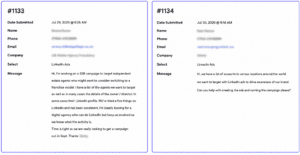
As you can see, both enquiries are specific about what they want to achieve, the type of LinkedIn support they’re looking for and what they need from an agency, suggesting they already have a clear understanding of what we do before getting in touch.
That difference carries through into the conversations our sales team is having with those prospects. Rob Lloyd, Head of Sales at StraightIn, sees it first-hand once those enquiries reach his team:
“We saw a big increase in AI citations almost immediately, but from a sales perspective, the more interesting change has been the quality of the enquiries. Prospects are coming to us already understanding who we are, what we do and how we can help. That means warmer conversations, less time educating buyers, and more time discussing how we can solve their challenges.”
Now, we still get forms asking us to help them reset a password or regain access to their LinkedIn account, and we’ve accepted that we probably always will. But we’re also seeing a noticeable difference in the quality of the genuine enquiries coming through.
That’s ultimately why we started looking more closely at the content behind those results. If the aim is to appear while someone is researching a problem, the next question is what makes one article easier to find, understand and reference than another.
We’ve spent the last few months looking at our most frequently cited content, comparing it with other articles appearing in generative AI search and testing changes across our own blogs and LinkedIn articles. A few patterns have started to emerge, particularly around how the content is structured.
How should you structure LinkedIn articles for generative AI search?
A good LinkedIn article should make it easy for someone to find the information they came for. The same principle helps when writing for generative AI.
That doesn’t mean every paragraph needs to follow a rigid GEO template. In fact, doing that can make an article repetitive and difficult to read. Instead, structure the content around the questions a reader is likely to ask and make sure important answers don’t get lost inside long introductions or unrelated background information.
Answer the main question early
If a section asks a specific question, give the reader a useful answer near the beginning. You can then add examples, evidence and further explanation.
For instance, an article answering, “How long does LinkedIn lead generation take?” shouldn’t spend several paragraphs discussing the history of LinkedIn before addressing the timeframe.
A clearer opening would be:
“LinkedIn lead generation can start producing conversations within the first few weeks, although meaningful results often take two to three months. The timeframe depends on factors such as the target audience, offer, messaging and length of the sales cycle.”
The same principle applies to the introduction of the article itself. Joseph Brown, Copywriting Lead at StraightIn, considers this one of the most important parts of the writing process:
“The introduction is arguably the most important part of the article. We try to make it clear from the start exactly what question we’re answering and, where we can, back that up with a strong proof point such as original data, a client result or a relevant statistic. AI platforms can review huge numbers of pages when looking for information to answer a prompt. The sooner we can establish what the article is about, answer the question and demonstrate why the information is credible, the easier we make it for both AI platforms and readers to understand the content. We carry that approach through the rest of the article with clear headings, direct answers and evidence where it’s needed. We’re not trying to write for a machine. We’re trying to remove unnecessary barriers between the question and the answer.”
You can see that approach in the introduction to this article. We start by explaining how generative AI is changing search and what that means for businesses publishing LinkedIn content. We then support the point with our own data, including 545 appearances in AI-generated results and 1,270 citations over the last 90 days.
By the end of the introduction, the reader knows what GEO means in the context of the article, why we’re qualified to discuss it and what the rest of the guide will cover. There’s no need for several paragraphs of general background before getting to the subject.
The same principle applies throughout the rest of an article. Give readers the information they came for, then use the space that follows to add evidence, examples and context. This also creates focused passages that generative AI can interpret without relying on several surrounding paragraphs to understand the point.
Use headings that describe what the section actually answers
Headings help readers scan an article and decide which sections are relevant to them. They also provide useful context about the information underneath.
Question-based headings work particularly well when they reflect something people genuinely search for, but there’s no need to turn every heading into a question.
For example:
Vague: “Getting Better Results”
Clearer: “How can you improve LinkedIn lead generation results?”
The second heading gives both the reader and a search system much more context about what the section covers.
Keyword research can help identify suitable questions, but headings still need to sound natural. Forcing “LinkedIn content marketing” into every other H2 won’t improve an article if it makes the writing awkward or repetitive.
Break complicated topics into focused sections
Long articles work best when each section has a clear purpose. A 3,000-word guide doesn’t need to feel like a 3,000-word wall of text.
If you’re writing about LinkedIn content marketing, for example, separate sections might cover content strategy, audience research, post formats, thought leadership, measurement and how content supports lead generation. Each section can then answer a distinct group of questions without trying to cover everything at once.
This also makes articles easier to update. If LinkedIn changes a feature or new data becomes available, you can revise the relevant section without rewriting the whole piece.
Use lists and tables when they genuinely make information clearer
Lists work well for steps, requirements, examples and short summaries. Tables can make comparisons much easier to understand, particularly when a reader wants to evaluate several options quickly.
They shouldn’t replace normal writing.
An article made up almost entirely of bullet points may be easy to scan, but it often lacks the context needed to explain more complicated ideas properly. It can also start to look formulaic.
Use the format that suits the information. If something needs explaining, explain it in a paragraph. If you’re listing five campaign metrics, a list or table will probably do the job better.
Use definitions where readers may need them
Definition boxes can be useful when an article introduces technical language, acronyms or terminology that a reader may not know.
GEO is a good example. Defining generative engine optimisation near the beginning of this article gives readers a clear reference point before we start discussing AI citations, content structure and generative engine answers.
The same approach can work in LinkedIn content for terms such as account-based marketing (ABM), ideal customer profile (ICP) or LinkedIn Sales Navigator.
There’s little benefit in defining everyday language simply because a definition box is part of a content template. Use definitions when they remove ambiguity or help someone understand what comes next.
Cover the topic properly rather than writing to a word count
Many of the articles we’ve seen performing well in generative AI search are detailed. They answer the main question clearly and then cover the related questions someone is likely to ask next.
That doesn’t mean every article needs to reach 3,000 words.
A narrow question might only require 1,500 words to answer properly. A detailed guide to LinkedIn content marketing could need considerably more. Adding another 800 words of repetition to hit an arbitrary target won’t make the article more useful.
We look at word count as an indication of depth, not a target in itself. The better test is whether someone can finish the article with a solid understanding of the subject without immediately needing to search elsewhere for the obvious next question.
If you’d like to see how we put these principles into practice, check out our guide:
What writing style works best for GEO?
There isn’t a special writing style you need to adopt for generative engine optimisation. If anything, trying too hard to write for AI tends to make the content worse.
The articles we’re seeing perform well are generally written in straightforward language, answer specific questions and make clear statements that can stand on their own. They don’t read as though they’ve been written to satisfy an algorithm.
That’s an important distinction. Your first job is still to write something worth reading. GEO should influence how clearly you communicate the information, rather than completely changing the way you write.
Be specific about what you mean
Broad statements are easy to write, but they rarely tell the reader very much.
Earlier in this article, we could simply have said that “LinkedIn is becoming more important for AI search.” Technically, that gets the point across, but it doesn’t give the reader much reason to believe us.
Instead, we used the Semrush research:
“In a 2026 study of 89,000 LinkedIn URLs cited by ChatGPT Search, Google AI Mode and Perplexity, Semrush found that LinkedIn was the second-most-cited domain in its dataset, appearing in around 11% of AI-generated responses on average.”
That’s much more useful. It explains what we mean by “important”, gives the claim some scale and allows the reader to judge the evidence for themselves.
Write passages that make sense on their own
Generative AI may reference a particular paragraph or section rather than treating your entire article as one piece of information.
That makes context particularly important.
For example: “This can significantly improve results.”
The sentence relies entirely on whatever came before it. Taken on its own, it tells you very little.
Something like this is much clearer: “Publishing LinkedIn articles that answer specific customer questions gives search engines and generative AI more relevant information to draw from.”
You don’t need to repeat the subject in every single sentence. That would quickly become painful to read. But important passages should contain enough context for someone to understand the point without having to work backwards through several paragraphs.
Use the language your customers actually use
Keyword research still has a place in GEO, but we don’t think in terms of squeezing an exact phrase into an article a certain number of times.
We’re more interested in how people describe the subject when they’re searching for information.
Someone might search for “LinkedIn content marketing”, but they could ask ChatGPT a much more detailed question: “How can I use LinkedIn content to generate more B2B leads?”
Another person might ask: “Is it worth outsourcing LinkedIn content to an agency?”
Those questions are related to the same broad topic, but the wording and intent are different.
That’s one reason we research the questions surrounding a topic rather than concentrating on one keyword. It gives us a better picture of what someone actually wants to know and helps us cover the terminology naturally throughout the article.
You can still include relevant phrases such as LinkedIn content, LinkedIn articles, content marketing, generative AI and generative engine optimisation. They should appear because they’re relevant to the subject, not because you’re trying to hit an arbitrary keyword count.
Don’t write for ChatGPT
This sounds slightly contradictory in an article about GEO, but it’s an important point.
Once businesses start thinking about AI search, there’s a temptation to make every paragraph short, every heading a question, and every answer sound like a dictionary definition. Do that throughout a 2,000-word article, and it becomes incredibly repetitive.
We’ve deliberately tried to avoid that.
Some answers need two sentences. Others need five paragraphs, an example and a statistic. Sometimes a list is the clearest format. Sometimes you need to tell the story behind the result.
The format should follow the information.
The same applies to keywords. Repeating “LinkedIn content marketing” ten times won’t suddenly make an article more useful to ChatGPT or Google AI Mode. If anything, forcing phrases into sentences where they don’t belong makes the writing less natural.
Cut the filler
One of the simplest changes we’ve made is getting to the point faster.
Introductions such as “In today’s rapidly evolving digital landscape…” take up space without giving the reader anything useful. The same goes for paragraphs that spend several sentences telling the reader why a subject is important before explaining anything about it.
If a sentence doesn’t add information, context, evidence or a useful opinion, question whether you need it.
This doesn’t mean every sentence needs to be short. Good writing needs rhythm, and sometimes a longer explanation is exactly what’s required. The aim is to remove the sentences that aren’t doing any work.
Don’t be afraid to have a point of view
This becomes increasingly important as more content is produced using generative AI. If ten articles all repeat the same advice, there’s little reason for someone to read the eleventh.
Originality doesn’t have to mean conducting a huge research project. It could come from client experience, campaign data, conversations with customers, an internal process, a mistake you’ve learned from or an informed opinion that differs from the conventional view.
A LinkedIn marketing agency should be able to say something about LinkedIn marketing that isn’t simply a rewritten version of the first five Google results.
That’s where subject-matter expertise matters. In this article, we’ve used research from Semrush and Gartner to establish the wider picture, then added what we’re seeing ourselves through our content, website performance and sales conversations.
We’ve also included perspectives from people in different roles and at different levels of seniority across StraightIn, from our CEO to the people writing the content. That gives us different perspectives on the same subject rather than relying on one person to speak for the whole business.
Research can tell you what’s happening more broadly. The experience within your own team gives you something original to add to it.
Write for the person who asked the question
This is probably the simplest way to think about all of the above.
If someone has searched “How do I optimise LinkedIn content for generative AI?”, they’ve arrived with a fairly specific reason for reading.
They don’t need 500 words explaining that artificial intelligence is changing marketing. They need to know what they should change, why those changes might help and what evidence there is to support them.
Answer that properly, and you’ve already done much of what good GEO requires.
Ultimately, the aim isn’t to make your content sound more like something an AI wants to read. It’s to make it more useful to the person asking the question. If you can do that consistently, while bringing genuine expertise and evidence to the answer, you’re giving both readers and generative AI a reason to pay attention to what you have to say.
Taken together, the best approach is relatively simple: structure LinkedIn articles so the important information is easy to find, then write in a way that makes that information clear, specific and worth referencing. That means answering questions directly, using descriptive headings, covering the subject in enough depth, cutting unnecessary filler and supporting what you say with evidence and genuine experience. None of those things require you to choose between writing for people and writing for generative AI.
In practice, making an article easier for a reader to understand also makes it easier for AI platforms to identify what the content is about and where it may be useful in an answer.
Key Takeaways
Generative AI is adding another layer to how people discover businesses, research suppliers, and find answers to their questions. For businesses already investing in LinkedIn content, that creates an opportunity to be found beyond the feed and traditional search results.
The principles we’ve covered throughout this guide are relatively straightforward:
- Answer the questions your customers are actually asking.
- Make important information easy to find.
- Use clear headings and give direct answers where they’re needed.
- Support claims with credible research, data and first-hand experience.
- Cover a subject properly rather than writing to an arbitrary word count.
- Use LinkedIn alongside your website rather than treating the two as separate content strategies.
- Above all, write something that’s genuinely useful to the person who asked the question.
That last point is probably the most important. It’s easy to get distracted by citations, prompts and LLMs, but the basic job hasn’t changed: answer the question clearly, credibly and with something useful to say.
There are simply more ways for that answer to be discovered. And for us, the real measure of GEO isn’t citations alone; it’s whether that visibility leads to better enquiries and better business outcomes.
The bottom line on GEO and LinkedIn content
Generative engine optimisation is still developing, and there’s no guarantee that following a particular structure will make an article appear in an AI-generated answer. What we’re seeing so far, however, suggests that the fundamentals matter: answer useful questions, structure the information clearly, support important claims with evidence and bring something original to the subject.
For businesses using LinkedIn content marketing, that creates an opportunity beyond generating impressions, engagement or traditional search traffic. A strong LinkedIn article can become part of the research process itself, helping potential customers understand a problem, evaluate their options and discover businesses with relevant expertise.
That’s how we’re approaching GEO at StraightIn. We’re not trying to write content for algorithms at the expense of the people reading it. We’re trying to produce better answers to the questions our potential customers are already asking, then make those answers as easy as possible for search engines, generative AI and, most importantly, the reader to understand.
If there’s one thing to take away from this guide, it’s that good GEO and good content marketing are increasingly the same thing: understand what your audience wants to know, answer it properly and give them a reason to trust the answer.
Ready to improve your LinkedIn visibility in generative AI search?
StraightIn is a full-service LinkedIn marketing agency helping B2B businesses get more from LinkedIn as a marketing and lead generation channel. Our services cover LinkedIn outreach, including fully manual and hybrid campaigns, LinkedIn content marketing, where we manage company pages and create GEO-optimised articles, and LinkedIn advertising for businesses looking to extend their reach through paid campaigns.
That means we can support the wider LinkedIn strategy rather than looking at content, outreach or advertising in isolation. Whether you want to generate more leads, improve your presence on LinkedIn or increase your visibility across traditional and AI search, get in touch with the StraightIn team to see how we can help.
Get in touch with the StraightIn team to discuss your current LinkedIn content strategy, where GEO could fit into your wider marketing approach and how we can help you build greater visibility with the people already searching for the expertise, services and solutions your business provides.
Frequently Asked Questions
Can LinkedIn posts appear in AI-generated search results?
Yes. Publicly accessible LinkedIn content can be discovered and referenced by AI-powered search tools, including posts; although long-form LinkedIn articles appear to have particularly strong potential for AI visibility because they give search systems more context to work with.
When an AI platform is building an answer, it looks for relevant passages across available sources that directly address the question being asked. A detailed article can contain definitions, explanations, supporting evidence and answers to several related questions, giving the platform more opportunities to find a useful passage to reference than it would typically find in a shorter LinkedIn post.
Should I publish GEO content on LinkedIn or my website?
Ideally, the two should work together rather than choosing one over the other. Your website gives you greater control over your content and remains an important part of traditional SEO, while LinkedIn gives your expertise another place to be discovered.
That doesn’t necessarily mean copying the same article word for word. In fact, we strongly suggest not doing that because it gives readers and search platforms little additional value and means you’re effectively publishing the same resource twice rather than creating another useful source around the topic.
Instead, a subject covered in depth on your website could be adapted into a LinkedIn article with a different angle, new examples or additional insights, then supported by shorter LinkedIn posts. The aim is to build a broader body of content around the subjects your customers are researching, with your website and LinkedIn complementing rather than duplicating each other.
How long does it take for LinkedIn content to appear in AI search?
There is no fixed timeframe for LinkedIn content to start appearing in generative AI search results. In some cases, it can happen surprisingly quickly. We’ve recently seen our own content picked up and cited by AI platforms within 12 hours of being published, which is an encouraging sign of how quickly new content can be discovered.
That won’t be the case for every article or post. We’ve also seen some blog posts take a week or two to earn their first citation. How quickly content appears in AI search can depend on a range of factors, including the topic, level of competition, relevance to the question being asked, the existing authority of the author or business, how easily the content can be discovered and the AI platform itself.
For that reason, GEO is better treated as a long-term content strategy rather than judging success based on how quickly an individual piece gets cited. Some content may appear within hours, while other articles could build visibility gradually as they’re discovered and become relevant to different searches over time.
Do backlinks still matter for generative engine optimisation?
Yes, backlinks and traditional SEO still matter. GEO does not remove the need for search engines and other systems to discover your content or understand the authority surrounding your website. However, backlinks alone won’t make an article useful enough to reference. The content itself still needs to answer the relevant question clearly; provide sufficient context and demonstrate why the information can be trusted. GEO and SEO are therefore better viewed as complementary rather than competing strategies.
How do you know if your LinkedIn content is performing well in AI search?
The easiest way is to track whether your business or content is being mentioned and cited in AI-generated answers. Specialist tools can do this at scale; at StraightIn, we’ve partnered with Otterly.AI to monitor brand mentions and citations across relevant prompts.
You can also test this manually by searching ChatGPT, Perplexity or Google’s AI-powered search with questions your potential customers might genuinely ask, then checking whether your business is mentioned or your content appears as a source. It isn’t completely accurate, as AI answers can vary between searches, but it’s a useful starting point.
