

Personal branding has always been about visibility. Getting the right message in front of the right people at the right time and being recognised for something when it matters most.
For years, that visibility was largely driven by search. Build a website, target the right keywords, and show up on Google when people go looking. LinkedIn existed alongside that, but it was often treated as a separate channel. A place for networking, distribution, and the occasional thought leadership post, rather than a core driver of discovery.
That separation is starting to disappear.
LinkedIn now sits much closer to the core of how people discover, evaluate, and trust information. It’s no longer just a social platform. It plays a direct role in search visibility, AI-generated answers, and how personal brands are formed online.
In practical terms, LinkedIn SEO is now a key part of how individuals and businesses build visibility beyond their own website.
Understanding how that works is becoming increasingly important, particularly as search behaviour continues to shift.
In today’s article, we will explore how LinkedIn fits into the modern search landscape, what this means for your visibility on Google and AI tools, and how to build a LinkedIn content marketing strategy that supports both SEO performance and personal brand growth.
How Search Behaviour Is Changing
Search still starts in the same place for most people. Google.
If someone is actively looking for a solution, a supplier, or even just trying to understand a topic, Google is usually the first stop. That hasn’t really changed.
What has changed is what happens next.
More people are now using AI tools alongside traditional search. They’re asking more detailed questions, comparing options, and looking for clearer answers without having to click through multiple different pages. According to Adobe, 77% of ChatGPT users treat it as a search engine, with adoption even higher among Gen Z.
According to the same study, people are starting to trust AI-generated answers as much as, or more than, traditional search results.
There are a couple of reasons for this shift:
- AI allows for more context. Instead of short keywords, users can ask full questions and refine responses in real time.
- AI delivers answers, not just links. It interprets information from multiple sources and presents it in a clear, direct format.
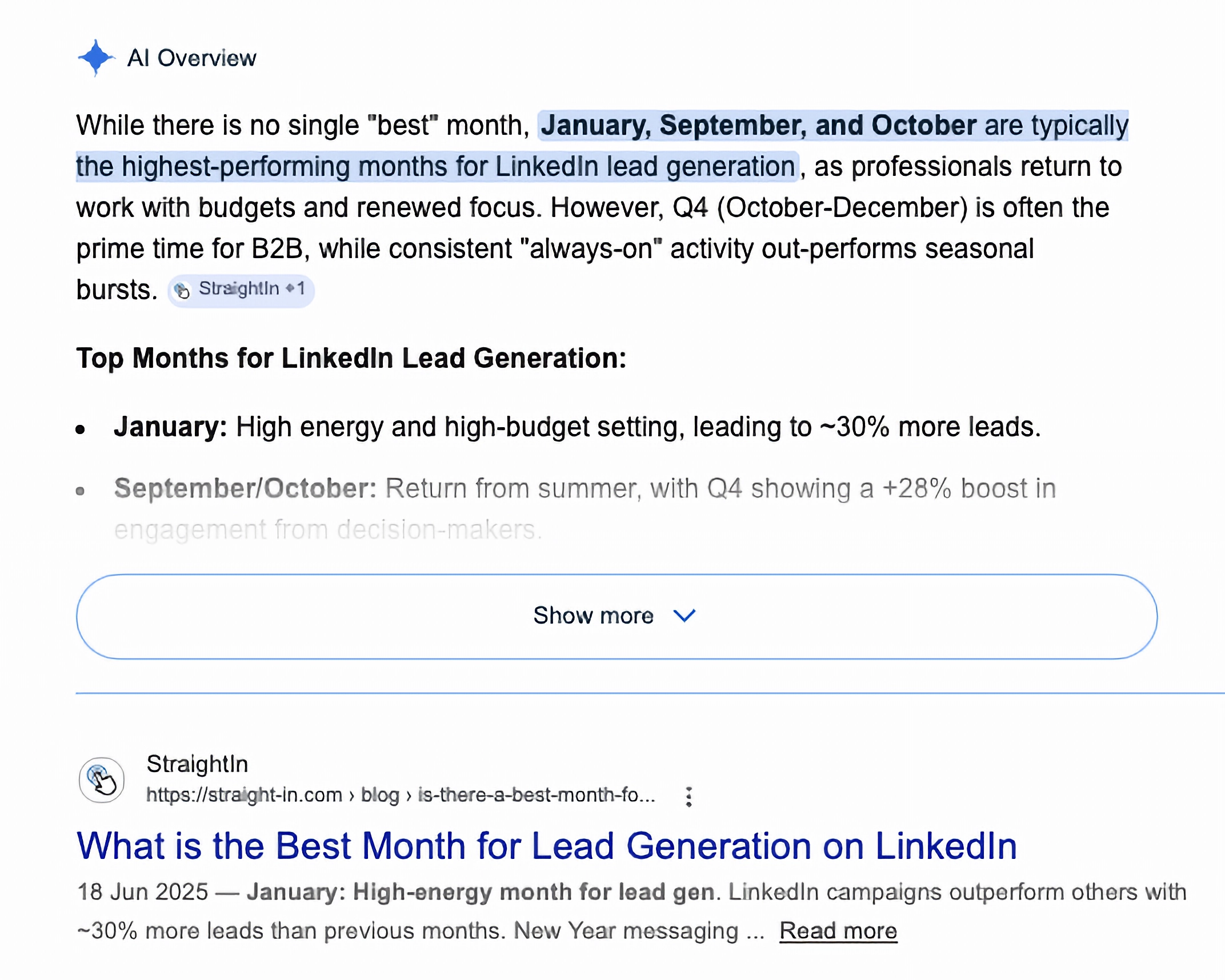
Search engines are heading in the same direction. Features like Google’s AI Overviews now surface generated answers directly within search results, reducing the need to browse multiple sites.
You’ve likely seen this in action already when browsing the web, but in case you’ve missed it, here’s what an AI overview looks like:
At this point, you might be thinking there’s been no mention of LinkedIn yet. Given that StraightIn is a LinkedIn marketing agency, it might feel slightly off track. There’s also been nothing on personal branding so far. Bit of a misleading title, isn’t it?
Here’s where it all ties together.
LinkedIn is one of the highest domain authority platforms on the internet, which means its content is consistently trusted and prioritised by search engines like Google…and is now playing an increasing role in AI-generated search results too.
Why LinkedIn Shows Up in AI Search
AI tools don’t generate answers from nowhere. They rely on trusted, high-quality sources, and LinkedIn has become one of the most important of those sources.
A study by SEMrush, which analysed 89,000 LinkedIn URLs cited in AI search, found that LinkedIn is one of the most referenced domains across AI models. But that’s not all:
- LinkedIn is the second most cited domain across AI models.
- Around 11% of AI-generated responses reference LinkedIn content.
- AI responses often mirror the meaning of the original LinkedIn content, not just link to it.
When your content is cited, it doesn’t just appear as a source. It actively shapes how the topic is explained. The language, positioning, and insights you share can directly influence the answer someone receives.
In simple terms, LinkedIn content is now feeding into how AI describes industries, solutions, and brands.
These findings reflect what we’re seeing across client campaigns, where consistent LinkedIn activity is increasingly contributing to visibility beyond the platform, particularly in AI search visibility.
If your content isn’t being published on LinkedIn, you’re not just missing visibility — you’re leaving space for someone else to define your category.
Why LinkedIn Ranks So Highly in Search Results (LinkedIn SEO Explained)
To understand why LinkedIn content appears so frequently in both Google results and AI-generated answers, it helps to start with one concept: domain authority.
What is Domain Authority?Domain authority is a metric that estimates how likely a website is to rank in search results based on trust, relevance, and backlinks. The higher the score, the more likely its content is to be surfaced. The score runs from 1 to 100, with higher numbers indicating a stronger ability to rank. LinkedIn sits right at the top end of that scale, alongside some of the most established platforms on the internet. |
LinkedIn has millions of active users, a constant flow of fresh content, and a strong backlink profile built over the years. All of that signals trust.
For context, here’s how LinkedIn scores from a domain authority perspective:
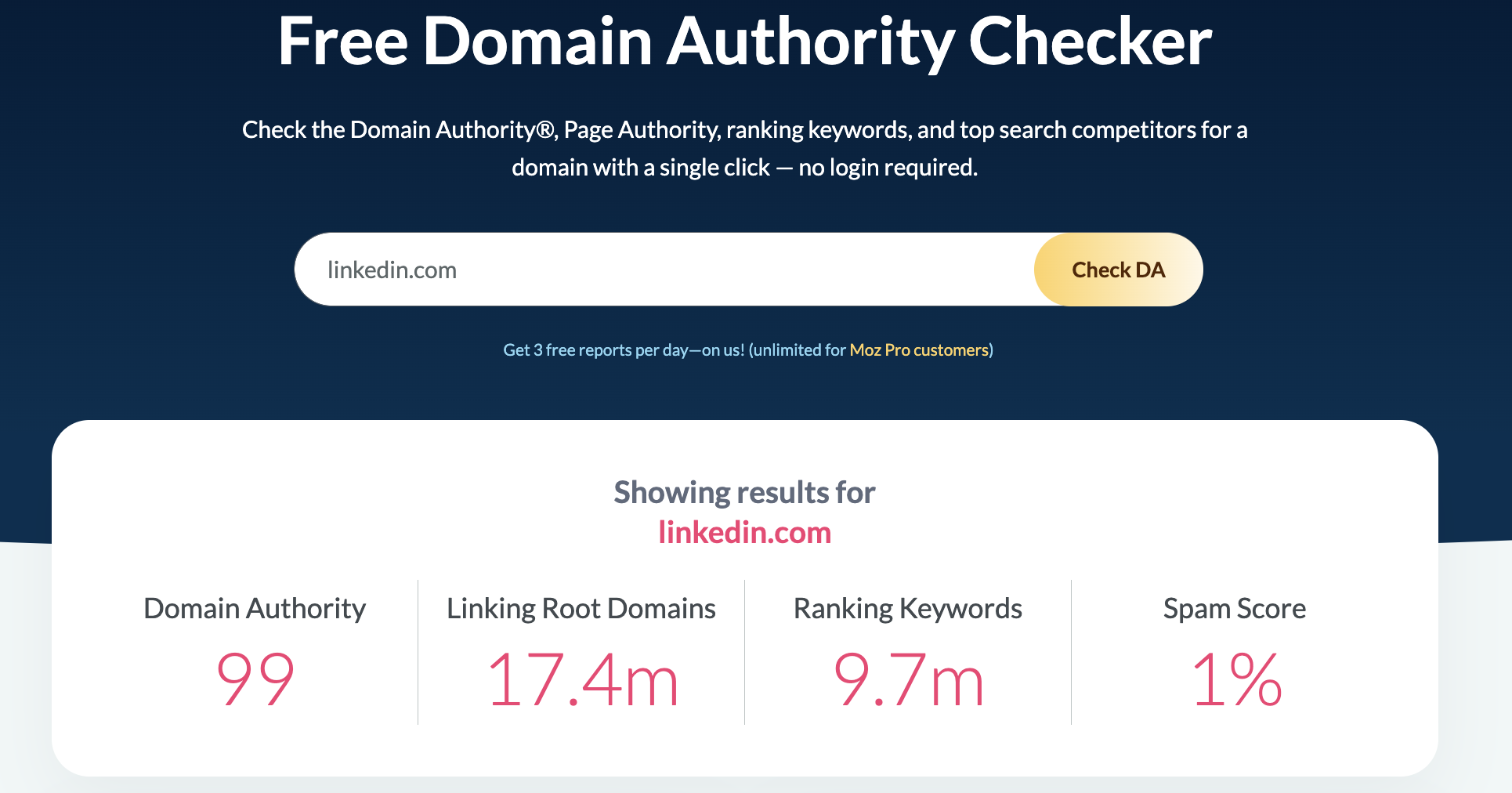
As a result, search engines are far more likely to prioritise LinkedIn pages, profiles, and articles when deciding what to show.
That explains why LinkedIn content performs well in traditional SEO.
But it also explains why AI models rely so heavily on it.
AI tools prioritise content they can trust, understand, and reuse. LinkedIn fits that criteria exceptionally well:
- Content is structured and indexable, making it easier for AI systems to extract key ideas.
- Content is written by identifiable individuals or companies with real-world expertise.
- Content is typically educational and designed to explain or inform.
That final point is particularly important. The SEMrush study found that over half of the cited LinkedIn content is focused on sharing knowledge or practical advice.
That’s exactly the type of content AI tools are designed to surface. They prioritise clear, useful explanations over promotional or surface-level posts.
There’s also a consistency factor. AI models tend to favour sources that publish regularly.
In fact, around 75% of cited LinkedIn authors post frequently, which increases the chances of their content being picked up. It’s not about going viral. Most cited posts have relatively modest engagement. It’s about relevance, consistency, and sustained effort over time.
Another key point is how closely AI responses reflect the original content.
LinkedIn shows high semantic similarity in AI outputs, meaning the answers generated often closely match the meaning of the original post or article. In practice, that means your content doesn’t just get cited, it shapes the explanation itself.
This is why LinkedIn results show up so often.
It’s not just because the platform is large. It’s because it consistently produces the type of content that both search engines and AI systems are designed to prioritise: credible, structured, original, and useful.
And that has a direct impact on visibility.
If you’re publishing that kind of content on LinkedIn, you’re not just improving your chances of ranking on Google. You’re increasing the likelihood of being included in AI-generated answers, which is quickly becoming just as important.
Key Takeaways So FarLinkedIn is no longer just a platform for posting content. It’s a core part of how visibility is built across search and AI.
Over time, this visibility compounds, supporting stronger positioning, network growth, and more inbound lead generation opportunities. |
Why People, Not Just Companies, Now Show Up in Search
Up to this point, we’ve focused on the platform. But there’s another layer to this that’s just as important. The people behind the content.
AI tools don’t just pull from company websites or brand pages. They pull from individuals. Founders, operators, subject matter experts. The people who are actively sharing insights in a clear, consistent way.
The SEMrush study highlights this clearly. While some AI models favour company pages (more on that here), others prioritise individual creators. In fact, across tools like ChatGPT Search and Google AI Mode, individual LinkedIn users account for the majority of cited content.
That changes how visibility works.
If your business is only publishing through a company page, you’re limiting your presence in search and AI-generated answers.
If your team is actively creating content, you multiply your chances of being surfaced.
This is where personal branding becomes more than just a marketing exercise.
It becomes a search strategy.
When individuals consistently share useful, relevant content:
- Their posts can appear in Google results.
- Their insights can be referenced in AI-generated answers.
- Their names become associated with specific topics or expertise.
Over time, that builds recognition.
In many cases, people don’t choose the best company. They choose the most visible expert.
That visibility also supports network growth, strengthens positioning, and creates more opportunities for lead generation.
When done well, it drives inbound leads from people who already recognise your name and understand your expertise.
If you want to explore this in more detail, particularly how personal profiles and Company Pages work together to support visibility and B2B sales, you can read our recent blog:
What Content Works for SEO and AI Visibility on LinkedIn
Understanding why LinkedIn shows up in search and AI answers is one thing. Knowing what content to create is another.
The good news is that the same principles apply across both.
AI tools and search engines tend to favour content that is clear, useful, and directly answers a question.
The common thread is simple. The best-performing content solves real problems in a clear, direct way.
As Joseph Brown, Copywriting Lead at StraightIn, puts it:
|
When you break that down, it becomes much more practical.
It’s not just about content creation. It’s about creating LinkedIn content that ranks well in search.
What This Looks Like in Practice
Answer specific questions
Content that directly addresses real problems is far more likely to be picked up than generic thought leadership.
For example:
- “How does LinkedIn outreach actually work in B2B?”
- “What should you include in a strong LinkedIn profile?”
- “Why aren’t my LinkedIn posts generating any leads?”
Explain how something works
Break down processes, share frameworks, or walk through real examples. This type of content is easy for both people and AI to interpret.
For example:
- “Step-by-step breakdowns of your sales process”
- “Here’s how we generate leads through LinkedIn content”
- “A simple framework for planning your weekly LinkedIn posts”
Share experience, not just opinion
First-hand insight carries more weight than surface-level commentary.
For example:
- “Lessons learned from a campaign”
- What worked (and didn’t) when trying a new strategy
- “What we learned after posting on LinkedIn every day for 30 days”
Be clear early on
State the main point or takeaway at the beginning. AI models often prioritise content that is easy to summarise and extract meaning from.
For instance, starting with a clear, direct statement such as: “Most LinkedIn outreach fails because…”
Stay consistent
Regular posting increases the likelihood that your content will be surfaced. It’s less about volume in isolation and more about sustained presence over time.
It’s also worth noting that you don’t need your content to go viral on LinkedIn.
Most of the content cited in AI responses has relatively modest engagement. What matters more is whether it answers a question clearly and comes from a credible source.
Frequently Asked Questions
Does optimising your LinkedIn profile help with SEO?
Yes. A well-optimised LinkedIn profile can rank in search results, particularly for your name, role, and areas of expertise. By structuring your headline, About section, and experience with clear, relevant keywords, you make it easier for search engines (and AI tools) to understand what you do. Over time, this strengthens your association with specific topics and improves your overall visibility online.
Why do individuals often show up in search results instead of company pages?
Search engines and AI tools often prioritise content from identifiable individuals with clear expertise. Personal profiles provide context, experience, and consistency, making them easier to interpret and surface. That said, combining this with activity on your company page tends to produce stronger, more complete results.
How long does it take to see results from LinkedIn content?
It’s typically a longer-term play. Visibility builds over time as your content creates a consistent signal around your expertise, rather than from a single post performing well. Each post adds to that overall picture, helping search engines and AI tools better understand what you do and when to surface your content.
What role does consistency play in LinkedIn visibility?
Consistency helps build a body of work over time. Rather than relying on individual posts, it creates a pattern that reinforces your positioning and increases the likelihood of being surfaced when relevant topics are explored. The key is consistency in quality, not just volume. Regular, well-considered content that clearly reflects your expertise is far more effective than posting frequently without direction.
How does LinkedIn support long-term personal brand growth?
LinkedIn allows you to combine profile positioning, content, and network building in one place. When these elements work together, they create ongoing visibility that supports recognition beyond the platform itself. Over time, this consistency helps reinforce what you’re known for, making it easier for people, search engines, and AI tools to understand your expertise and surface your name in relevant contexts.
Does engagement (likes and comments) affect visibility in search?
Not directly in the same way as on LinkedIn’s feed, but engagement can increase the reach of your content on the platform. This extended reach gives your content more opportunities to be seen, shared, and interacted with, which can, in turn, improve how widely it’s discovered. Over time, that increased exposure can contribute to your content being referenced or picked up beyond LinkedIn.
What’s the difference between LinkedIn visibility and LinkedIn reach?
Reach is a short-term metric that measures how many people see a specific post within a given timeframe. Visibility is longer-term and reflects how often you appear when people search, research, or explore topics related to your expertise. While reach can fluctuate from post to post, visibility builds gradually through consistent, relevant content that reinforces your positioning over time.
Put simply, the more consistently you create useful, well-structured content on LinkedIn, the more likely you are to show up in the moments that actually drive decisions.
Why LinkedIn Now Sits at the Centre of Search and AI Visibility
The way people search, evaluate, and make decisions is changing.
Google still matters, but it’s no longer the only place visibility is built. AI tools are shaping what people see, how topics are explained, and which brands or individuals are positioned as experts.
LinkedIn now sits at the centre of that shift.
It’s not just a platform for posting content. It’s a place where your ideas can influence search results, shape AI-generated answers, and build recognition over time.
The businesses and individuals who understand this early and build a consistent LinkedIn content marketing strategy around it will be the ones who show up when it matters most.
At StraightIn, we’re a full-service LinkedIn marketing agency with over seven years of experience helping B2B businesses do exactly that through LinkedIn outreach, paid advertising, content marketing, and personal branding. What we’ve found is simple: visibility doesn’t come from isolated activity. It comes from a clear, structured approach in which your profile, content, and network work together.
Our Brand Builder service is built around that idea, helping you develop a consistent LinkedIn presence that strengthens your positioning, builds recognition, and creates more opportunities for inbound conversations over time.
If you want to build a more consistent and effective presence on LinkedIn, get in touch with the team at StraightIn.