

LinkedIn outbound continues to outperform many traditional B2B lead generation channels because it’s how many decision-makers prefer to connect and engage.
Over the last 8 years, we’ve helped more than 7,000 businesses generate 500,000+ leads on LinkedIn. During that time, we’ve seen buyer behaviour change dramatically. Decision-makers are harder to reach, inboxes are more crowded, and generic outreach is easier than ever to ignore.
That’s one of the reasons LinkedIn continues to stand out.
While cold email, cold calling, events, and partnerships all play a role, LinkedIn offers something many other channels can’t: the ability to build credibility before a conversation even starts. Buyers can see who you are, what you do, who you know, and the expertise you share before deciding whether to engage.
In this article, we’ll look at why LinkedIn outbound continues to outperform many alternative lead generation channels and how businesses can use it to build a more predictable sales pipeline.
Contents
- Modern B2B buyer behaviour in 2026
- Why LinkedIn outbound stands out
- LinkedIn outbound vs cold email
- LinkedIn outbound vs cold calling
- LinkedIn outbound vs events & partnerships
- A real-world LinkedIn outbound case study
- Key takeaways
- Frequently asked questions about LinkedIn outreach
What Defines Modern B2B Buyer Behaviour in 2026?
The biggest change we’ve seen over the last few years is that buyers simply don’t need salespeople as early in the process as they used to.
Before speaking to a supplier, most decision-makers will research the company, review its website, check LinkedIn profiles, read content, and compare alternatives. By the time they respond to outreach, they’ve often already formed an opinion.
The research backs this up. Between 61% and 67% of B2B buyers now prefer a largely rep-free buying experience.
A few trends stand out.
Buyers Do Their Own Research
There is research suggesting that buyers complete around 60% of their purchasing journey before ever engaging with a supplier.
We see this regularly. Prospects often arrive at meetings already familiar with the company, its services, and key team members. They’re not looking for a sales pitch. They’re looking for reassurance that they’re making the right choice.
As StraightIn Sales Director Rob Lloyd puts it:
“The reality is that B2B sales has become harder than it’s ever been. Buyers are busier, they’ve got more information at their fingertips, and they’re being approached from every direction. Five, six years ago you could pick up the phone, have a decent conversation and book a meeting. Today, by the time someone speaks to you, they’ve probably looked at your website, checked your LinkedIn profile, read reviews and formed an opinion about your business. That’s not necessarily a bad thing, but it does mean sales teams have to work harder to earn attention and build trust. The companies still relying on volume alone are finding that out the hard way.”
This shift in buyer behaviour is one of the main reasons LinkedIn has become such an effective outbound channel. It allows businesses to build visibility and credibility long before a prospect is ready to have a conversation.
Buyers Already Have Suppliers in Mind
One statistic that surprises many businesses is that 92% of buyers begin their journey with at least one vendor already in mind.
Even more telling, 95% of winning suppliers were already on the buyer’s original shortlist.
That’s why visibility matters. If your business isn’t appearing during the research phase, you’re often competing from behind. By the time many buyers start actively engaging with suppliers, they’ve already narrowed down their options and formed initial impressions about who they trust.
We’ve seen this ourselves across countless campaigns. The companies that consistently generate opportunities on LinkedIn aren’t always the biggest or most well-known. They’re the ones showing up regularly, sharing useful insights, and staying visible while prospects are researching their options.
Relevance Matters More Than Volume
One mistake we regularly see businesses make is assuming more outreach automatically means more results. It doesn’t.
Buyers are becoming increasingly selective about who they engage with. Generic messaging is easy to spot and even easier to ignore.
Inboxes and LinkedIn notifications are full of templated messages that could have been sent to anyone. Most decision-makers have become very good at filtering out outreach that doesn’t feel relevant to their role, industry, or current challenges.
The companies generating the best results understand their audience well enough to make every interaction feel relevant. In our experience, a smaller number of well-targeted conversations will almost always outperform a larger volume of generic outreach.
Why is LinkedIn Outbound a Differentiator for B2B Sales Pipelines?
LinkedIn outbound stands out because it allows businesses to reach decision-makers in an environment where professional networking and business conversations are already expected.
What is LinkedIn outbound?
LinkedIn outbound is the process of proactively engaging target prospects through personalised connection requests, messaging, content engagement, and relationship building on LinkedIn to generate qualified sales opportunities.
LinkedIn works because it fits naturally into how modern professionals already communicate.
Unlike email, where you’re competing with hundreds of messages every week, LinkedIn is a professional environment where networking and business conversations are expected.
We’ve found that prospects are far more likely to engage when they can quickly understand who they’re speaking to.
Before replying, many people will check your profile, review your experience, look at shared connections, and browse recent content. That additional context creates trust before a conversation begins.
The platform’s scale also makes a difference.
LinkedIn drives around 80% of all B2B social media leads, making it the dominant social platform for B2B lead generation. Around 89% of B2B marketers actively use LinkedIn to generate leads.
There’s also a significant decision-maker audience. Four out of five LinkedIn members influence business decisions, giving sales teams direct access to the people who matter most.
Another factor that’s often overlooked is the strength of personal brands. Posts published by individuals receive up to eight times more engagement than identical content shared through company pages.
In practice, people buy from people. LinkedIn simply reflects that reality better than most other channels.
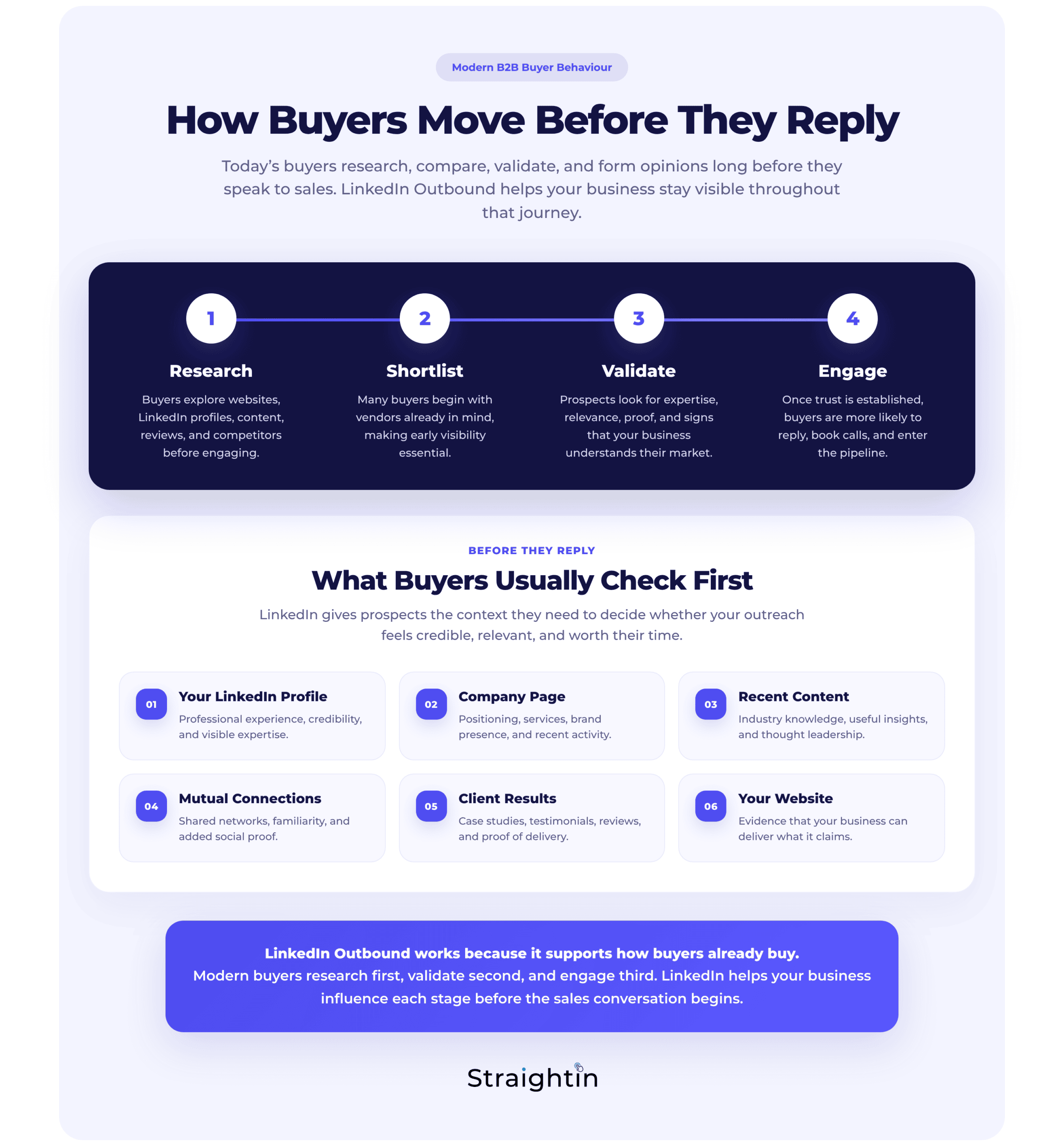
Below, we show how modern B2B buyers typically move through the decision-making process before replying to outreach, along with the key touchpoints they often review to assess credibility and determine whether a supplier is worth engaging with.
How Does LinkedIn Outbound Compare to Cold Email?
Cold email still has a place in modern B2B lead generation. In fact, many of the strongest outbound campaigns use both email and LinkedIn together.
Although they serve different purposes and tend to generate different outcomes.
1. Response Rates
LinkedIn generally produces stronger response rates than cold email, particularly when outreach is personalised.
LinkedIn response rates:
- Typically 5-15%
- Some studies report 15-25% for highly personalised campaigns
- Outbound system reports an average response rate of 10.3%
This reflects something we’ve seen across thousands of campaigns: decision-makers are far more likely to engage when they can see who they’re speaking to and why the conversation is worth having.
Cold email response rates:
- Typically 1-5%
- Well-executed campaigns may achieve 5-12%
- Exceptional campaigns can reach 8-15%
The exact figures will vary, but we’ve consistently found that LinkedIn generates more conversations with decision-makers than email alone.
2. Trust and Credibility
This is where LinkedIn has a significant advantage.
When a prospect receives a cold email, they’re making a decision based on:
- The sender’s name
- The subject line
- The content of the email
When a prospect receives a LinkedIn message, they can also see:
- Your profile
- Your experience
- Mutual connections
- Recommendations
- Content you’ve shared
- Activity on the platform
That extra context helps establish trust before a conversation begins.
3. Personalisation
Both channels allow personalisation, but LinkedIn gives sales teams more information to work with.
Before reaching out, you can often see:
- Recent posts
- Company updates
- Career history
- Shared interests
- Mutual connections
This makes it easier to create messages that feel relevant rather than generic.
In our experience, prospects are far more likely to engage when it’s clear you’ve taken the time to understand who they are and what they do.
4. Scale
This is where cold email often comes out ahead.
Cold email platforms allow businesses to:
- Send thousands of emails each month
- Automate large parts of the process
- Reach audiences quickly
- Scale campaigns efficiently
LinkedIn is generally a more targeted channel.
You won’t send the same volume of messages, but the conversations tend to be more qualified.
LinkedIn vs Cold Email: Which Is Better?
For most B2B businesses, the question isn’t whether to use LinkedIn or email. It’s how to combine them effectively.
LinkedIn is often better for building trust and starting conversations, while email can help reinforce your message and create additional touchpoints. Used together, they can create a more consistent and recognisable presence throughout the buyer’s journey.
How Does LinkedIn Outbound Compare to Cold Calling?
Cold calling still has a place in B2B sales. There are industries where picking up the phone remains highly effective, particularly when combined with other outbound channels.
However, the reality is that reaching decision-makers by phone has become increasingly difficult.
1. Accessibility
One of the biggest challenges with cold calling is simply getting hold of the right person.
Today, many decision-makers:
- Work remotely or hybrid
- Don’t have publicly listed direct numbers
- Use gatekeepers and call screening
- Prefer digital communication channels
As a result, more than 80% of cold calls go unanswered, with average conversion rates sitting at around 2%.
LinkedIn removes many of these barriers by giving businesses direct access to decision-makers without needing to navigate switchboards or reception desks.
2. Time Efficiency
Cold calling can be extremely time-intensive.
A sales representative may spend hours:
- Researching prospects
- Dialling numbers
- Leaving voicemails
- Following up repeatedly
Often without speaking to a single decision-maker.
LinkedIn outreach allows sales teams to engage a larger number of relevant prospects in less time while still maintaining a personalised approach.
For businesses looking to build a predictable pipeline, that efficiency can make a significant difference.
3. Prospect Qualification
One advantage LinkedIn has over cold calling is the amount of information available before outreach begins.
Sales teams can quickly assess:
- Job titles
- Seniority levels
- Company size
- Industry
- Recent activity
This makes it easier to focus efforts on prospects that closely match an ideal customer profile.
The result is less time spent pursuing poor-fit opportunities and more time speaking with people who are genuinely relevant.
LinkedIn vs Cold Calling: Which Is Better?
Much like the LinkedIn versus email debate, the answer depends on your objectives.
If you need immediate conversations and have access to accurate contact data, cold calling can still be effective, albeit increasingly difficult as buyers become harder to reach and more selective about how they engage with suppliers.
If you’re looking to build awareness, start conversations at scale, and engage decision-makers more efficiently, LinkedIn often delivers stronger results.
It’s also worth quickly mentioning that it’s now possible to combine many of the benefits of LinkedIn outbound and cold calling. StraightIn’s AI Voice solution uses proprietary SpeakIn technology to send personalised LinkedIn voice messages in your own voice, allowing businesses to scale outreach while retaining the human element that has traditionally made phone conversations so effective.
Below is an example of one of our messages and the impact it can have on engagement.
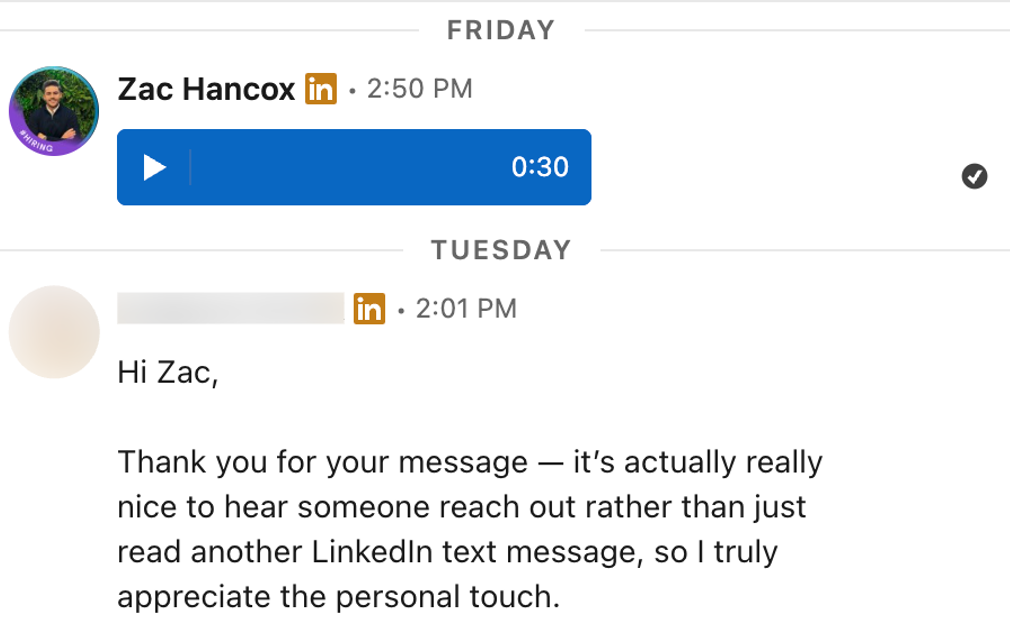
LinkedIn provides access to decision-makers and rich prospect data, while AI Voice adds personality, authenticity, and familiarity to the outreach process. The result is a more engaging way to start conversations that combines the efficiency of LinkedIn with the impact of hearing a real human voice.
If you’d like to learn more, we’ve explored the technology, data, and real-world results in greater detail in our blogs on AI Voice and the growing role of voice AI in LinkedIn lead generation.
- The Growing Role of Voice AI in LinkedIn Marketing & Lead Generation
- Why AI Is the Key to Scaling LinkedIn Voice Messaging
- Why AI Voice Is Becoming the Next Big Channel for LinkedIn Marketing
- What Prospects Really Want to Hear in Your First AI Voice Message on LinkedIn
What About Events and Partnerships as Outbound Channels?
Events and partnerships can be highly effective lead generation channels. We should know; attending the recent B2B Marketing Expo UK generated a number of valuable new business opportunities for StraightIn. However, they work very differently to LinkedIn outbound.
In our experience, both tend to deliver strong results when relationship-building is the primary objective. The challenge is that they’re often harder to scale and less predictable than a structured outbound campaign.
Events
Events remain one of the best ways to build relationships and create meaningful conversations.
Some of the key benefits include:
- Face-to-face interactions with prospects
- Stronger personal relationships
- Opportunities to demonstrate expertise
- Increased brand awareness within a target market
However, events also come with limitations:
- Significant time investment
- Travel and sponsorship costs
- Limited scalability
- Long gaps between opportunities to engage prospects
The quality of leads can be excellent, but generating a consistent flow of opportunities from events alone is often difficult.
Partnerships
Strategic partnerships can also be a valuable source of new business.
A strong partner can provide:
- Warm introductions
- Access to new audiences
- Shared credibility
- Additional referral opportunities
The challenge is that partnerships often take time to develop and rarely produce immediate results. Success depends heavily on maintaining strong relationships and ensuring both parties benefit from the arrangement.
This is where LinkedIn can play an important supporting role.
Businesses can use LinkedIn to:
- Identify attendees before an event
- Engage prospects before and after conferences
- Stay visible between industry events
- Research potential partners
- Build relationships with referral sources
Rather than replacing events or partnerships, LinkedIn helps businesses get more value from both. It provides a way to maintain momentum between face-to-face interactions, nurture relationships over time, and turn one-off conversations into long-term opportunities.
That’s one reason many organisations use LinkedIn as the foundation of their outbound strategy while complementing it with events, partnerships, email, and other lead generation channels where appropriate.
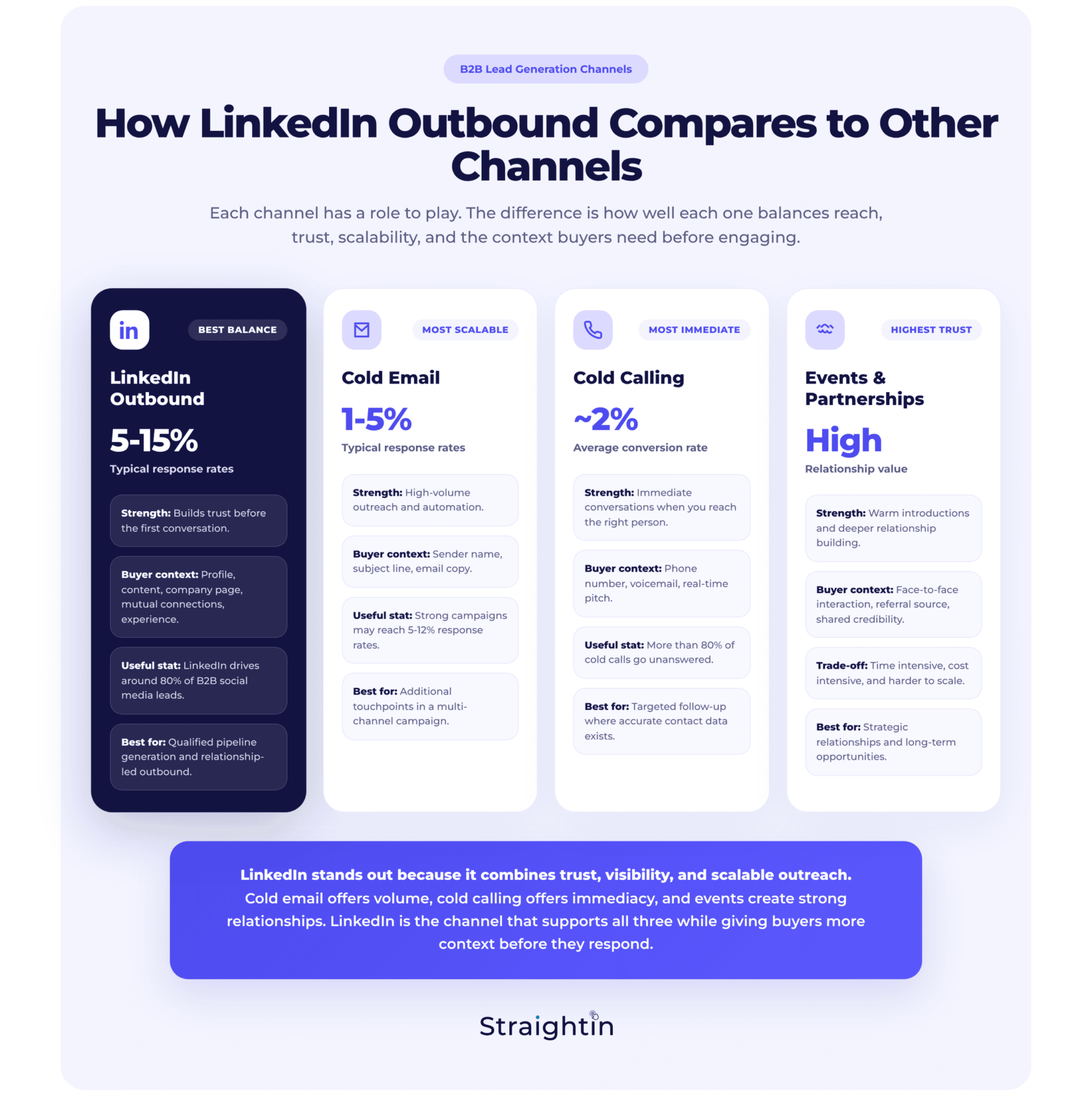
The graphic below compares LinkedIn outbound with cold email, cold calling, and events or partnerships, highlighting how LinkedIn uniquely balances trust, scalability, and buyer context to generate more qualified conversations.
How Does StraightIn Achieve Real-World Results with LinkedIn Outbound?
One example comes from a client we worked with: a specialist marketing consultancy that wanted to generate more opportunities without relying so heavily on referrals.
Like many businesses, they had built a strong reputation and delivered excellent work, but growth wasn’t always predictable. Most new business came through existing relationships and word of mouth. While that created opportunities, it didn’t provide the consistent pipeline they needed to scale.
Their goal was to connect with more senior marketing decision-makers, expand beyond their existing network, and create a steadier flow of qualified conversations.
To help achieve this, we implemented a LinkedIn outreach campaign that included:
- LinkedIn profile optimisation to strengthen credibility and positioning, ensuring prospects immediately understood the client’s expertise and the value they could offer.
- Targeted prospecting focused on senior marketing decision-makers, allowing us to concentrate efforts on the individuals most likely to influence purchasing decisions.
- Personalised outreach designed to start relevant conversations, using messaging tailored to the prospect’s role, challenges, and objectives rather than relying on generic sales pitches.
- InMail campaigns to extend reach beyond direct connections, helping the client engage decision-makers who may not have been accessible through traditional connection requests alone.
- Ongoing audience refinement based on campaign performance and engagement data, enabling us to continuously improve targeting, focus on the most responsive segments, and maximise results over time.
The focus wasn’t on sending as many messages as possible. It was about identifying the right prospects and starting meaningful conversations with people who were already likely to benefit from the client’s services.
Over a 12-month period, the campaign generated 204 qualified sales opportunities, averaging 17 opportunities per month. It achieved a 36.3% connection acceptance rate and an 8% message-to-opportunity conversion rate, while delivering leads at an average cost of $48.24.
For businesses considering whether to work with a LinkedIn Marketing Agency, the results provide a good example of what’s possible when strategy, targeting, and messaging are all working together.
Generating 204 qualified opportunities through cold calling would have required huge amounts of time simply trying to reach the right people. Achieving the same outcome through cold email would have meant persuading prospects to trust a business they knew very little about.
LinkedIn changes that dynamic. Before replying, prospects can review your profile, explore your content, check mutual connections, and build a picture of who you are and what you do. By the time a conversation actually starts, much of the groundwork has already been done.
That’s why LinkedIn consistently generates not just more conversations, but better conversations with people who are genuinely relevant to your business.
Key Takeaways
As buyer behaviour continues to evolve, businesses need lead generation strategies that reflect how decision-makers actually research, evaluate, and engage with suppliers.
- B2B buyers prefer self-directed research and a rep-free experience for a significant part of their buying journey.
- LinkedIn outbound supports modern buyer behaviour by enabling professional, credible, and personalised interactions.
- LinkedIn consistently generates a higher volume of quality B2B leads compared to other social platforms and traditional cold outreach methods.
- Personalised LinkedIn outreach typically yields higher response and connection acceptance rates than generic cold email or calling.
- Integrating LinkedIn into a multi-channel outbound strategy enhances overall campaign effectiveness and ROI.
- A dedicated LinkedIn Marketing Agency can deliver significant, measurable results, as evidenced by real-world case studies.
Ultimately, the businesses generating the best results are those that focus less on interrupting prospects and more on building visibility, credibility, and trust before the conversation begins.
Ultimately, the businesses generating the best results are those that focus less on interrupting prospects and more on building visibility, credibility, and trust before the conversation begins.
Why LinkedIn Continues to Deliver Better B2B Lead Generation Results
Every lead generation channel has its strengths. Cold email offers scale, cold calling can create immediate conversations, and events and partnerships are excellent for building relationships. The challenge is that each comes with limitations, whether that’s declining response rates, difficulty reaching decision-makers, or a lack of scalability.
LinkedIn sits in a unique position. It combines the reach and efficiency of digital outreach with the credibility and relationship-building qualities that make referrals, partnerships, and networking so effective. By helping prospects understand who you are before they respond, LinkedIn makes it easier to start relevant conversations with the right people and build a more predictable sales pipeline.
At StraightIn, we’re a full-service LinkedIn Marketing Agency helping businesses generate more leads, build stronger pipelines, and connect with decision-makers through LinkedIn. Our services include LinkedIn outreach, LinkedIn advertising, LinkedIn content marketing, personal branding, and AI Voice campaigns.
If traditional outbound isn’t delivering the results it once did, LinkedIn could be the missing piece. Get in touch with the StraightIn team to find out how we can help you reach more decision-makers, generate more qualified opportunities, and build a pipeline you can rely on.
Frequently Asked Questions
What response rates can you expect from LinkedIn outreach?
Response rates vary by industry, audience, and messaging quality, but LinkedIn outreach typically generates response rates of between 5% and 15%. Highly personalised campaigns can often achieve even stronger engagement, particularly when supported by a credible profile and relevant content.
How long does it take for LinkedIn outbound to generate results?
Many businesses start seeing conversations and opportunities within the first few weeks, although results depend on factors such as audience size, targeting, and campaign objectives. Like most lead generation channels, consistency tends to produce the strongest long-term results.
Should LinkedIn outbound replace cold email and cold calling?
No. For most businesses, LinkedIn works best as part of a wider outbound strategy. Cold email, cold calling, referrals, events, and LinkedIn all have strengths. The most effective approach is usually combining multiple channels to create more touchpoints throughout the buyer journey.
What industries benefit most from LinkedIn outbound?
LinkedIn outbound can work for almost any B2B business. Whether you’re selling software, professional services, manufacturing solutions, financial products, recruitment services, or specialist consultancy, the ability to reach decision-makers directly and build trust before the first conversation makes LinkedIn a highly effective lead generation channel.
How important is your LinkedIn profile for lead generation?
Your LinkedIn profile is often one of the first things prospects review before responding to outreach. A well-optimised profile helps establish credibility, demonstrate expertise, and reassure buyers that you’re worth engaging with. Even the best outreach campaigns can struggle if prospects are met with an incomplete or poorly positioned profile.
If you’d like to improve your profile, we cover this in more detail in our guide, How to Make Your LinkedIn Profile Stand Out, including practical tips on headlines, profile photos, experience sections, recommendations, and the changes that can help generate more profile views, conversations, and opportunities.
How important is a LinkedIn Company Page for lead generation?
A LinkedIn Company Page helps prospects validate your business before they engage. When someone receives outreach, sees an advert, or visits an employee’s profile, they’ll often check the Company Page to assess credibility, expertise, and activity. A well-maintained Page strengthens trust and supports every other LinkedIn activity.
If you’d like to learn more, read our article: Why LinkedIn Company Pages Are Still Being Undervalued in B2B Marketing.
