


If you want your articles to appear in answers generated by AI search engines such as ChatGPT, Google AI Overviews, Perplexity and Microsoft Copilot, they need to do more than rank well in traditional search results.
They need to answer questions clearly, demonstrate genuine expertise and make it easy for AI systems to understand and reference the information.
This approach is known as Generative Engine Optimisation (GEO). While it’s often discussed in relation to websites, it’s becoming increasingly relevant for LinkedIn content marketing too. Well-written LinkedIn articles are now being cited by AI platforms alongside traditional webpages, giving businesses another way to build visibility beyond the LinkedIn feed.
At StraightIn, we’ve spent nearly eight years helping more than 7,000 B2B businesses grow through LinkedIn, generating over 500,000 qualified sales leads along the way. Now we’re helping businesses improve their AI search visibility by creating content that’s more likely to be understood, referenced and cited by AI-powered search platforms.
We’ve also noticed something interesting. The articles most frequently cited by AI aren’t always the ones ranking highest in Google. More often than not, they’re the ones that answer a question clearly, back up their claims and are easy for AI systems to understand.
In this guide, we’ll explain how AI search works, what makes an article more likely to be cited, and the changes we’ve made to our own LinkedIn marketing content and website articles to improve their visibility across AI-powered search.
Contents
- What is Generative Engine Optimisation (GEO)?
- Why are AI search engines changing content marketing?
- How AI platforms choose which articles to cite
- Why do LinkedIn articles work so well for AI search?
- How we structure LinkedIn articles for AI search
- Common mistakes businesses make
- Frequently asked questions
What Is Generative Engine Optimisation (GEO)?
Generative Engine Optimisation, usually shortened to GEO, is the process of writing and structuring content so AI search platforms can understand it, trust it and confidently use it when answering questions.
Traditional SEO focuses on helping webpages rank in search results. GEO focuses on helping those same pages become part of the answer itself.
That difference is becoming increasingly important.
When someone searches Google today, they’re just as likely to see an AI-generated summary at the top of the page as they are a list of blue links. Platforms such as ChatGPT, Perplexity and Microsoft Copilot are doing something similar, answering questions directly by combining information from multiple trusted sources.
If your content isn’t one of those sources, there’s a good chance your competitors’ content will be.
That doesn’t mean SEO has become obsolete. Strong technical SEO and backlinks still matter because AI platforms need to discover your content in the first place. What has changed is what happens next.
Once your article has been found, AI systems assess whether it’s actually worth using. They’re looking for content that’s easy to interpret, factually accurate and genuinely useful. Articles that ramble, bury the answer halfway down the page or make vague marketing claims are far less likely to be referenced than those that answer the reader’s question quickly and back up what they’re saying.
We’ve found this ourselves.
When we first started tracking AI citations, one of the biggest surprises was that some articles with relatively modest Google rankings were being cited regularly by AI platforms. They weren’t necessarily the highest-ranking pages on the internet, but they were often the clearest and most complete answers available for a particular question.
What Are AI Citations and Why Do They Matter?
An AI citation is when an AI search engine such as ChatGPT, Google AI Overviews, Perplexity or Microsoft Copilot references your content when generating an answer to a user’s question. Depending on the platform, this may appear as a direct link to your website, a cited source or a reference to your content within the AI-generated response.
AI citations are becoming an increasingly important measure of online visibility. They indicate that an AI system considers your content accurate, trustworthy and helpful enough to support its answers. As more people rely on AI-powered search to research products, services and business topics, earning these citations gives your expertise greater visibility and increases the likelihood of attracting qualified visitors to your website.
That’s changed how we approach content creation.
Rather than asking, “How do we rank for this keyword?”, we now ask a different question:
If ChatGPT, Perplexity or Google’s AI Overview answered this question tomorrow, would they choose to cite your content?”
That simple shift in thinking has influenced everything from how we structure introductions to how we write headings, present statistics, and organise supporting evidence.
Why are AI Search Engines Changing Content Marketing?
Search has changed more in the last two years than it did in the previous decade.
For years, businesses competed for a place on the first page of Google. Success was largely measured by rankings, impressions and clicks.
Today, many users never reach those search results at all.
Instead, they ask ChatGPT a question. They search using Perplexity. They read Google’s AI Overview without clicking through to a website. Microsoft Copilot answers questions directly inside the browser.
The behaviour has changed because it’s faster. Instead of opening five articles and comparing them yourself, AI does much of that work for you.
That has obvious implications for businesses publishing content online.
Research from Gartner predicts that traditional search engine volume will fall by 25% as users progressively turn to AI assistants and conversational search. At the same time, zero-click searches continue to rise, with many users getting the information they need without ever visiting the source website.
At first glance, that sounds like bad news.
In reality, it’s changing what success looks like.
Instead of asking whether someone clicked your article, businesses should ask another question: “Was our content influential enough to become part of the answer?”
That’s exactly what we’re now measuring for our own clients.
Being cited by AI platforms increases visibility among people who may never have heard of your business before. It likewise reinforces authority. If your company appears repeatedly across answers related to your area of expertise, people begin to associate your brand with that topic long before they visit your website or speak to your sales team.
In many ways, AI citations are becoming the digital equivalent of word-of-mouth recommendations. Rather than another person recommending your business, it’s an AI platform deciding your content is trustworthy enough to include in its response.
How Do AI Platforms Choose Which Articles to Cite?
One of the biggest misconceptions about AI search is that it simply copies the pages already ranking at the top of Google’s search results.
From what we’ve seen, that isn’t how it works.
Traditional search engines are primarily trying to rank webpages. AI search engines are trying to answer questions. Those are two very different objectives.
That means an article ranking first in Google won’t automatically become the source an AI platform references. Likewise, we’ve seen LinkedIn articles and blog posts with relatively modest search rankings appear in AI-generated answers because they provided the clearest explanation of a topic.
Although every platform uses its own technology, we’ve found they all tend to favour similar characteristics.
They Answer the Question Immediately
AI platforms don’t want to sift through 1,500 words to find the answer.
If someone asks “How do businesses optimise articles for AI search?”, they expect the first few sentences to answer that question directly before expanding into the detail.
We’ve started writing both our website articles and LinkedIn content this way. Rather than spending several paragraphs building towards the answer, we give readers the answer first and then explain the reasoning behind it.
That creates a better experience for readers and makes it much easier for AI platforms to identify the information they’re looking for.
They Reward Genuine Expertise
AI search is increasingly moving towards content written by people with first-hand experience.
General advice is everywhere.
Original experience is much harder to find.
That’s why we include examples from our own campaigns whenever possible. Instead of simply saying businesses ought to structure their content differently, we explain what we’ve tested, what changed and what we’ve learned from helping clients improve their AI search visibility.
Those practical observations are often far more valuable than generic advice because they’re based on real campaigns rather than theory.
They Favour Factual, Well-Supported Content
AI platforms need confidence that the information they’re presenting is accurate.
That’s why articles supported by credible research, recognised industry reports and first-party data are generally stronger candidates for AI citations than pages packed with unsupported opinions or marketing claims.
Whenever we reference statistics in our own LinkedIn content, we always link back to the original source where possible. It gives readers confidence in what they’re reading and makes it easier for AI systems to verify the information.
They Prefer Content That’s Easy to Understand
Structure matters more than many people realise.
Clear headings, descriptive subheadings, concise paragraphs and logical sections all help AI platforms understand what each part of an article discusses.
This is one of the reasons we’ve changed how we write LinkedIn articles.
Rather than treating them as long-form social posts, we now structure them much more like high-quality knowledge resources. Each section answers a specific question, follows a logical sequence and builds naturally on the previous one.
That makes the article easier for people to read and easier for AI to interpret.
They Look for Evidence That People Trust Your Content
Trust isn’t built through one article. It’s built over time.
When businesses consistently publish accurate, well-researched LinkedIn content and website articles, they begin to establish themselves as reliable sources within their industry.
We’ve found that this consistency often matters just as much as individual articles. Businesses that regularly publish helpful content on related topics are far more likely to become recognised authorities than those producing isolated pieces without a wider strategy.
Why Do LinkedIn Articles Work So Well for AI Search?
When most people think about search, they immediately think about websites.
What many don’t realise is that LinkedIn articles are increasingly being referenced by AI search engines alongside traditional webpages. That’s because AI search engines aren’t particularly concerned about where content is published. They’re looking for information that’s useful, trustworthy and provides a clear answer to the question being asked.
For B2B businesses, LinkedIn presents various benefits.
LinkedIn Has Become a Trusted Source of Professional Knowledge
Over the last few years, LinkedIn has evolved from a networking platform into one of the web’s largest libraries of professional content.
Millions of businesses and industry experts now publish articles covering everything from sales and marketing to manufacturing, finance, HR and technology. As a result, AI platforms increasingly treat LinkedIn as a credible source when answering business-related questions.
In fact, research by SEMrush found that LinkedIn is among the most frequently cited domains across leading AI search platforms, particularly for professional and B2B topics. We explored that research in more detail in our recent article on how LinkedIn Company Pages drive AI search visibility.
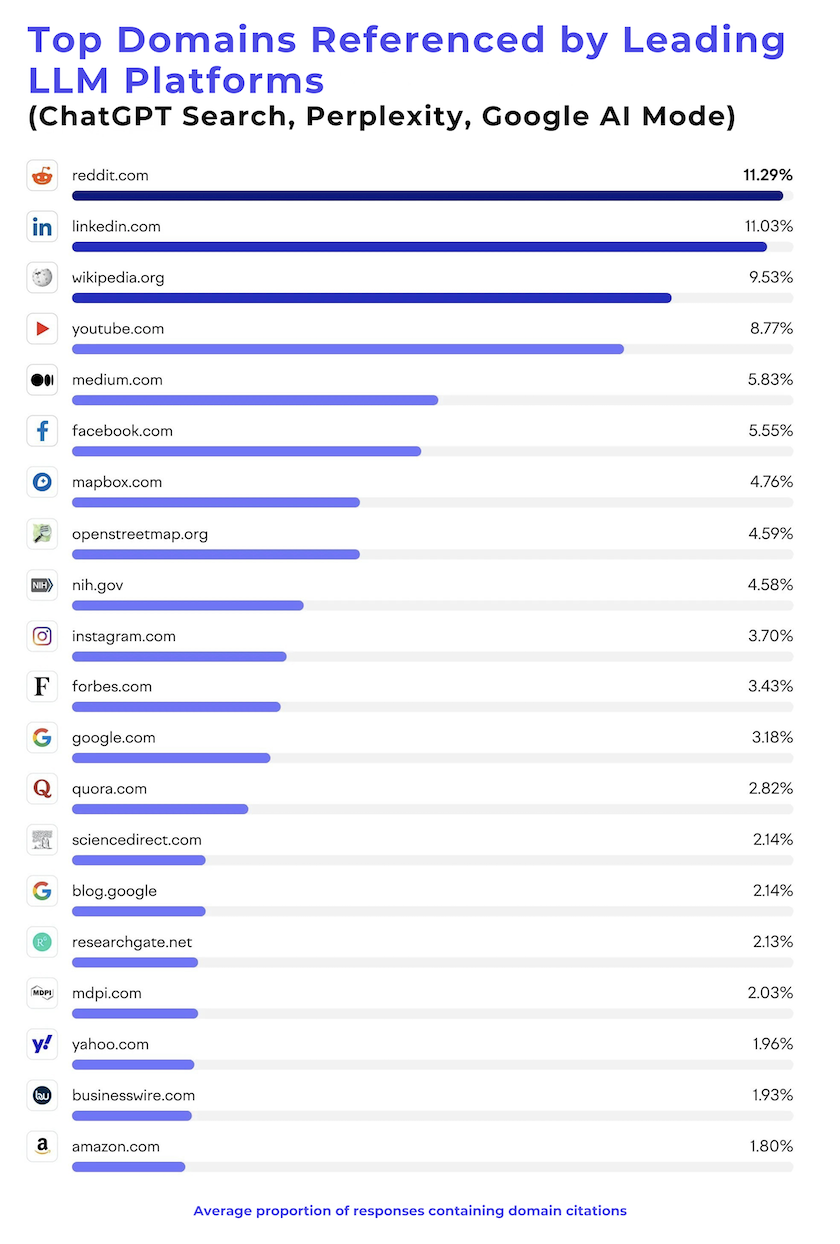
For businesses already investing in LinkedIn content marketing, that’s an important shift. Your articles are no longer just reaching people scrolling through their feed. They also have the potential to influence how AI platforms explain your industry, your services and your area of expertise.
Articles Demonstrate First-Hand Experience
One of the biggest strengths of LinkedIn articles is that they’re written by real people sharing practical experience.
Unlike anonymous webpages or AI-generated content, LinkedIn articles are connected to identifiable professionals with established careers, businesses and networks. That context helps reinforce credibility and provides AI systems with stronger signals about who created the content and why it should be trusted.
We’ve found that articles sharing genuine experience, lessons learned and practical advice consistently perform better than content that simply repeats information available elsewhere.
Long-Form Content Gives AI Greater Context
Short social posts are excellent for starting conversations and sharing tidbits. Articles serve a very different purpose.
They give you the space to answer complex questions properly, explain how something works, include supporting research and demonstrate your knowledge in a way that simply isn’t possible in a few hundred characters.
That depth benefits readers, but it also gives AI platforms far more context to work with. Rather than extracting a single sentence from a short post, they can reference definitions, explanations, examples and supporting evidence from a single article.
They Naturally Demonstrate Trust Signals
Another reason LinkedIn articles perform well is the context surrounding them.
Every article sits alongside information about the author, the business, their experience, their network and their previous content. Together, those signals help build a much richer picture than a standalone webpage.
AI platforms appear to value this broader context. They’re not just assessing the article itself. They’re also evaluating who published it and whether they have genuine experience in that subject.
They Support Your Website Rather Than Replace It
Publishing on LinkedIn doesn’t mean abandoning your website. The strongest content strategies use both.
Your website remains the central hub for your business, while LinkedIn articles help reinforce your expertise, reach professional audiences and increase the number of places where your content can be discovered.
We’ve found that businesses achieve the best results when they treat LinkedIn articles as an extension of their wider content strategy rather than a separate marketing activity. A well-written article can attract readers on LinkedIn, appear in traditional search results and increase the likelihood of being referenced by AI platforms, all while directing people back to your website.
- If you’d like to explore this in more detail, including why LinkedIn is now one of the most frequently cited domains across leading AI search platforms, we’ve covered the research in our article How LinkedIn Company Pages Drive AI Search Visibility.
How We Create LinkedIn Articles That Perform Well in AI Search
Every LinkedIn article starts long before we write the first sentence.
We use search data and AI prompt research to understand what people are actually asking, then combine that with observations from our own client campaigns, internal testing and day-to-day experience working with B2B businesses.
More importantly, we test our approach on ourselves before recommending it to clients.
Over the past several months, we’ve built our own methodology for creating GEO-optimised LinkedIn articles and website content, publishing both side by side and tracking how AI platforms respond. Rather than relying on assumptions, we’ve monitored AI citations, brand mentions and website performance to understand what genuinely influences visibility across platforms such as ChatGPT, Google AI Overviews, Microsoft Copilot and Perplexity.
The results have been encouraging. During our own campaign, our content generated 441 AI citations and 246 brand mentions across leading AI platforms. At the same time, we saw a nine-fold increase in website views, a six-fold increase in website clicks, and a six-fold increase in web enquiries.
Those results have shaped the way we now create every LinkedIn article. Rather than guessing what AI platforms might prefer, we’re continuously refining our content using real citation data, buyer prompt research and ongoing performance tracking. Every new article gives us another opportunity to learn what works, improve existing content and strengthen our clients’ visibility across AI-powered search.
As our Copywriting Lead, Joseph Brown, explains:
“This article is a good example of how we approach content. We didn’t decide to write about AI Search Optimisation because it was trending. We wrote it because our research showed people were actively asking questions such as ‘How do you optimise articles for generative engine answers?’ Once we understood what people wanted to know, our job became answering that question as clearly and completely as possible. That’s the approach we take with every LinkedIn article we write.”
Once we’ve identified the topic, we map out the questions someone is likely to ask from beginning to end. Those questions become the structure of the article.
Rather than writing around a keyword, we’re writing around the reader’s thought process. Only then do we start writing.
- How do AI platforms decide which sources to cite?
- Why are LinkedIn articles appearing more frequently in AI search?
- What can businesses do to improve their AI search visibility?
- Which mistakes prevent content from being referenced?
That creates a resource that’s genuinely useful rather than simply optimised for one search term.
We Focus on Topics Rather Than Individual Keywords
Traditional SEO often encouraged businesses to create separate pages targeting individual keywords.
We’ve found it’s far more effective to build in-depth articles around a single topic. For example, instead of writing an article purely targeting “GEO”, we’d cover related questions such as:
- What is Generative Engine Optimisation (GEO)?
- How do AI search engines decide which sources to cite?
- Why are LinkedIn articles appearing more frequently in AI search?
- What can businesses do to improve their AI search visibility?
- Which mistakes prevent content from being referenced?
That creates a resource that’s genuinely useful rather than simply optimised for one search term.
We Combine Research with Experience
Every article starts with research, but it doesn’t finish there.
We use research to understand what people are asking and what evidence already exists. We then combine that with observations from our own client campaigns, internal testing and day-to-day experience working with B2B businesses.
That’s usually where the most valuable insights come from.
We Treat Every Article as a Long-Term Asset
One thing that’s changed over the last year is how we think about content after it’s published.
Previously, success might have been measured by impressions or engagement during the first week.
Today, we’re just as interested in how an article performs six months later.
- Is it still ranking?
- Is it still attracting readers?
- Has it started appearing in AI-generated answers?
- Has it generated enquiries?
Thinking this way changes how you approach content. You’re no longer writing for a single day in the LinkedIn feed. You’re building a library of knowledge that continues working long after publication.
We Routinely Review and Improve Existing Articles
Publishing isn’t the end of the process.
As AI search continues to evolve, we regularly revisit existing articles to improve them.
Sometimes that means updating statistics or adding new research. Other times, it’s as simple as answering a question more clearly or expanding a section that has become more relevant.
Small improvements often have a much bigger impact than starting again from scratch.
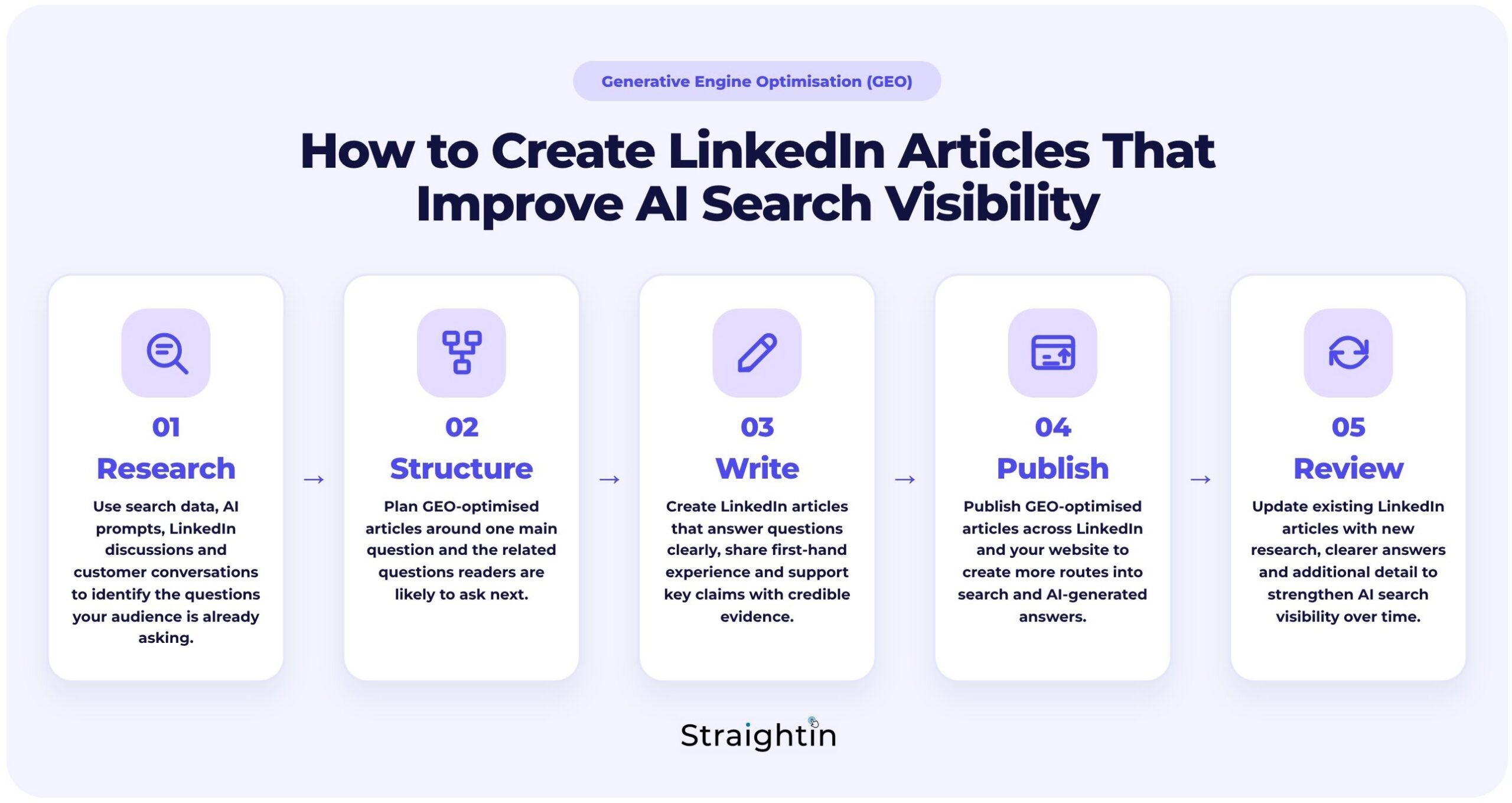
In the infographic below, we break down the process we follow to create LinkedIn articles that educate readers, perform well in AI search and continue generating value long after they’re published.
Common Mistakes Businesses Make with AI Search
As AI search continues to evolve, we’ve noticed the same mistakes appearing time and time again. Most aren’t technical problems or complex SEO problems. More often than not, they come down to how businesses approach content in the first place.
Treating AI Search as a Separate Strategy
One of the biggest misconceptions we come across is that AI Search Optimisation requires an entirely separate content strategy from traditional SEO.
In reality, the two work hand in hand.
The same qualities that help an article perform well in search engines often make it more valuable to AI platforms. Clear structure, well-researched information, first-hand experience and genuinely useful answers benefit both.
Rather than creating one version of an article for Google and another for AI search, focus on producing the best resource you can on a particular topic. If your content answers the reader’s question better than competing articles, it’s far more likely to perform well across both traditional search results and AI-generated answers.
They’re simply the result of writing content for search engines rather than for the people using them.
Chasing Keywords Instead of Questions
Keywords still matter, but they’re no longer the starting point.
Instead of asking how many times a keyword appears in an article, ask what someone is actually trying to understand. Every search begins with a question, even if that question isn’t typed out in full.
The strongest articles don’t just target a keyword. They answer the main question, anticipate the follow-up questions and provide enough depth that the reader doesn’t need to look elsewhere.
That’s exactly the type of content AI platforms are trying to surface.
Publishing Promotional Content
It’s tempting to use every article as an opportunity to promote your products or services, but that approach rarely produces the best results.
People don’t search for sales pitches. They search for answers.
The businesses earning the most AI citations are generally those that educate first and sell second. They share useful knowledge, explain complex topics clearly and demonstrate genuine expertise before introducing their services.
Ironically, that often makes the promotion far more effective because readers already trust the information they’ve been given.
Overlooking LinkedIn
Many businesses invest significant time and budget in their website while treating LinkedIn as a place to repost company updates.
That’s becoming a missed opportunity.
As we’ve discussed throughout this guide, LinkedIn articles are increasingly appearing alongside traditional webpages in AI-generated answers. Every article you publish gives your business another opportunity to demonstrate expertise, answer common questions and reinforce your authority.
As Joe puts it:
“One of the things I hear all the time is, ‘We don’t need LinkedIn because we already publish blogs on our website.’ I think that’s one of the biggest mistakes businesses can make. Most company websites have a relatively modest Domain Authority, often somewhere between 1 and 20, while even well-established businesses might only reach 50 or 60. LinkedIn, on the other hand, has a Domain Authority of 99. If you’re only publishing on your own website, you’re ignoring one of the most authoritative platforms on the internet. As more people use ChatGPT, Perplexity and Google’s AI Overviews to research businesses, publishing your expertise on both your website and LinkedIn gives you a much better chance of being discovered.”
The strongest content strategies don’t choose between a website and LinkedIn. They use both, allowing each platform to strengthen the other.
You can check your own website’s Domain Authority using Moz’s free Domain Authority Checker. It’s a score out of 100 that estimates a website’s relative strength, based largely on its backlink profile, making it a useful way to compare your site’s authority with other domains.
Publishing Inconsistently
Publishing one excellent article is a great start.
Publishing useful content consistently is what builds authority over time.
Every article becomes another opportunity to answer a question, demonstrate your knowledge and strengthen your presence across search engines, LinkedIn and AI-powered search.
We’ve found that businesses that produce content regularly are far more likely to build lasting visibility than those that publish occasionally. Rather than chasing one standout article, focus on creating a growing library of content that continues attracting readers, generating enquiries and earning AI citations long after it’s published.
If there’s one theme running through all of these mistakes, it’s this: Successful AI Search Optimisation starts with the reader, not the algorithm.
Businesses that consistently answer questions, share genuine expertise and publish content across both their website and LinkedIn are giving themselves the strongest possible foundation for long-term visibility.
Key Takeaways
If you’re looking to improve the chances of your content appearing in answers generated by AI search engines, these are the main points worth remembering:
- AI Search Optimisation (GEO) complements traditional SEO rather than replacing it. The strongest content strategies are built to perform well across both.
- AI platforms prioritise articles that answer questions clearly, demonstrate genuine expertise and support claims with credible evidence.
- LinkedIn articles are becoming an increasingly valuable source for AI platforms, giving businesses another opportunity to build authority beyond their own website.
- Publishing on both your website and LinkedIn creates more opportunities for your expertise to be discovered, referenced and cited across AI-powered search.
- Focus on topics and questions rather than individual keywords. The best-performing articles provide complete, well-structured answers that genuinely help the reader.
- Firsthand experience and original insights are becoming increasingly important as AI platforms seek content that goes beyond generic advice.
- Think of every article as a long-term asset. Regularly updating and improving existing content can be just as valuable as publishing something new.
- Consistency matters. Building a library of high-quality content over time is far more effective than publishing occasional standalone articles.
- Above all, write for people first. If your content educates readers, answers their questions and demonstrates genuine expertise, you’re giving both search engines and AI search engines more reasons to trust and reference it.
AI visibility isn’t achieved through tricks or shortcuts. It’s the result of consistently creating useful, authoritative content across both your website and LinkedIn.
Your Next Step Towards Better AI Search Visibility
AI search engines are changing how people discover businesses and consume content. The companies that earn the most visibility will be those consistently publishing GEO-optimised content that answers real questions, demonstrates genuine expertise and gives AI search engines confidence to cite it.
The truth is this is the future of online visibility, and if you want your business to stay ahead of the competition, now is the time to start creating content that’s built for AI search as well as traditional search engines.
Want Your LinkedIn Articles to Be Cited by AI Search Engines?
At StraightIn, we’re a full-service LinkedIn marketing agency helping B2B businesses create GEO-optimised content that performs across both traditional search and AI search engines. By combining LinkedIn content marketing with LinkedIn outreach and LinkedIn advertising, we help businesses build authority, increase AI citations and generate more qualified opportunities.
Get in touch with the StraightIn team to find out how our AI Search Optimisation services can help your business improve AI search visibility, earn more AI citations and create content that continues generating value long after it’s published.
Frequently Asked Questions
What are AI search engines?
AI search engines use artificial intelligence to answer questions directly rather than simply displaying a list of webpages. Platforms such as ChatGPT, Google AI Overviews, Perplexity and Microsoft Copilot analyse information from multiple trusted sources to generate a single response, often citing the content they relied on.
Rather than expecting users to click through several websites and compare the information themselves, these platforms summarise the most relevant insights into a clear, conversational answer. That means businesses now need content that’s written to be understood, trusted and referenced, not just ranked in traditional search results. Clear explanations, credible evidence and genuine expertise are becoming just as important as traditional SEO when it comes to improving online visibility.
Is Generative Engine Optimisation (GEO) replacing SEO?
No. GEO complements traditional SEO rather than replacing it. SEO helps search engines discover and rank your content, while GEO focuses on making that content clear, trustworthy and useful enough for AI platforms to reference when generating answers. The strongest content strategies are designed to perform well across both.
Should I publish the same article on my website and LinkedIn?
In many cases, yes, with one important caveat. Publishing on both platforms gives your content more opportunities to be discovered by both traditional search engines and AI search platforms. Your website remains your primary content hub, while LinkedIn provides additional authority and exposure on one of the web’s most trusted professional platforms.
Importantly, it shouldn’t be the exact same article copied word for word. While duplicate content isn’t always penalised by search engines, publishing identical versions provides little additional value and can create uncertainty about which version should be prioritised. Instead, adapt the article for each platform by rewriting sections, adding different examples or insights, and so on. It also creates natural opportunities to link between your website and LinkedIn article, helping readers discover related content while strengthening your overall content strategy.
How long does it take to improve AI search visibility?
Improving AI search visibility is usually a gradual process rather than an immediate one. It depends on factors such as the quality of your content, how consistently you publish, your authority within your industry and whether your articles provide the best available answer to common questions. AI platforms also need time to discover, evaluate and build confidence in your content, so it’s unlikely that a single article will transform your visibility overnight.
Building a library of useful, well-structured content that demonstrates genuine expertise across related topics generally produces much stronger long-term results than focusing on one standalone article. Regularly reviewing and updating existing content with new insights, research and examples can also improve its chances of continuing to be referenced over time.
Once you’ve built authority, however, momentum can increase significantly. After several weeks of consistently publishing content and earning AI citations, we found that new articles began gaining visibility much more quickly. In one example, an article received 16 AI citations in under 12 hours of being published, showing how an established reputation can help new content be discovered and referenced faster.