

Generating a steady flow of qualified leads is one of the biggest challenges facing small businesses.
Unlike larger organisations, most SMEs don’t have huge marketing budgets or dedicated sales teams. Every conversation matters, which means finding a reliable way to connect with the right people can make a real difference to growth.
That’s one of the reasons LinkedIn has become such a valuable platform for B2B lead generation.
With more than one billion members worldwide, LinkedIn gives small businesses direct access to business owners, directors and senior decision-makers across almost every industry. Whether you’re targeting local SMEs or larger organisations, it’s one of the few marketing platforms that lets you identify the people you want to speak to, start conversations with them and continue building trust over time.
At StraightIn, we’ve spent almost eight years helping more than 7,000 B2B businesses generate leads through LinkedIn. During that time, we’ve generated over 500,000 qualified opportunities for clients across industries extending from professional services and manufacturing to software, cybersecurity and managed IT. It’s also the same approach that helped us grow StraightIn from a one-man band into an international company with offices in three countries.
In this guide, we’ll explain what LinkedIn lead generation services involve, why they’re especially effective for small businesses, some of the common mistakes to avoid and what you should look for if you’re thinking about outsourcing your LinkedIn lead generation.
Contents
- Why LinkedIn is one of the best platforms for B2B lead generation
- Why small businesses benefit from LinkedIn lead generation services
- What challenges might small businesses face with LinkedIn lead generation?
- How targeted LinkedIn campaigns generate better leads
- A real-world example of targeted LinkedIn outreach
- The biggest mistakes that hold small businesses back
- What we’ve learned from managing thousands of LinkedIn campaigns
- How to choose the right LinkedIn lead generation agency
- Key takeaways
- Turning LinkedIn into a reliable source of new business
Why LinkedIn Is One of the Best Platforms for B2B Lead Generation
Most social media platforms are built around entertainment. LinkedIn is different. People use it to build professional relationships, keep up with their industry and research potential suppliers.
That makes it one of the few places where businesses can actively connect with the people responsible for buying decisions.
Today, LinkedIn has more than one billion members worldwide, including over 65 million business decision-makers. For small businesses, that creates an opportunity to reach people who would otherwise be difficult to access through traditional marketing.
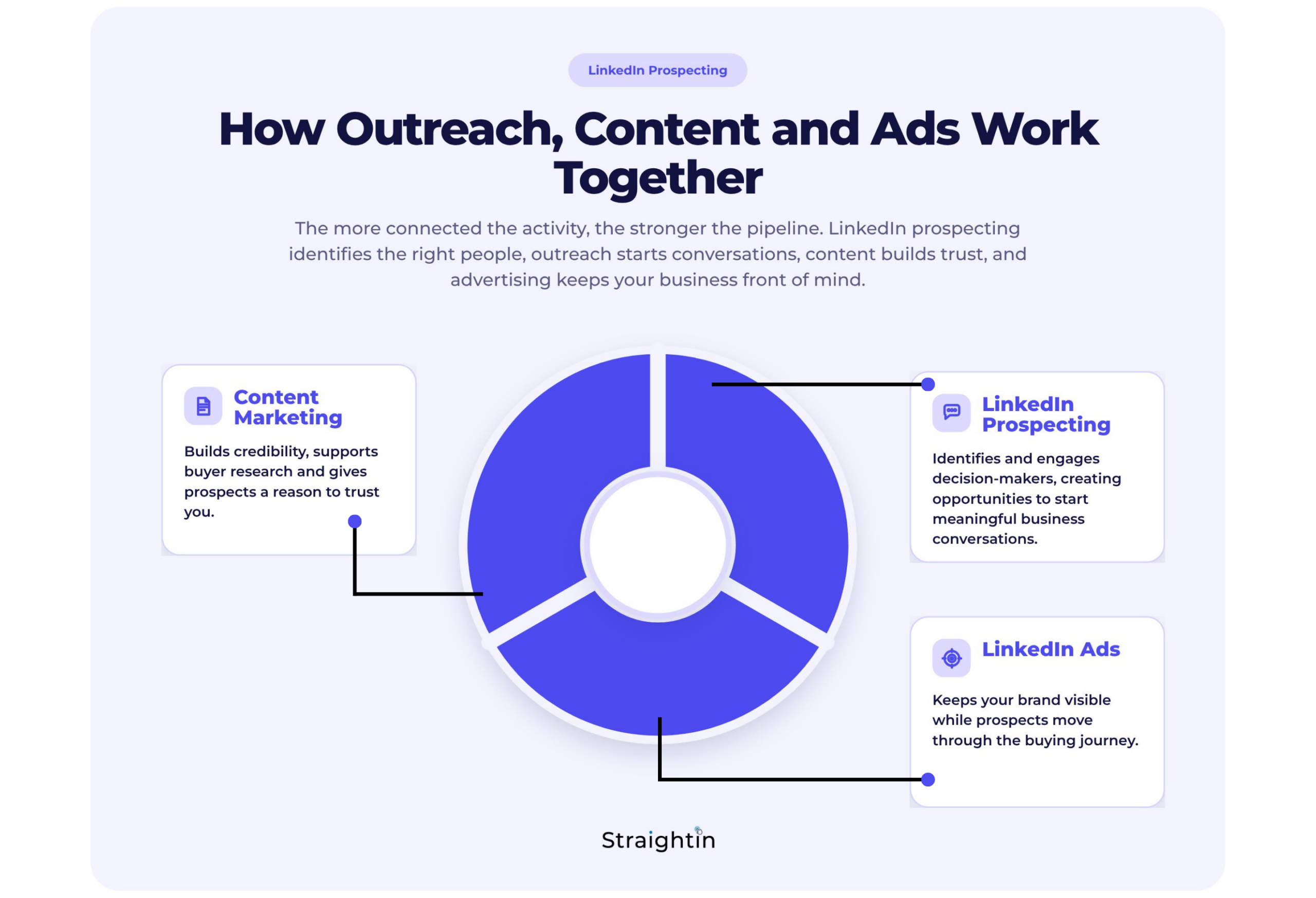
It’s also a platform that supports the entire buying journey. You can introduce your business through LinkedIn outreach, build credibility by sharing useful content and stay visible through LinkedIn advertising while prospects compare suppliers and weigh up their options.
Very few marketing channels allow you to combine all three in one place.
Below is an infographic showing how LinkedIn outreach, content marketing and advertising work together to help businesses generate more qualified leads throughout the buying journey.
Of course, having access to decision-makers is only part of the equation. The real challenge is turning those connections into conversations and, ultimately, into customers. That’s where a well-planned LinkedIn lead generation strategy can make all the difference.
Why Small Businesses Benefit from LinkedIn Lead Generation Services
Running a small business means every opportunity counts.
Unlike larger organisations with dedicated sales teams and sizeable marketing budgets, most SMEs have to be far more selective about where they invest their time and money. Every conversation needs to have the potential to lead somewhere.
That’s one of the reasons LinkedIn works so well.
Rather than casting a wide net and hoping the right people come across your business, LinkedIn allows you to identify the companies you want to work with, connect directly with decision-makers and start building relationships with people who genuinely fit your ideal customer profile.
For many small businesses, that creates a number of advantages:
- Reach the right people – Target decision-makers by industry, company size, job title, location, and other professional criteria, so your outreach focuses on businesses that are genuinely relevant.
- Make your marketing budget work harder – Instead of paying to reach large audiences that may never become customers, LinkedIn allows you to invest your time and budget in building relationships with businesses that are much more likely to convert.
- Compete on expertise, not company size – A strong LinkedIn presence, combined with useful content and personalised outreach, allows smaller businesses to demonstrate their knowledge and credibility alongside much larger competitors.
- Grow at your own pace – As your business develops, your LinkedIn strategy can grow with it, whether that’s targeting new industries, expanding into different regions or increasing outreach activity.
We’ve seen this time and time again. Some of our most successful clients started out as small businesses with limited budgets but a clear understanding of who they wanted to work with. By consistently putting themselves in front of the right people and building trust over time, they were able to compete with businesses many times their size.
StraightIn’s own story has followed exactly the same path. As our CEO Zac Hancox explains:
“Before I started StraightIn, I’d spent years working in sales and marketing. One thing became obvious very quickly: businesses don’t grow because they shout the loudest; they grow because they consistently get in front of the right people, build relationships and stay visible. That’s exactly how StraightIn started. There were no outside investors, no huge marketing budget and no shortcuts. All I had was a clear strategy, plenty of hard work and a belief that LinkedIn could become one of the most effective B2B lead generation platforms out there.”
“As the business grew, I was fortunate enough to bring together an incredibly talented team who shared that same belief. Many of the businesses we work with today are small start-ups and SMEs looking for their first few clients, just as we once were. That’s why we’re so confident in the strategies we recommend. We’ve used them ourselves, we’ve refined them through thousands of campaigns, and we’ve seen first-hand the difference they can make.”
LinkedIn gives small businesses the opportunity to compete with much larger organisations, but making the most of that opportunity still requires commitment, consistency and, above all else, the right strategy.
What Challenges Might Small Businesses Face with LinkedIn Lead Generation?
Although LinkedIn offers huge opportunities for small businesses, it isn’t a shortcut to generating new customers.
One of the biggest misconceptions is that creating a profile, sending a few connection requests and posting occasionally will automatically lead to enquiries. Wrong.
In reality, successful LinkedIn lead generation requires consistency, patience and a clear understanding of your audience.
That’s one of the reasons so many businesses conclude that LinkedIn doesn’t work, or at least doesn’t work for them. In reality, it’s usually the approach that’s letting them down, not the platform.
More often than not, the platform isn’t the problem. The challenge is finding the time to do it properly.
For many business owners, LinkedIn is something they squeeze in around everything else. One day they’re speaking to customers; the next, they’re preparing quotes, managing staff, dealing with suppliers, or trying to keep on top of their accounts. Finding another five or ten hours each week for prospecting, writing content and following up on conversations simply isn’t possible.
Even when businesses do make the time, there’s still a learning curve.
Knowing who to target, how to write messages that don’t feel like sales pitches, when to follow up, what content to publish and how often to post are all skills that improve with experience. It’s one of the reasons why some businesses see excellent results while others struggle to generate meaningful conversations.
Some of the most common challenges small businesses face include:
- Finding enough time to consistently prospect, create content and follow up conversations.
- Knowing who to target, particularly when trying to define an ideal customer profile.
- Writing outreach messages that feel personal rather than generic.
- Maintaining consistency, even during busy periods when sales and customer work take priority.
- Measuring success beyond likes and impressions, concentrating instead on conversations, opportunities and long-term pipeline growth.
None of these problems is insurmountable. You could hire someone with the right experience or build an in-house team, but for many small businesses, that’s a significant investment. That’s one of the reasons many SMEs choose to outsource to a specialist LinkedIn lead generation agency instead, giving them access to experienced outreach, content and strategy without the cost and commitment of building an internal team from scratch.
If you’re considering outsourcing your LinkedIn lead generation, choosing the right partner could make all the difference.
- If you’d like to learn more about whether outsourcing is the right option for your business, take a look at our recent guide, When Should You Outsource LinkedIn Prospecting?
How Targeted LinkedIn Campaigns Generate Better Leads
One of the biggest advantages LinkedIn offers small businesses is the ability to be highly selective about who they approach.
Unlike broader marketing channels, where you’re often hoping the right people see your message, LinkedIn allows you to identify businesses that actually fit your ideal customer profile before you even begin your outreach.
That means you’re not trying to sell to everyone. You’re focusing your time on the organisations most likely to benefit from what you offer.
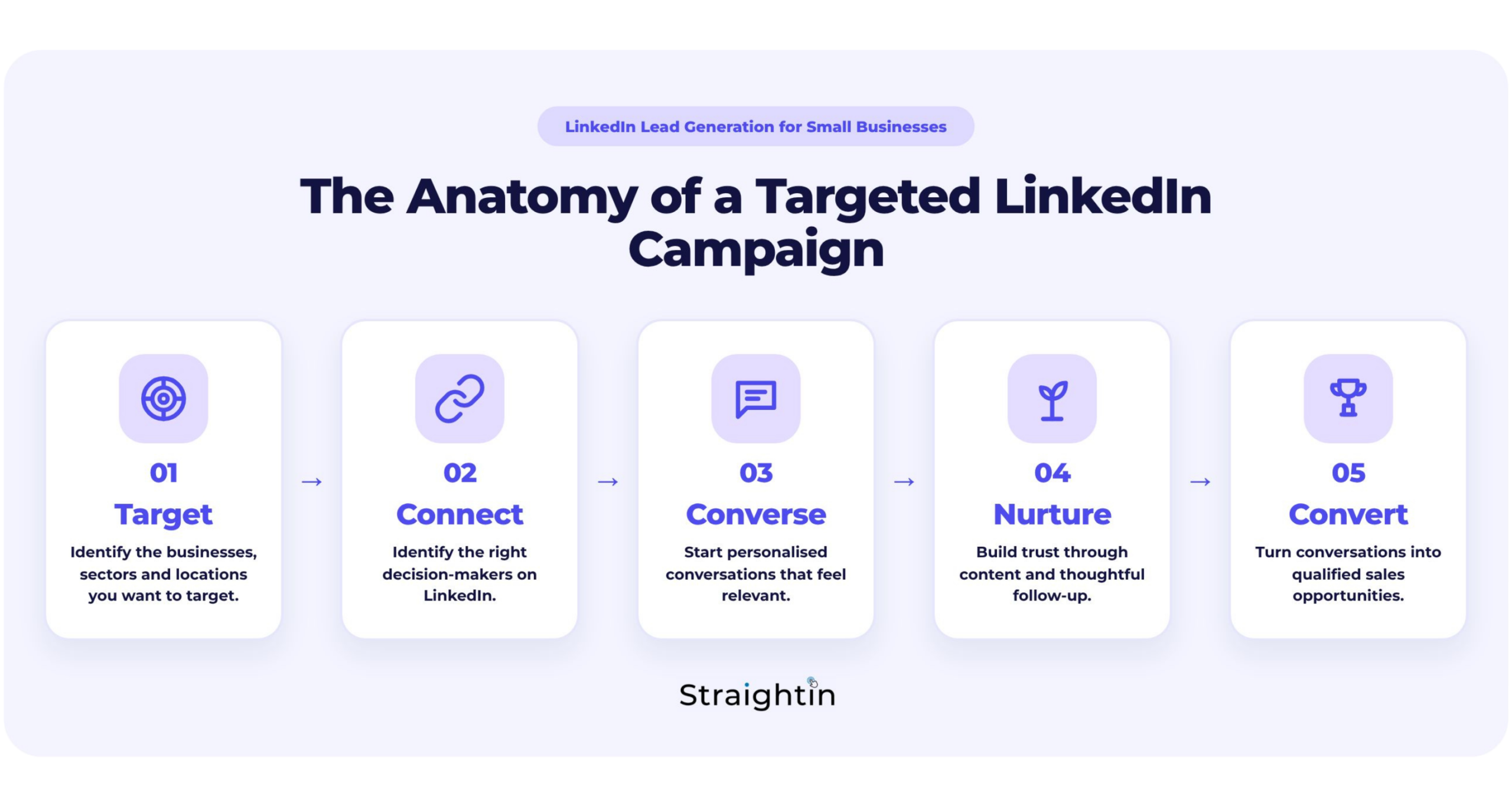
The strongest LinkedIn campaigns usually follow the same process:
- Define your ideal customer profile (ICP) – Identify the types of businesses you’re best placed to help based on factors such as industry, company size, location and the challenges they face.
- Find the right decision-makers – Once you’ve identified your target companies, focus on the people involved in buying decisions, whether that’s the owner, managing director, operations manager or another senior stakeholder.
- Personalise your outreach – Generic messages rarely generate meaningful conversations. Referencing a prospect’s role, industry or business challenges makes your outreach far more relevant.
- Build trust before selling – Rather than pushing for a meeting immediately, successful campaigns focus on starting conversations and building relationships first.
- Follow up consistently – Many opportunities don’t come from the first message. Well-timed follow-ups keep conversations moving and ensure your business stays visible.
Below is an infographic that shows how each stage of a successful LinkedIn lead generation campaign works together, from identifying the right prospects through to building relationships and generating qualified opportunities.
Now let’s take a small IT support provider as an example.
Instead of sending connection requests to thousands of business owners, they might focus on companies in their local area with between 20 and 100 employees that don’t have an in-house IT team. Their outreach could be aimed specifically at managing directors or operations managers responsible for technology decisions, with messaging centred on cutting downtime, improving cybersecurity, or supporting business growth.
A digital marketing agency would take a completely different approach, targeting marketing managers or business owners struggling with challenges with lead generation, SEO, or paid advertising. The principle stays the same, but the audience and messaging change.
That’s why successful LinkedIn lead generation isn’t about sending more messages. It’s about sending the right message to the right person at the right time.
The better you define your audience, the more relevant your conversations become. And the more relevant your conversations become, the more likely they are to turn into qualified business opportunities.
A Real-World Example of Targeted LinkedIn Outreach
To see why targeted LinkedIn campaigns are so effective, let’s look at one of our recent clients.
Like many small businesses, this content and SEO consultancy had built a strong reputation through referrals. While referrals had helped the business grow, they weren’t creating the consistent flow of opportunities needed to support the next stage of growth. The founder was also wearing multiple hats, balancing client delivery, business development and day-to-day management, leaving little time for regular prospecting.
Rather than trying to reach as many businesses as possible, we focused on identifying the organisations that were most likely to become long-term clients.
The campaign targeted marketing agencies, professional services firms, and technology businesses with established marketing teams, focusing on senior decision-makers, including CEOs, Marketing Directors, Heads of Marketing, and CMOs, across North America, specifically the South and Midwest, where the client was based. This was especially important because, as a growing small business, they weren’t trying to target the whole of North America at once. By concentrating on the regions where they already had an established presence, they could establish stronger relationships, generate referrals and grow in a much far more sustainable way.
Every message was personalised using details such as the recipient’s role, industry and location. By focusing on businesses in the same region of the United States, the outreach felt far more relevant and local, helping to start genuine conversations rather than simply delivering yet another sales pitch.
As StraightIn Client Manager Kailey Redmond, who ran the campaign, explains:
“One of the biggest challenges small business owners face is finding enough time to consistently generate new business while still delivering great work for existing clients. That’s why defining the right audience is so important.”
“Instead of trying to speak to everyone, we focused on the businesses most likely to benefit from our client’s services. Once we had that clarity, every conversation became far more relevant, and the results followed.”
Over a 12-month period, the campaign generated 204 qualified sales opportunities, averaging 17 qualified leads every month, with an 8% message-to-opportunity conversion rate. More importantly, it helped the business expand beyond its existing network, secure higher-value clients, and build a far more predictable pipeline than it could have with referrals alone.
That’s the real value of a targeted LinkedIn strategy for small businesses. You don’t need a huge sales team or a massive marketing budget. You need a clear understanding of who you want to work with, a consistent approach to building relationships and the patience to let those relationships develop into opportunities over time.
When it’s laid out like this, it’s easy to think, “We could probably do that ourselves.” You just define who you want to target, reach out to them, and wait for the conversations to roll in. Nice and easy. Yet that’s rarely how it pans out.
There are certain mistakes businesses of all sizes make time and time again…
The Biggest Mistakes That Hold Small Businesses Back
Over the years, we’ve worked with close to 8,000 B2B businesses, from start-ups looking for their first customers to established SMEs ready to scale. Although every business is different, the same mistakes appear time and time again.
The encouraging part is that most of them are entirely avoidable.
Treating LinkedIn Like a Cold Email Platform
One of the biggest mistakes small businesses make is treating LinkedIn like another email database.
Someone accepts a connection request and, within minutes, they’re hit with a sales pitch or a request to book a meeting.
It’s understandable why this happens. When you’re running a small business, every opportunity feels important, and it’s tempting to get straight to the point.
The problem is that LinkedIn doesn’t work like that.
People use the platform to build professional relationships, learn from others and keep up to date with what’s happening in their industry. If your very first interaction is a sales pitch, there’s a good chance the conversation will end before it’s even begun.
The businesses that consistently generate the best results tend to take a slower, more relationship-focused approach. They start conversations, provide value and build credibility before asking for anything in return.
Prioritising Volume Over Relevance
Another common misconception is that sending more connection requests will automatically generate more leads. In reality, the opposite is often true.
Sending hundreds of generic messages every week might make a campaign look busy, but activity alone doesn’t generate opportunities. Relevance does.
We’ve consistently found that a smaller list of carefully selected prospects outperforms a much larger audience with only a loose connection to a client’s ideal customer profile.
For small businesses, this matters even more. Time is one of your most valuable resources, so every conversation should be with someone who is genuinely interested in what you offer.
Forgetting That Prospects Will Research You
Your outreach message is rarely the only thing a prospect sees. In many cases, they’ll click on your LinkedIn profile or company page before deciding whether to reply.
If they find an incomplete profile, an inactive company page or very little evidence of your expertise, you’ve immediately made it harder to build trust.
On the other hand, a well-written profile, regular thought leadership, customer success stories and helpful industry insights all reinforce your credibility before you’ve even spoken to them.
For small businesses, this is one of LinkedIn’s biggest strengths. You don’t need to be the biggest company in your industry to look credible. If you consistently demonstrate your expertise, you can compete with significantly larger businesses.
- If you’d like to learn more about why LinkedIn outreach and content marketing work best together, take a look at our recent guide, Why LinkedIn Outreach and Content Work Best Together to Drive Results.
Giving Up Too Soon
Perhaps the biggest mistake of all is expecting immediate results.
Unlike consumer purchases, B2B buying decisions often take weeks or even months. Prospects are busy, priorities change, and the timing isn’t always right.
One of the biggest reasons LinkedIn campaigns fail is that businesses stop too early. They send a handful of messages, don’t receive the response they hoped for, and decide the platform doesn’t work.
In reality, successful LinkedIn lead generation is built on consistency.
Ultimately, though, successful LinkedIn lead generation isn’t about finding a clever shortcut or sending thousands of messages every month. It’s about building trust with the right people, staying visible and creating opportunities over time.
What We’ve Learned from Managing Thousands of LinkedIn Campaigns
No two businesses are the same.
Different industries, different audiences, and different goals all require slightly different approaches. Yet despite those differences, we’ve noticed some remarkably consistent patterns over the years.
The businesses that achieve the strongest results aren’t necessarily those with the biggest marketing budgets, the largest sales teams or the most recognisable brands.
More often than not, they’re the ones who get the fundamentals right.
They understand exactly who they want to work with. They communicate their value clearly, show up consistently and treat LinkedIn as a platform for building relationships rather than simply generating quick sales.
As Zac puts it:
“People often ask us what the secret is to successful LinkedIn lead generation. The truth is there isn’t one. The businesses that consistently generate opportunities are the ones that stay disciplined.”
“They know who they’re targeting, they focus on building genuine relationships, and they keep improving their approach based on what they learn. It’s not about finding a shortcut; it’s about doing the fundamentals well, week after week.”
There are a few principles we see time and time again:
- Know exactly who you’re trying to reach. The clearer your ideal customer profile, the easier every stage of your campaign becomes.
- Quality beats quantity. A handful of conversations with the right decision-makers will almost always outperform hundreds with people who were never likely to become customers.
- Personalisation matters. Outreach should feel relevant to the person receiving it. The more specific and genuine your message, the more likely it is to start a conversation.
- Consistency wins. Opportunities are rarely generated from a single message. They come from staying visible through regular outreach, useful content and thoughtful follow-ups.
- Measure what really matters. Likes and impressions can be encouraging, but conversations, qualified opportunities and revenue are the metrics that have the greatest impact on business growth.
Perhaps the biggest lesson we’ve learned is that successful LinkedIn lead generation is rarely about quick wins.
For most small businesses, the first few weeks are spent building visibility, expanding their network and starting conversations. As those relationships develop, opportunities become more consistent, referrals begin to grow, and LinkedIn becomes a much more predictable source of new business.
Get the fundamentals right, stick with them and continually polish your approach, and LinkedIn can become one of the most effective long-term lead generation channels available to a growing business.
How to Choose the Right LinkedIn Lead Generation Agency
Choosing a LinkedIn lead generation agency isn’t simply about finding someone who can send messages on your behalf.
For small businesses, the right partner should feel like an extension of your team. They should understand your goals, help you define the right audience, manage outreach properly and give you clear visibility over the opportunities being generated.
Before choosing an agency, it’s worth seeing how many of these boxes they can tick.
| Do they understand small businesses? Small businesses don’t have unlimited time or budget, so the agency needs to understand how important every conversation is. |
|
| Do they have a clear process? A good agency should be able to explain how they define your audience, write messages, manage follow-ups and report results. |
|
| Do they focus on quality rather than volume? More messages don’t always mean more qualified leads. Look for an agency that prioritises relevant conversations. |
|
| Do they personalise their outreach? Generic templates are easy to spot. The strongest campaigns are built around your audience, offer and tone of voice. |
|
| Do they provide clear reporting? You should know what’s happening, what’s working and where improvements are being made. |
|
| Do they support outreach with wider LinkedIn marketing? Content, personal profiles, company pages and LinkedIn advertising can all help strengthen your outreach. |
The biggest red flag is any agency who promises guaranteed results without first understanding your business. LinkedIn lead generation depends on your audience, offer, market, sales process and the quality of the campaign itself. A good agency will set realistic expectations rather than making promises they can’t control.
For small businesses, the right LinkedIn lead generation agency should save time, improve consistency and help create a more predictable flow of qualified opportunities without the cost of building an in-house team from scratch.
-
-
- If you’d like to learn more about what to look for when finding a partner, read our recent guide, How Can B2B Founders Choose a Reliable LinkedIn Outreach Agency?
-
Key Takeaways
If you’re considering LinkedIn lead generation services for your small business, these are the main points worth remembering:
- LinkedIn gives small businesses direct access to decision-makers without needing huge marketing budgets.
- Successful campaigns start with a clearly defined audience and relevant messaging.
- Outreach works best when it’s supported by useful content, consistent follow-up and a credible LinkedIn presence.
- Small businesses commonly struggle because they don’t have the time or internal resources to manage LinkedIn properly.
- Relevance matters more than volume. A smaller list of well-matched prospects will usually outperform a broad, generic campaign.
- Outsourcing can give SMEs access to experienced people, established processes and consistent execution without the cost of building an in-house team.
- The right LinkedIn lead generation agency should focus on qualified conversations, not vanity metrics or activity for the sake of it.
Get the fundamentals right—define your audience, build genuine relationships, stay visible and remain consistent—and LinkedIn can become one of the most reliable and cost-effective sources of qualified leads for a growing business.
Turning LinkedIn Into a Reliable Source of New Business
LinkedIn can be one of the most effective lead generation channels available to small businesses, but only when it’s used properly.
Creating a profile and sending a few messages isn’t enough. The businesses that see the strongest results are the ones that understand who they want to reach, communicate clearly, follow up consistently and build trust over time.
Ready to generate more qualified leads through LinkedIn?
At StraightIn, we’ve spent almost eight years helping small businesses generate qualified leads through targeted LinkedIn outreach, thought leadership content and LinkedIn advertising. Every campaign is tailored around your ideal customers, your business goals and the conversations that are most likely to turn into long-term clients.
Get in touch with the StraightIn team to find out how our LinkedIn lead generation services can help your small business build stronger relationships, generate more qualified opportunities and create a more predictable sales pipeline.
Frequently Asked Questions
Is LinkedIn lead generation worth it for small businesses?
Yes. LinkedIn lead generation can be highly effective for small businesses because it allows you to target specific business owners and decision-makers rather than marketing to a broad audience. With the right strategy, SMEs can generate qualified conversations, build credibility and compete with much larger organisations without needing a large marketing budget.
How long does LinkedIn lead generation take to produce results?
Most businesses begin generating conversations within the first few weeks, but building a consistent pipeline of qualified opportunities usually takes longer. Success depends on factors such as your target audience, outreach strategy, follow-up process and the quality of your LinkedIn content. The strongest results typically come from maintaining a consistent approach over several months rather than expecting immediate enquiries.
Should I manage LinkedIn lead generation in-house or outsource it?
It depends on your available time, resources and experience. Managing LinkedIn lead generation in-house gives you complete control but requires ongoing prospect research, copywriting, content creation and campaign management. Many SMEs choose to outsource because it provides access to experienced specialists without the cost of hiring a dedicated internal team.
Can a small business compete with larger companies on LinkedIn?
Yes. LinkedIn allows small businesses to compete on expertise rather than company size. By targeting the right decision-makers, sharing useful insights and building relationships over time, smaller businesses can establish credibility and generate opportunities that might otherwise be difficult to access through traditional marketing.
Can LinkedIn lead generation work alongside other marketing channels?
Yes. LinkedIn is often most effective when it’s part of a wider marketing strategy. Outreach introduces your business to potential customers, while content marketing, LinkedIn advertising, email marketing and your website help build trust and keep your business visible throughout the buying journey. Combining these channels creates multiple touchpoints that make prospects more likely to engage when they’re ready to buy.
Can LinkedIn lead generation work alongside referrals?
Yes. Many small businesses use LinkedIn to complement their existing referral network rather than replace it. Referrals are valuable, but they can be unpredictable. LinkedIn provides a more proactive way to build relationships with potential customers, helping create a steadier flow of opportunities throughout the year.