
A lot of the best-performing LinkedIn advertising campaigns right now are not the ones with the slickest branding or the most polished creative.
That is partly because LinkedIn itself has evolved significantly over the past few years, fundamentally changing how businesses approach LinkedIn ads management. It is no longer simply a platform for online CVs, corporate announcements, or highly polished B2B advertising. The feed has become far more content-driven, personality-driven, and conversation-led.
Founders, consultants, sales leaders, marketers, and industry specialists now use LinkedIn daily to share opinions, insights, lessons, and experiences in a much more natural and human way.
As a result, user behaviour has changed too.
People scroll LinkedIn today much like they scroll other social platforms. They consume content quickly, ignore anything that feels overly promotional, and engage more with posts that feel authentic, useful, relevant, or opinionated.
That creates a major challenge for traditional advertising.
Many highly polished corporate ads now stand out for the wrong reasons. They often feel disconnected from the actual feed experience around them. Users have become increasingly good at spotting templated messaging, generic value propositions, and content clearly designed to sell something.
In contrast, the campaigns performing best on LinkedIn right now are often those that blend naturally into the platform.
In today’s article, we will explore the types of LinkedIn Ads currently performing best and what they reveal about the future of LinkedIn ads management.
Why The Best LinkedIn Ads No Longer Feel Like Ads
As our Head of LinkedIn Advertising, Tom Watson, recently put it:
“Most LinkedIn ads still look and feel like ads, and that’s the problem. Users are getting much quicker at filtering out polished corporate messaging that adds nothing to the feed. The campaigns performing best are usually the ones that feel like they actually belong on LinkedIn rather than interrupting it.”
That shift in user behaviour is having a major impact on modern LinkedIn ads management.
For years, many businesses approached LinkedIn advertising in a fairly traditional way. The focus was often on polished, creatively designed visuals, heavily branded visuals, corporate slogans, and direct-response messaging designed to generate immediate clicks or leads.
The problem is that LinkedIn users have become far more selective about the content they engage with.
The platform is now filled with daily commentary, industry insight, personal stories, business lessons, and professional discussion. Against that backdrop, highly manufactured advertising can often feel disconnected from the rest of the feed experience.
As a result, users have become extremely good at identifying content that exists purely to sell something. In many cases, they scroll past it almost instantly.
In contrast, the campaigns currently performing best are often the ones that feel more natural, relevant, and platform-native.
That is one reason founder-led campaigns, thought leadership ads, and content-first LinkedIn Ads are becoming increasingly effective.
Rather than interrupting the feed, these campaigns work because they feel like part of it.
The LinkedIn Ad Formats Driving The Best Results
One of the biggest shifts happening across LinkedIn advertising right now is that the best-performing campaigns often look far less like traditional adverts.
Highly polished corporate messaging is becoming easier for users to ignore, particularly when it interrupts a feed filled with opinions, insights, industry commentary, and professional discussion.
Instead, the campaigns generating the strongest performance are usually the ones that feel more natural to the platform itself.
Thought Leadership Ads
Thought leadership campaigns are currently some of the strongest-performing LinkedIn Ads formats.
Rather than leading with a direct sales message, these campaigns focus on sharing expertise, insight, or commercial experience first.
That could involve:
- Breaking down industry trends.
- Explaining common business challenges.
- Challenging outdated thinking.
- Sharing lessons from real projects.
- Offering commentary on market changes.
The key difference is that the content earns attention before asking for anything in return.
Instead of immediately pushing users towards a demo or sales conversation, the ad succeeds by being useful enough to stop the scroll.
Commercially, the results are often significantly stronger too.
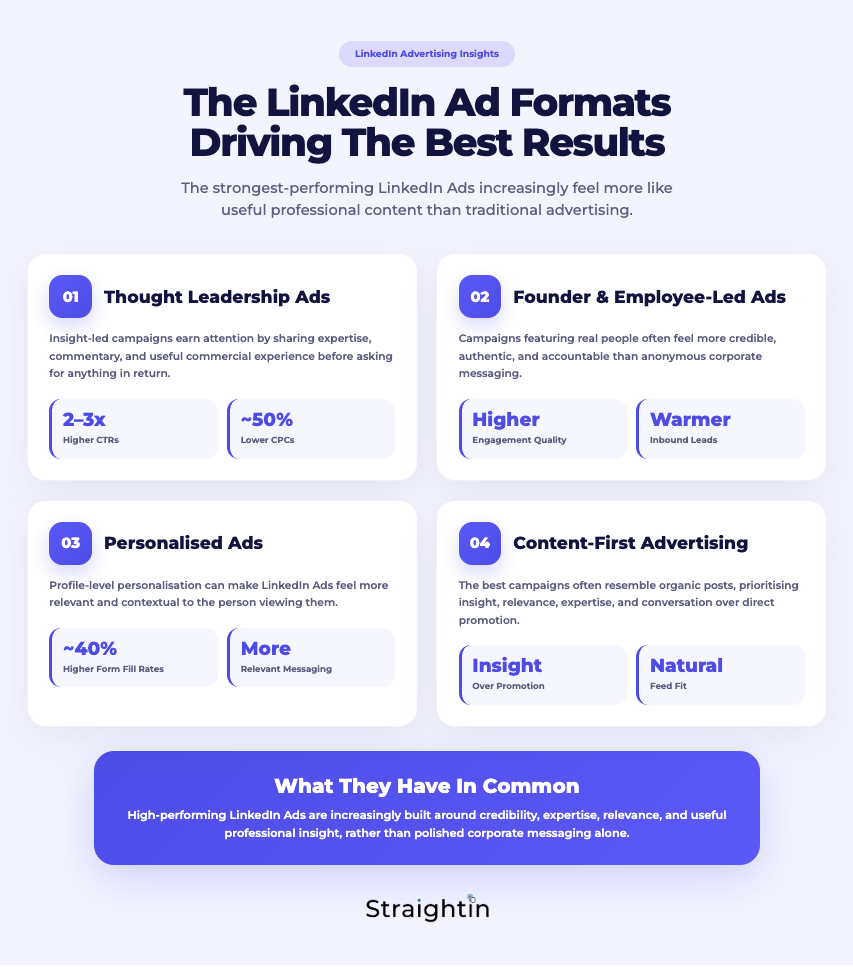
Across a number of campaigns we manage, thought leadership-style LinkedIn Ads are often generating two to three times higher CTRs than more traditional corporate adverts, while also reducing average CPCs by close to 50%.
Part of the reason is simple: people are far more likely to engage with businesses they already perceive as knowledgeable, credible, or genuinely informed about their industry.
Founder-Led And Employee-Led LinkedIn Ads
Founder-led and employee-led campaigns are also performing strongly for similar reasons.
People naturally trust people more than logos, particularly on a professional platform like LinkedIn where users are actively assessing expertise, credibility, and commercial understanding.
A founder talking openly about:
- A mistake they learned from.
- A challenge facing the industry.
- A lesson from scaling the business.
- A shift happening in the market.
- An opinion on where things are heading.
often feels far more authentic than a heavily branded corporate advert.
The same applies to employee-led campaigns featuring internal specialists and subject matter experts.
For example:
- A cybersecurity consultant explaining emerging attack trends.
- A recruiter discussing hiring challenges.
- A finance expert commenting on lending conditions.
- A logistics specialist analysing supply chain disruption.
This type of LinkedIn advertising tends to perform well because it reflects real expertise from people actively working in the industry, rather than generic brand messaging designed to appeal to everyone.
It also creates accountability. There is a visible person attached to the message, which naturally makes the content feel more credible and trustworthy.
LinkedIn Ads Are Becoming More Personalised Too
Another major development is LinkedIn’s expanding personalised ad functionality inside Campaign Manager.
Instead of every user seeing identical messaging, LinkedIn can now personalise elements of the advert using profile-level information, helping the content feel more relevant to the individual viewing it.
That matters because LinkedIn users have become increasingly skilled at filtering out generic advertising.
Personalised messaging creates a stronger interruption in the scroll because it immediately feels more contextual to the audience reading it.
We are already seeing this reflected in campaign performance too, with personalised LinkedIn Ads generating roughly 40% higher form fill rates across some campaigns compared to more standard ad formats.
The important thing, however, is that personalisation alone does not fix weak advertising.
If the messaging lacks relevance, credibility, or useful insight, the campaign still feels generic, even if someone’s name or job title has been inserted into the copy.
Strong positioning, targeting, and genuinely valuable content still matter far more than personalisation features themselves.
If you want to learn more about LinkedIn’s new personalised ad features and how they are performing so far, read Tom’s full breakdown here:
Content-First LinkedIn Advertising
One of the biggest shifts is that many successful LinkedIn Ads now resemble organic posts more than traditional adverts.
The strongest campaigns often prioritise:
- Insight over promotion.
- Conversation over slogans.
- Relevance over reach.
- Expertise over polished branding.
That does not mean branding stops mattering. It still matters enormously.
But the businesses performing best on LinkedIn are usually those that combine strong branding with content that genuinely belongs in the feed.
In many ways, the most effective LinkedIn advertising today behaves less like interruption marketing and more like useful professional content that happens to be promoted.
The Behavioural Changes Influencing LinkedIn Ads Management
A lot of this also connects back to wider changes in B2B buying behaviour.
As Tom Watson, explains: “The rise of founder-led campaigns and thought leadership ads isn’t some random LinkedIn trend marketers invented overnight. Buyers are far more sceptical now. People trust expertise, opinions, and real commercial experience far more than polished corporate messaging pretending to say something interesting.”
That shift is one reason founder-led campaigns, employee-led content, and more natural-looking LinkedIn Ads are becoming increasingly effective. They reflect how buyers now research businesses, assess credibility, and make decisions online.
How Modern B2B Buying Behaviour Is Changing
Many of these changes have been building for years, but LinkedIn’s evolving feed and visibility systems have accelerated them further.
Buyers are becoming more independent, more research-driven, and far more selective about who they engage with online. According to Gartner’s 2025 Sales Survey, 61% of B2B buyers now prefer a rep-free buying experience altogether.
That means decision-makers are often researching suppliers, comparing providers, and forming opinions long before they ever speak to sales.
For businesses relying solely on cold outreach, generic advertising, or disconnected marketing, building trust and attention has become much harder.
Why Modern B2B Buying Journeys Are Harder To Track
Buyers are often forming opinions about your business long before they:
- Fill out a lead form.
- Reply to outreach.
- Book a call.
- Speak to sales.
Before converting, they may already have:
- Seen your LinkedIn Ads.
- Read posts from your founders.
- Visited your company page.
- Consumed thought leadership content.
- Seen multiple touchpoints across the platform.
That is why LinkedIn advertising is becoming increasingly reputation-driven.
Campaigns no longer exist in isolation. Every ad, post, comment, and interaction contributes to how your business is perceived.
It also makes attribution more difficult. Somebody might click a LinkedIn Ad, ignore it, then later:
- See another founder post.
- Search for your business on Google.
- Come across your brand through outreach.
- Only convert after multiple interactions, weeks later.
- From the outside, the lead can appear to come “out of nowhere.” In reality, trust was gradually building.
That is why businesses that treat advertising, content, and outreach on LinkedIn as separate activities often struggle to maximise results.
The businesses performing best on LinkedIn are usually those that build consistent visibility, positioning, and expertise across the platform.
- We recently explored this in more detail in our article, How LinkedIn Ads Management Is Evolving As Buyer Behaviour Changes. If you want a deeper look at how LinkedIn advertising is evolving and what businesses need to do differently moving forward, it is well worth a read.
The New Rules Of LinkedIn Ads Management
The best-performing LinkedIn Ads right now are not necessarily the loudest, most polished, or most aggressively sales-focused campaigns.
They are usually the ones that feel credible, relevant, and genuinely useful to the audience seeing them.
That shift reflects a much bigger change happening across both LinkedIn itself and wider B2B buying behaviour. Buyers are more sceptical, more research-driven, and far more selective about the businesses they choose to engage with online. As a result, attention has become much harder to earn.
Modern LinkedIn ads management is no longer just about targeting the right job titles and launching polished creative. It is increasingly about building trust, visibility, authority, and familiarity over time.
That is why founder-led campaigns, thought leadership content, employee-led ads, and content-first strategies are becoming so effective. They align far more closely with how people now consume content and assess credibility on the platform.
The businesses performing best on LinkedIn today are usually those that understand one important shift: successful advertising no longer operates in isolation.
Your ads, organic content, founder activity, employee engagement, messaging, and overall positioning now work together to shape how buyers perceive your business, long before they become leads.
In many ways, the future of LinkedIn advertising looks less like traditional interruption marketing and more like consistent professional visibility built through expertise, relevance, and trust.
At StraightIn, we help B2B businesses build LinkedIn ads management strategies that go beyond simply running paid campaigns. We connect paid advertising, LinkedIn outreach, content, and personal branding into one joined-up strategy that reflects how modern buyers actually make decisions.
If you want to improve your LinkedIn ads management strategy and create LinkedIn campaigns that generate stronger engagement, higher-quality leads, and better long-term commercial results, get in touch with the team at StraightIn.
