
LinkedIn advertising has always rewarded businesses that understand the platform properly.
Strong campaigns have never been built on budget alone. Good LinkedIn Ads management requires the right audience, strong positioning, relevant messaging, and a clear understanding of how professionals actually behave on the platform.
What’s changing now is the environment in which those campaigns operate.
LinkedIn itself is evolving, and users are becoming far more selective about who they engage with. Buyers are spending more time researching businesses independently and placing greater importance on credibility, relevance, and the quality of the content appearing in their feed.
That naturally affects how businesses should approach LinkedIn advertising.
The strongest-performing LinkedIn advertising campaigns are usually the ones supported by visible expertise, consistent content, and strong positioning. Businesses with active founders, useful thought leadership, and clear market credibility often generate warmer audiences before the ad click even happens.
At the same time, generic corporate messaging is becoming easier for users to ignore, particularly in a feed increasingly shaped around relevance and professional interest.
How LinkedIn’s Feed Changes Are Affecting LinkedIn Advertising
Over the past year, we’ve seen organic visibility tighten across LinkedIn.
In simple terms, businesses and individuals are finding it harder to get their posts seen naturally without paid promotion.
Content that may previously have reached large parts of a network through normal posting alone often generates lower impressions and engagement unless it is highly relevant, consistent, and genuinely useful to a specific audience.
At the same time, businesses investing in focused, experience-led LinkedIn content generally appear to be maintaining stronger reach than those relying on broader or repetitive posting strategies.
As our Copywriting Lead, Joseph Brown, recently explained:
“LinkedIn’s becoming a lot less forgiving of ‘content for the sake of content.’ The platform now seems far more interested in whether somebody actually knows what they’re talking about, adds something useful to the conversation, and can stay focused on one area of expertise for longer than three posts at a time.”
This wider shift is closely tied to LinkedIn’s evolving 360Brew update, which appears to place greater emphasis on relevance, expertise, and the quality of engagement across the platform.
block similiar to the other text
What is 360Brew?360Brew is the name for LinkedIn’s evolving AI-driven feed system and ranking model. While LinkedIn has not publicly explained every detail, the update appears to focus more heavily on:
In practical terms, LinkedIn seems to be getting better at understanding:
The result is a feed that appears more selective, with greater emphasis on credibility, consistency, and useful professional insight. If you want a deeper breakdown of how 360Brew works and what it means for LinkedIn visibility, read our full report below: |
While much of the conversation around 360Brew has focused on organic content and personal branding, the impact appears to go much further than that.
It is increasingly influencing how audiences respond to campaigns across the platform.
Why Generic LinkedIn Ads Are Losing Attention
LinkedIn has always been different from other social media platforms.
The company prides itself on being the world’s largest professional network, with more than 1.3 billion members and a mission “to connect the world’s professionals to make them more productive and successful,” which is why the platform has always placed greater emphasis on professional value, expertise, and industry relevance than purely entertainment-driven engagement.
This is in line with how people actually use LinkedIn.
Most users are not opening the platform to watch viral videos or mindlessly scroll content. They are there to:
- Learn from industry experts.
- Research suppliers and service providers.
- Assess credibility before making decisions.
- Follow conversations happening in their sector.
- Evaluate potential business relationships.
That behaviour appears to be becoming even more pronounced.
As LinkedIn gets better at understanding relevance, expertise, and engagement quality, users are becoming far more selective about what they engage with in-feed. Buyers are scrolling past generic content and paying more attention to posts that offer genuine insight or practical value.
That creates a problem for businesses still relying on overly corporate messaging or generic LinkedIn Ads.
A lot of advertising still follows the same predictable formula:
- Sleek graphics with little to no substance.
- Safe slogans that could apply to any company.
- Buzzwords that sound impressive but say nothing concrete.
- “Industry-leading solutions” with no clear outcome attached.
- Copy so generic it disappears into the feed instantly.
People have become very good at filtering that out.
Modern LinkedIn buyers want specifics. They respond to messaging that feels tangible and tied to real business outcomes, rather than vague prompts like “learn more” or empty corporate language. The strongest copy explains exactly what the solution does, who it helps, and why it matters, for example:
- Reduce onboarding time from six weeks to ten days.
- Give sales teams visibility into stalled deals before pipeline reviews.
- Help compliance teams identify risk before audits become costly problems.
That kind of messaging stops the scroll because people can immediately picture the value in a real-world context.
This is one reason thought leadership campaigns, founder-led ads, and content-first strategies are often performing better on LinkedIn right now. They feel more natural on the platform and blend better into the feed experience.
What High-Performing LinkedIn Ads Look Like Now
The strongest-performing campaigns often resemble the type of LinkedIn content users already come to the platform to consume.
Below is an infographic breaking down the types of LinkedIn Ads and content formats currently performing best in-feed and why they are resonating more strongly with professional audiences.
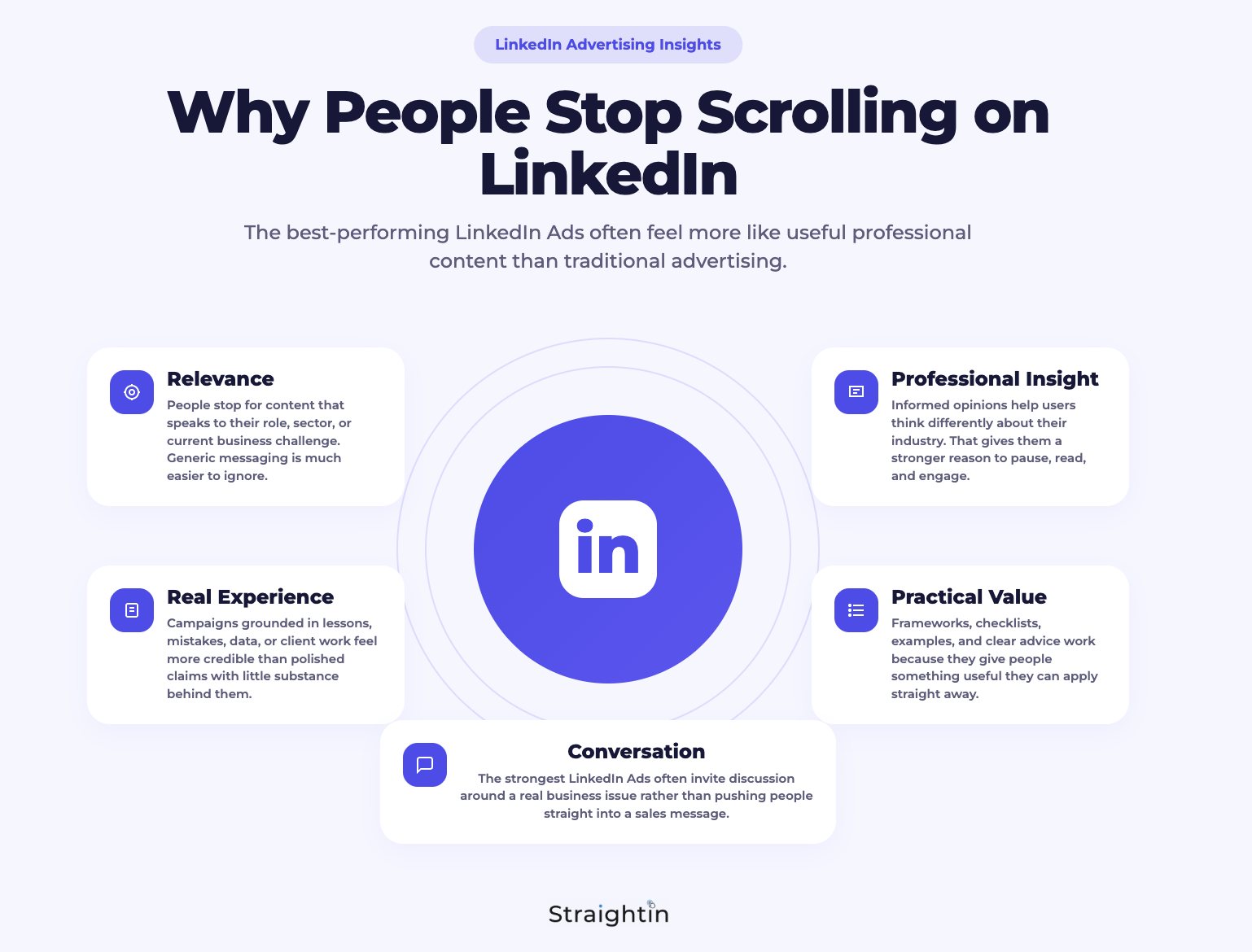
We go into more detail on each area below.
Industry insight
Posts analysing trends, challenges, or changes happening within a specific industry often perform well because they help users stay informed. For example, a cybersecurity company discussing how AI is changing phishing attacks is likely to attract more attention than a generic “book a demo” advert.
Professional opinions
People respond well to informed perspectives, especially when someone is willing to say something with conviction. A founder discussing why most B2B lead generation fails, or a sales director challenging outdated outreach tactics, often generates stronger engagement than polished corporate messaging.
Real commercial experience
LinkedIn users are more and more attracted to content grounded in real business experience. That could be a managing director sharing lessons from a failed campaign, a recruiter discussing hiring challenges, or a marketing leader explaining how they improved the pipeline performance.
Practical advice
Useful content consistently performs well because it gives people something they can apply immediately. This could be:
- A checklist for improving LinkedIn outreach.
- A breakdown of high-performing LinkedIn Ads.
- A framework for measuring lead quality.
- Tips for improving LinkedIn content engagement.
Useful conversations
Some of the best-performing LinkedIn advertising campaigns simply start conversations people genuinely want to join. Instead of pushing a hard sell, the content invites discussion around a relevant business issue or industry topic.
In many cases, the best-performing LinkedIn advertising no longer feels like advertising at all. It feels like content that naturally belongs in the feed, which is exactly why people are more willing to engage with it.
If you want to see how these behavioural shifts are influencing the actual LinkedIn Ads currently generating the strongest engagement, read our latest breakdown: The Best-Performing LinkedIn Ads Right Now. We explore the formats, messaging styles, and campaign approaches businesses are using to blend more naturally into the LinkedIn feed and generate better results.
Why Relevance and Credibility Matter More Than Ever
Ultimately, LinkedIn Ads management is becoming less about pushing campaigns harder and more about understanding how professional audiences actually make decisions.
People are paying closer attention to credibility, expertise, and relevance long before they ever click an ad. The businesses seeing the strongest results are usually those that combine paid activity with genuine industry insight, consistent positioning, and content that feels useful rather than promotional.
That shift is unlikely to slow down any time soon.
As LinkedIn continues refining how content is surfaced and how relevance is measured, the gap between thoughtful, experience-led campaigns and generic advertising will only become more obvious.
The companies that adapt will not necessarily be the loudest. They will be the ones who understand their audience best, communicate clearly, and give people a genuine reason to pay attention.
At StraightIn, we’re a LinkedIn advertising agency that helps B2B businesses connect paid advertising, LinkedIn outreach, content, and personal branding into one joined-up strategy that reflects how modern buyers actually make decisions.
The strongest LinkedIn Ads campaigns rarely succeed in isolation. They work best when supported by credibility, consistency, and content that gives people a genuine reason to engage with your business.
If you want to improve your LinkedIn ads management strategy and generate stronger visibility, better-quality leads, and more meaningful long-term growth, get in touch with the team at StraightIn.