

The most successful LinkedIn Ads campaigns rarely rely on paid promotion alone. Instead, they combine valuable content, consistent visibility, and targeted advertising to build trust before asking prospects to take action.
Agencies combine LinkedIn content and ads by using organic posts to build credibility first, then amplifying the strongest-performing content through paid campaigns. This strategy makes ads feel less like cold promotions and more like trusted, relevant insights, while retargeting keeps engaged prospects moving through the funnel towards conversion.
At StraightIn, a full-service marketing agency specialising in outbound lead generation, content marketing, and LinkedIn advertising, we have supported over 7,000 businesses and generated more than 500,000 leads for our clients.
We have seen that the highest-converting LinkedIn Ads campaigns are often those supported by strong organic content, thought leadership, and strategic retargeting rather than paid advertising in isolation.
Why combine organic content and paid ads on LinkedIn?
Combining organic LinkedIn content with paid advertising amplifies reach and builds trust more effectively than either strategy alone.
What Do We Mean By Organic LinkedIn Content?
Organic LinkedIn content refers to any content shared on LinkedIn without paid promotion. This includes posts published by company pages, founders, employees, and subject matter experts to engage audiences, share expertise, and build credibility.
Examples include:
- Thought leadership posts
- Industry insights and commentary
- Case studies and success stories
- Educational content and practical advice
- Employee-generated content
- LinkedIn newsletters and articles
- Polls, videos, and discussion posts
The goal of organic content is to build visibility, trust, and authority over time by consistently providing value to your audience.
When combined with paid advertising, organic content helps warm up prospects before they see an advert, making them more likely to engage and convert.
Organic content establishes thought leadership and genuine connections, while paid ads ensure that valuable messages reach a precise, targeted audience. This integrated approach shortens sales cycles and improves overall marketing return on investment.
- Organic content fosters authentic engagement and builds a loyal audience over time, with LinkedIn pages that post weekly seeing 5.6x more follower growth.
- Paid ads provide immediate visibility and granular audience targeting, allowing businesses to reach specific job titles, industries, or company sizes.
- Together, they create a cohesive marketing funnel, moving prospects from awareness to conversion efficiently.
How does organic content build credibility for LinkedIn ads?
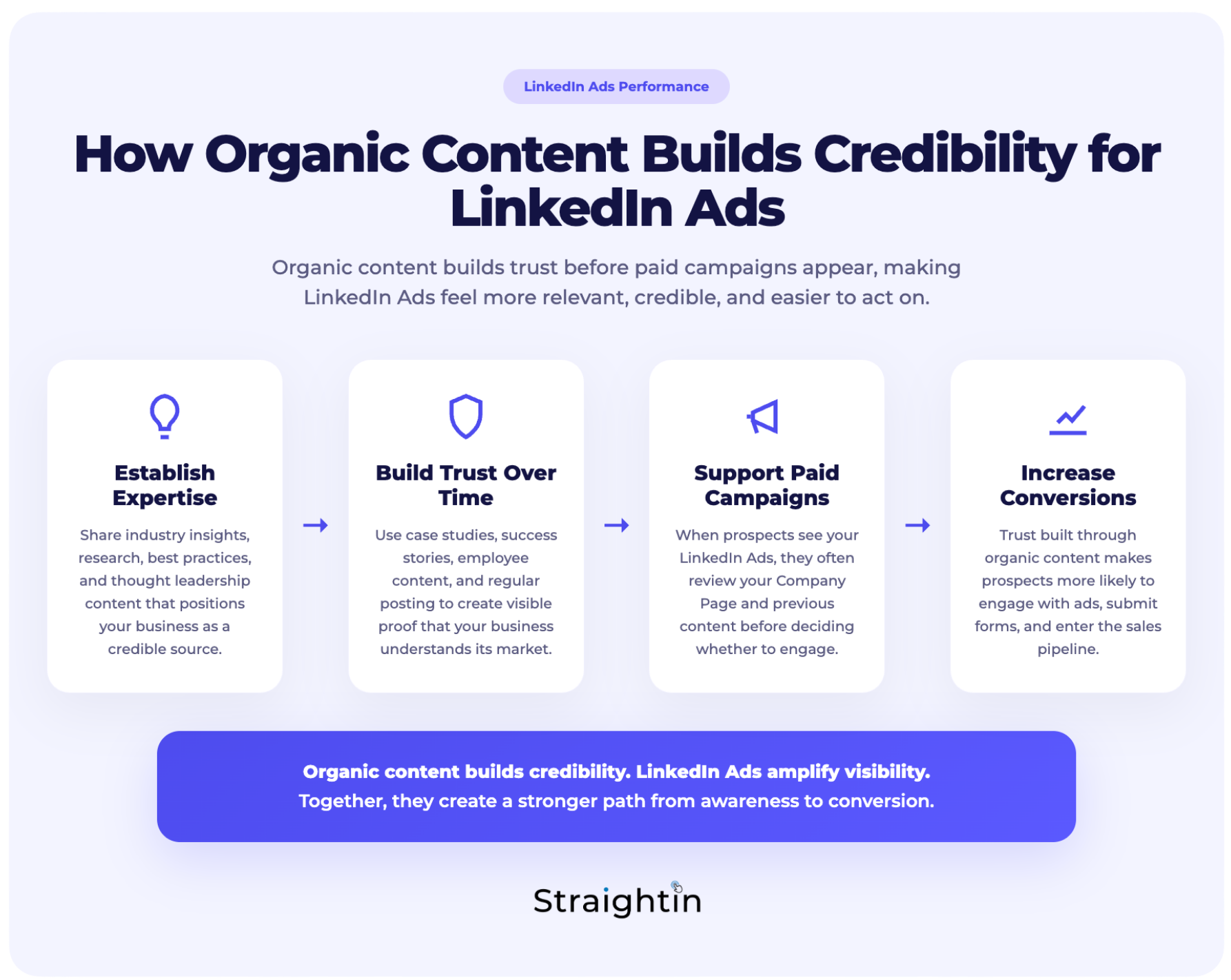
Organic content on a LinkedIn Company Page acts as social proof and establishes expertise before a paid message appears. When prospects encounter an ad, they often check the company page, where consistent, high-quality posts reinforce the brand’s authority. This pre-built trust makes paid content significantly more impactful.
- Share industry insights, research, and best practices to position your company as a leader.
- Post case studies and success stories that demonstrate real-world results and client satisfaction.
- Engage with comments and messages, showing responsiveness and genuine interest in the audience.
- Consistent posting builds a library of valuable resources that validates your paid messaging.
As a result, prospects are more likely to trust, engage with, and ultimately convert from LinkedIn ads when they have already encountered valuable organic content from the brand.
In the infographic below, we show how organic content builds trust before paid campaigns appear, creating a stronger path from visibility to conversion.
Which content types perform best for amplification?
Content that resonates most organically, such as thought leadership articles, data-driven reports, and insightful video snippets, is ideal for amplification through LinkedIn Ads.
Identifying top-performing posts by analysing engagement metrics like likes, shares, and comments ensures that ad spend is directed towards content with proven audience appeal.
- Thought Leadership Articles: Long-form posts sharing unique perspectives on industry challenges perform well. LinkedIn reports that 64% of its audience prefer thought leadership content for industry insights.
- Data-Driven Reports: Content backed by research, statistics, or original surveys establishes credibility. A strong emphasis on research and data makes content more valuable to B2B buyers.
- Case Studies: Detailed accounts of how your solutions helped clients achieve specific results are powerful.
- Short-form Video: Engaging video content captures attention quickly and can explain complex ideas concisely. Video content saw a 36% increase in views year-on-year on LinkedIn.
This approach reduces guesswork and helps make sure advertising budgets are focused on content with a proven track record of audience engagement.
How to structure LinkedIn Ads for optimal conversion?
Effective LinkedIn Ads integrate seamlessly with organic content by focusing on value-driven messages, precise audience targeting, and clear calls to action.
The goal is to move prospects through the marketing funnel, from initial engagement to lead capture and, ultimately, conversion.
- Sponsored Content: Promote high-performing organic posts to a wider, targeted audience. This expands the reach of your best content.
- Lead Generation Forms: Integrate LinkedIn Lead Gen Forms directly into campaigns to simplify the lead capture process. These forms pre-fill with LinkedIn profile data, reducing friction for prospects and leading to completion rates of 6-10%.
- Retargeting Campaigns: Target website visitors, video viewers, or people who engaged with your previous LinkedIn content. This keeps your brand top-of-mind for interested prospects.
- Audience Targeting: Use LinkedIn’s extensive targeting options, including job title, industry, company size, and seniority, to reach ideal B2B buyers. Layered targeting can achieve up to 30% higher conversion rates.
Together, these elements create a smoother path from awareness to action, helping prospects convert with less friction.
What impact does retargeting have on conversion rates?
Retargeting campaigns on LinkedIn significantly improve conversion rates by re-engaging prospects who have already shown interest in your brand. By serving relevant ads to a warm audience, businesses can nurture leads more effectively and guide them closer to a purchase decision.
- Increased Engagement: Prospects who have previously interacted with your content are more likely to engage with subsequent ads. Retargeted users are 70% more likely to convert than those seeing a brand for the first time.
- Higher Conversion Likelihood: Retargeted audiences convert at a higher rate compared to cold audiences. LinkedIn’s pilot study showed retargeting campaigns can lead to 3x higher conversion rates compared to cold prospects.
- Nurturing Leads: Retargeting allows for a tailored approach, delivering specific messages based on a user’s previous interactions, effectively guiding them through the sales pipeline. This reduces B2B lead nurturing time by 15-30%.
As a result, retargeting helps convert initial interest into meaningful action by keeping your brand visible throughout the buyer’s decision-making process.
StraightIn’s insights from real-world advertising campaigns
Our experience at StraightIn consistently shows that content-led LinkedIn Ads outperform traditional promotional campaigns. We have refined our strategies to maximise engagement and drive tangible results for our B2B clients.
- Thought leadership ads we’ve run have generated 2–3x higher Click-Through Rates (CTRs) compared to standard promotional ads.
- This also reduced Cost Per Click (CPC) by almost 50%. This fits with industry data showing thought leader ads can be ~6x more efficient than single-image ads with 77% cheaper CPC.
- Personalised LinkedIn Ads have achieved CTRs of 1–1.2% versus the typical LinkedIn benchmark of 0.3–0.6% for sponsored content. These higher CTRs directly contribute to stronger engagement and improved conversions.
- Focusing on valuable content within ads helps prospects perceive the brand as a trusted advisor, rather than just another vendor. This shift in perception is crucial for B2B lead generation, as 73% of B2B buyers consider thought leadership more trustworthy than traditional marketing.
These results underscore the importance of a strategic, content-first approach to LinkedIn Advertising.
As Tom Watson, Head of LinkedIn Advertising at StraightIn, explains:
“Buyers are far more sceptical now. People trust expertise, opinions, and real commercial experience far more than polished corporate messaging pretending to say something interesting. The campaigns performing best are usually the ones that feel like they actually belong on LinkedIn rather than interrupting it.”
When organic content, thought leadership, and paid promotion work together, LinkedIn Ads become far more effective at building trust, generating engagement, and converting high-quality B2B prospects.
How to improve LinkedIn Ads conversion rates?
Improving LinkedIn Ads conversion rates requires a continuous cycle of testing, refining targeting, and optimising ad creatives and landing pages. Focusing on relevance and providing clear value to the audience drives better performance.
- A/B Test Ad Creatives: Experiment with different headlines, ad copy, images, and video formats to identify what resonates best with your audience.
- Refine Audience Targeting: Regularly review and adjust your audience segments based on campaign performance data. LinkedIn’s audience targeting is one of its most powerful features for reaching decision-makers.
- Optimise Landing Pages: Ensure landing pages are highly relevant to the ad content, provide a clear value proposition, and have a simple, intuitive conversion path. External site conversion rates from LinkedIn ads typically range from 1.5-3.5%.
- Strong Call-to-Action (CTA): Use compelling CTAs that clearly state the next step, such as “Download the Report,” “Register for Webinar,” or “Request a Demo.”
- Use LinkedIn Lead Gen Forms: For lead generation, these forms simplify the process, leading to higher completion rates by pre-filling user information.
Small improvements across targeting, creative, and conversion paths can have a significant impact on overall LinkedIn Ads performance.
If you want to learn more about improving LinkedIn Ads performance, explore our latest insights on ad formats, buyer behaviour, bidding strategies, and personalisation.
-
How LinkedIn Ads Management Is Evolving As Buyer Behaviour Changes
-
LinkedIn Ads Bidding Strategy Doesn’t Need To Be Complicated
Key Takeaways
Successfully combining LinkedIn content and ads requires more than simply boosting posts. The most effective campaigns use organic content to build trust before paid promotion drives visibility and conversions.
- Agencies combine organic LinkedIn content and paid ads to build credibility and amplify reach.
- High-performing organic content, especially thought leadership and data-driven reports, is ideal for ad amplification.
- LinkedIn’s robust audience targeting ensures valuable content reaches the right B2B professionals.
- Retargeting engaged audiences significantly boosts conversion rates by nurturing leads through the sales pipeline.
- Content-led LinkedIn Ads consistently deliver higher CTRs and lower CPCs compared to traditional promotional campaigns.
- Continuous A/B testing, audience refinement, and landing page optimisation are crucial for maximising ad conversion rates.
When content and advertising work together, businesses can build stronger relationships with prospects, generate higher-quality leads, and achieve better long-term results from LinkedIn marketing.
LinkedIn Content and Ads Work Better Together
The most effective LinkedIn Ads campaigns are rarely built on targeting and budget alone. They succeed because the audience already recognises the brand, trusts the expertise behind the message, and sees genuine value in the content being promoted.
That is why agencies increasingly combine organic content and paid advertising into a single strategy rather than treating them as separate activities. Organic content builds visibility, credibility, and familiarity over time, while paid campaigns amplify the right messages to the right people at the right moment.
For B2B businesses, this approach is particularly powerful. Buyers are conducting more research independently, consuming more content before speaking to sales, and placing greater importance on expertise and trust when evaluating suppliers. As a result, content-led LinkedIn Ads often outperform purely promotional campaigns because they feel relevant, useful, and aligned with how people actually use the platform.
At StraightIn, we help businesses combine LinkedIn content, LinkedIn advertising, and outbound lead generation into one joined-up strategy designed to generate visibility, engagement, and commercial results.
If your LinkedIn Ads are not converting as effectively as you’d like, the issue may not be your targeting or budget. It may be that your content and advertising are working in isolation rather than together. Get in touch with the StraightIn team to find out how a content-first LinkedIn strategy can help generate more leads and better long-term results.
