

Let me start with something I see all the time.
A company comes to us convinced LinkedIn ads don’t work. They’ve tested different creatives, changed audiences, maybe even switched agencies once or twice. On the surface, it looks like they’ve “tried everything.”
Then you open the account.
And within a few minutes, the real issue becomes obvious. The campaigns were never properly competing in the first place.
The issue wasn’t the offer, and it certainly wasn’t that LinkedIn advertising doesn’t work. It came down to the bidding strategy being wrong from the start.
So, let’s strip this back to the absolute basics: What do we actually mean by bidding strategy in LinkedIn Ads?
I will break it all down below for you.
How LinkedIn Ads Bidding Actually Works
At its simplest, it’s how you tell LinkedIn how much you’re willing to pay to get in front of the right person and drive a specific action. That might be a click, a lead, a video view, or something further down the funnel.
A LinkedIn Ads bidding strategy determines how competitively your campaign enters the auction and how efficiently your budget is spent to achieve results.
Every time your ad has the chance to be shown, it enters a LinkedIn advertising auction. Your bid plays a role in whether you win that auction and how often your ads get delivered. But it’s not the only factor.
LinkedIn is also weighing things like relevance, engagement, and how likely your ad is to achieve the objective you’ve set. In other words, you’re not just competing on budget. You’re competing on how strong your campaign is overall.
This is what it looks like in practise.
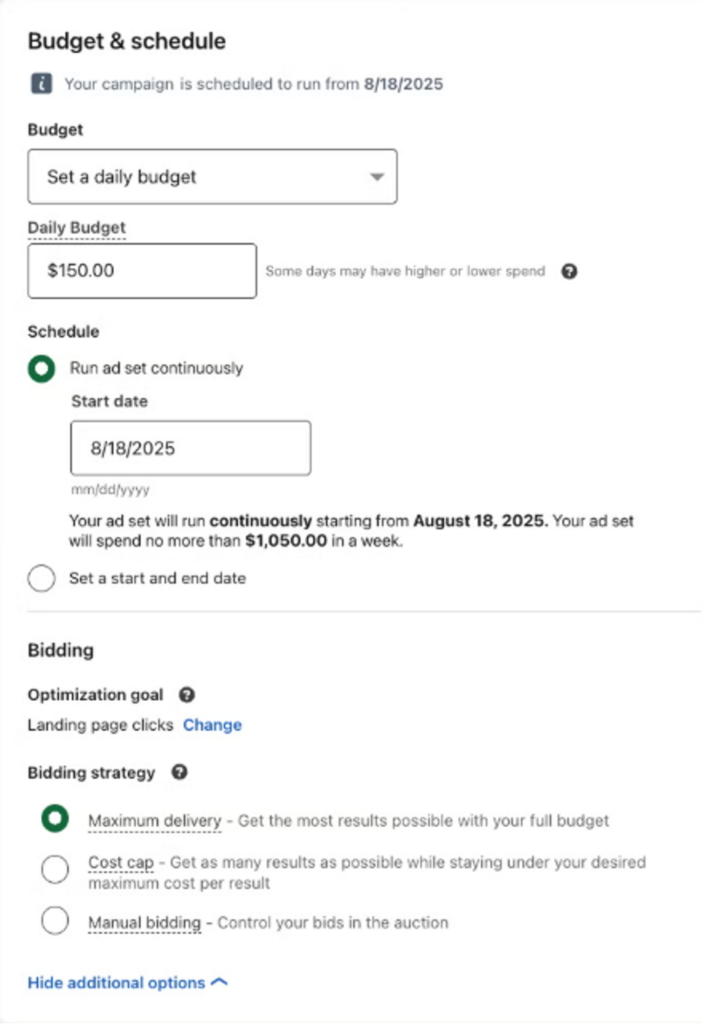
Source: (LinkedIn Advertising: Bidding for LinkedIn Ads made simple)
Simple enough.
So why do so many LinkedIn ad campaigns struggle?
Because bidding is one of those areas where small decisions have a disproportionate impact. Get it right, and your campaigns scale efficiently. Get it wrong, and you either burn budget too quickly or fail to spend it at all.
Both happen more often than people like to admit.
If your bids are too low, you quietly drop out of the auction. You assume LinkedIn Ads “don’t work” when in reality, you were never really competing.
If your bids are too aggressive, you end up winning auctions you shouldn’t. Costs creep up, lead quality drops, and suddenly your CPL looks like a problem that needs explaining.
So no, bidding strategy isn’t the most exciting part of LinkedIn Ads.
But it is one of the few levers that directly affects both volume and efficiency.
Ignore it, and you’re guessing.
The Three Bid Types Most Marketers Pretend to Understand
LinkedIn gives you three main bidding options. On paper, they’re straightforward. In practice, most people either misunderstand them or use them without much thought.
That’s usually where problems start.
Below is a graph showing how each bidding approach behaves over time in terms of cost, delivery, and control, and where performance can become unpredictable if the setup isn’t right.
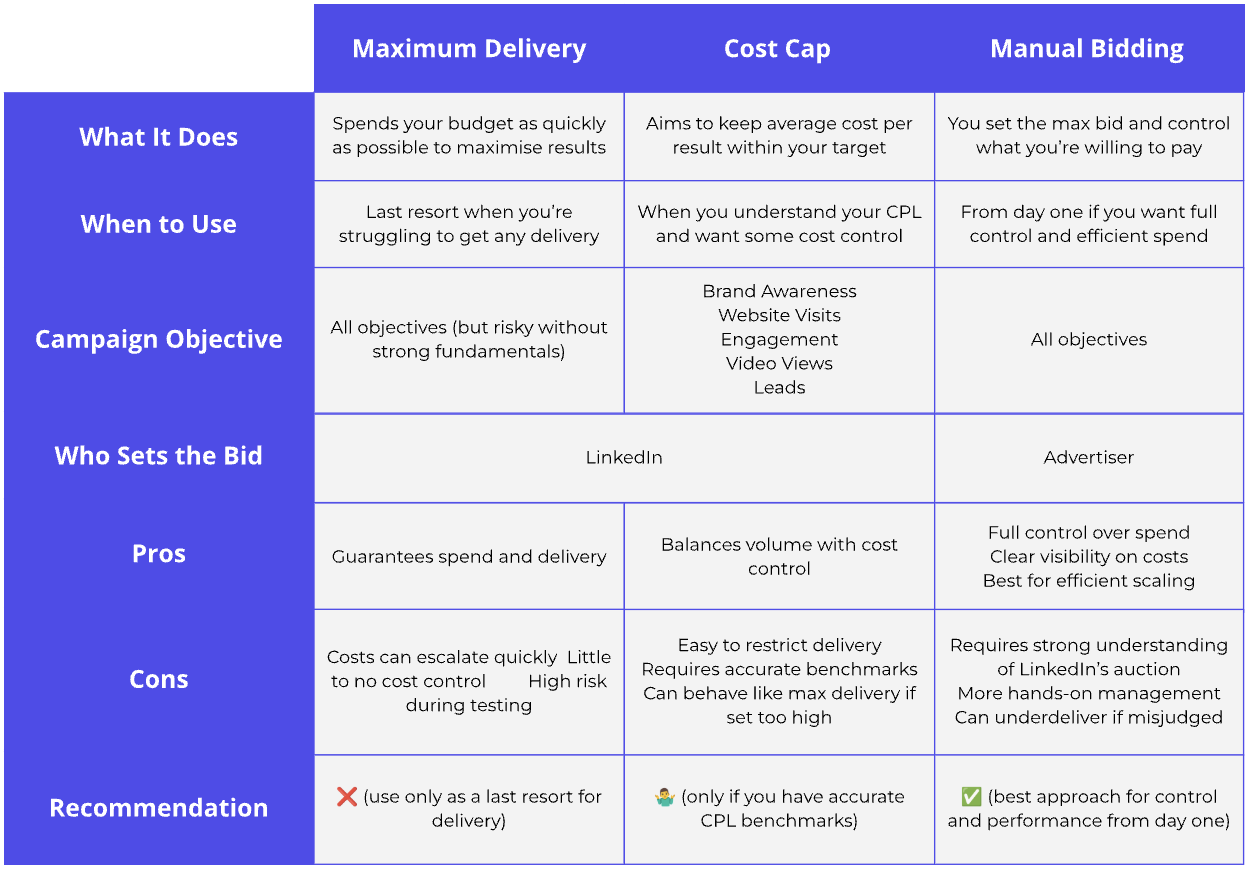
I’ll break each option down in more detail below so you can see where they work, where they don’t, and how to use them properly.
Maximum Delivery
This is LinkedIn’s default recommendation, and for most LinkedIn ad campaigns, it’s where people start.
You hand control over to LinkedIn’s algorithm, and it automatically sets bids to get you as many results as possible while spending your full budget.
Sounds ideal, right?
Wrong. This is actually where many campaigns go wrong.
If your priority is volume and you lean on maximum delivery too early, it can become one of the fastest ways to lose control of your costs.
LinkedIn will push to spend your budget. That part works exactly as intended. But without the right constraints in place, it often does so at increasingly expensive CPCs and CPLs, especially during testing phases where performance is still uncertain.
That’s where the risk sits.
You’re effectively telling LinkedIn: get me results, regardless of how much it costs. And unless your campaign fundamentals are already strong, that cost can escalate quickly.
Costs rise, efficiency drops, and before long, you’ve spent a significant portion of your budget without learning anything meaningful.
This is why, for most campaigns, maximum delivery isn’t a starting point. It’s more like a fallback. Something you use when delivery is so limited that you need to force visibility just to generate data.
So the decision here isn’t just about simplicity versus control. It’s about risk tolerance.
Are you in a position where you can afford to let the platform spend freely to gain traction? Or do you need tighter control to protect budget while you validate performance? Because maximum delivery assumes you’re comfortable with the former.
Cost Cap
Cost cap sits somewhere in the middle, which is why it appeals to a lot of advertisers.
You set a target cost per result, and LinkedIn works to keep your average around that number while still driving volume. In theory, it gives you a balance between automation and control.
Sometimes it does.
But it’s also one of the easiest bidding strategies to get wrong.
If your cost cap is set too low, delivery slows down almost immediately. Impressions drop, your ads stop competing properly, and performance looks like it’s fallen off a cliff.
Nothing has really broken. You’ve just made it too difficult for your campaigns to enter the auction.
On the other hand, if your cap is too high, it behaves very similarly to maximum delivery. At that point, you’ve added complexity without gaining much control.
So, the effectiveness of cost cap isn’t really about the feature itself. It comes down to whether you actually understand your numbers.
If you don’t know what a realistic CPL looks like in your market, you’re not controlling cost. You’re guessing, just with slightly better tools.
Manual Bidding
Then there’s manual bidding.
This is where you set the maximum amount you’re willing to pay, and LinkedIn won’t go above it (unless you allow some flexibility).
In my opinion, this is what marketers should be using from day one.
It’s the only approach that gives you real control over how your budget is spent while still allowing you to drive efficient results. You’re not handing the keys over to LinkedIn and hoping it behaves. You’re setting clear boundaries and forcing the campaign to operate within them.
There’s also an option to let LinkedIn go slightly above or below your bid and daily budget, which you can think of as training wheels.
You can start with a recommended bid, let the campaign find its average, and use that data to understand where the market actually sits. Once you’ve got that baseline, you can tighten things up and take full control.
That’s where manual bidding becomes powerful.
Most campaigns don’t fail due to a lack of features or strategy. They fail because spend isn’t controlled properly. Budgets drift, costs creep up, and performance becomes harder to justify.
Manual bidding prevents that.
It forces discipline early, gives you visibility into what you’re actually paying, and makes it much easier to scale what’s working without letting costs run away.
It’s also why most businesses struggle with LinkedIn ads. Too often, control is handed over before there’s a clear understanding of what efficient performance actually looks like.
Manual bidding forces you to define that benchmark first.
It’s also one of the reasons companies come to StraightIn — we get this right from day one 😉
Key Takeaways for LinkedIn Ads Bidding Strategy
|
Campaign Optimisation Is Doing More Work Than You Think
Bidding doesn’t operate on its own.
It’s directly tied to campaign optimisation, which is LinkedIn’s way of deciding who actually sees your ads.
When you choose an objective, you’re effectively telling LinkedIn what kind of behaviour to prioritise. If you optimise for clicks, it looks for people who tend to click. If you optimise for conversions, it focuses on users who are more likely to take that action.
That part is straightforward.
What’s less obvious is how often people expect this to compensate for a weak strategy elsewhere.
It doesn’t.
If your targeting is off, your messaging doesn’t resonate, or your offer isn’t compelling, no bidding approach will fix it. All it changes is how efficiently your budget gets spent, while those problems still exist.
That’s why optimisation and bidding need to work in sync.
If you’re optimising for leads but you don’t have enough conversion data, LinkedIn doesn’t have much to learn from. If you’re optimising for clicks but expecting a strong pipeline from your LinkedIn ads, you’re solving a different problem entirely.
So before changing your bids, it’s worth pausing for a moment.
Are you actually optimising for the outcome you care about, or just the one that’s easiest to track?
Most LinkedIn Ads Bidding Problems Aren’t Really Bidding Problems
This is usually the part people don’t want to hear.
Bidding strategy matters. Of course it does. It influences cost, delivery, and how efficiently you scale.
But it’s rarely the reason your LinkedIn ads aren’t working.
More often, it just exposes what’s already broken.
Take targeting.
If you’re going broad or defaulting to the same generic audiences everyone else is using, you’re not “opening things up.” You’re walking straight into a bidding war. The more crowded the audience, the more you pay to stay competitive. At that point, you either have genuinely strong ads that deserve to win… or you’re just outspending everyone else to compensate.
Most campaigns aren’t doing the former.
They’re paying a premium to show average ads to the same over-targeted audience everyone else is chasing. And then wondering why CPL creeps up.
It’s the same pattern we’re seeing with 360Brew on the organic side. LinkedIn is getting better at rewarding relevance, context, and clear audience fit across the platform. Broad, unfocused content tends to stall in the feed, and broad, unfocused targeting tends to become more expensive in ads.
In both cases, LinkedIn is favouring advertisers and marketers who are clear about who they want to reach and why they matter to them.
So, when someone says their LinkedIn ads aren’t working and immediately focuses on bidding, it’s usually a sign they’re looking in the wrong place.
A better question is this: If you doubled your budget tomorrow, would your campaigns actually convert more of the right people? Or would they just spend faster and produce the same results at a higher cost?
Bidding strategy can only improve what already exists. It doesn’t fix the fundamentals.
LinkedIn Ads Bidding Strategy FAQsWhat is the best LinkedIn Ads bidding strategy?
Why are my LinkedIn Ads not delivering?
Is manual bidding better than automated bidding on LinkedIn?
How long does it take for LinkedIn Ads bidding to stabilise?
Should I change my LinkedIn Ads bids frequently?
|
The Real Advantage in LinkedIn Advertising Isn’t the Bid Type
Most conversations around LinkedIn ads tend to drift in the same direction.
Which bidding option is best? Maximum delivery, cost cap, or manual.
It’s an easy question to ask, but it’s usually the wrong one.
In the webinar Zac Hancox and I ran recently on the Fundamentals of LinkedIn Advertising, this came up almost immediately. People want to know which lever to pull, which setting gives them the edge, and which option unlocks better performance.
The reality is that the advertisers who consistently get results aren’t winning because they picked the perfect bid type. They’re winning because their campaigns are built on strong targeting, relevant messaging, and clear commercial intent.
Bidding then becomes a tool to scale what’s already working.
So, if you’re spending time trying to fine-tune your bidding strategy, it’s worth stepping back for a second and asking:
- Are you optimising a strong campaign?
- Or trying to rescue a weak one?
Because those are two very different situations.
If you want to go deeper into how LinkedIn ads actually work in practice, we’ve broken it down in more detail across the articles below:
Bidding Doesn’t Fix Weak LinkedIn Ads. It Exposes Them
Bidding strategy isn’t where LinkedIn ads are won or lost. It’s where weak campaigns get exposed.
You can spend hours tweaking bids, switching between cost cap and maximum delivery, or trying to find the “perfect” number. But if the targeting is off, the messaging doesn’t land, or the offer isn’t strong enough, none of it really matters. You’re just changing how efficiently you spend money.
That’s the part most people don’t want to hear.
Because the truth is, it’s easier to blame the platform, or the settings, or the algorithm, than it is to accept that the campaign itself isn’t strong enough yet.
At StraightIn, we’ve run enough LinkedIn ad campaigns to know where performance actually comes from. It’s not clever bidding tricks or hidden settings. It’s getting the fundamentals right first, then using bidding as a tool to scale what’s already working.
That’s also how we’ve built our own pipeline.
So, if your LinkedIn ads aren’t delivering what you expected, the question isn’t “which bid type should I use?”
It’s whether the campaign is strong enough to compete in the first place.
If you want a clear answer to that, we can show you exactly where things are working, where they’re not, and what needs to change.
StraightIn is a specialist LinkedIn advertising agency that helps B2B companies build campaigns that actually compete. From paid ads to LinkedIn outreach and content marketing, we focus on what drives real pipeline. Get in touch with the team today.
And if you want a free LinkedIn ads audit, drop me a message—I’ll be more than happy to take a look: t.watson@straight-in.co.uk
