


For years, LinkedIn advertising performance was heavily judged using surface-level metrics.
High impressions, strong click-through rates, rising engagement, follower growth, and cheap cost-per-click numbers were often treated as clear signs that a campaign was working. Those figures were easy to present internally and gave businesses a simple way to benchmark campaign performance.
But LinkedIn has changed a hell of a lot since then.
B2B buyers are now more informed, more sceptical, and far less likely to convert after a single interaction. Decision-makers spend longer researching suppliers, comparing providers, consuming content, and validating credibility before ever speaking to sales.
That shift is changing how businesses approach LinkedIn ads management and how campaign performance should actually be measured.
Today, a campaign generating huge visibility can still produce very little commercial value. At the same time, LinkedIn Ads campaigns with lower engagement or fewer clicks can sometimes generate far stronger pipeline because the audience already recognises the business and trusts the people behind it.
The click itself is no longer the full story.
In today’s article, we will explore why vanity metrics are becoming less reliable in LinkedIn advertising, how buyer behaviour on the platform is changing, and why businesses investing in LinkedIn ads management are increasingly prioritising lead quality, pipeline contribution, and commercial outcomes over clicks and impressions alone.
LinkedIn Buying Journeys Are Becoming More Complex
One of the biggest changes in LinkedIn advertising is that buying journeys are now far less linear than they once were.
A potential buyer might:
- See a LinkedIn Ad today.
- Engage with an organic post next week.
- Visit a founder’s LinkedIn profile afterwards.
- Notice employees sharing company content.
- Search for the business on Google later that month.
- Only enquire after several different touchpoints.
From a reporting perspective, that journey can look very messy.
Traditional attribution models often struggle to capture how trust actually develops, since conversions rarely occur after a single isolated interaction.
As our Head of LinkedIn Ads, Tom Watson, explains:
“Vanity metrics can create a very misleading picture of performance on LinkedIn. We’ve seen campaigns with lower CTRs generate far better pipeline because the audience was more relevant and already familiar with the business before clicking.”
That is becoming increasingly common across LinkedIn advertising campaigns.
In many cases, conversions happen because:
- The business already felt familiar.
- The audience recognised the brand.
- The founder had visible credibility.
- The content-built trust gradually over time.
- The business consistently appeared in front of the right audience.
That means the interaction that generates the conversion is not always the one doing the heavy lifting.
If you want to explore this shift in more detail, we recently published a deeper breakdown of how LinkedIn ads management is evolving alongside changing buyer behaviour, feed visibility, and audience expectations on the platform.
Why Vanity Metrics Are Becoming Less Reliable
Vanity metrics still provide useful information.
Impressions can indicate visibility. Engagement can show audience interest. CTR can reveal whether messaging is resonating at a surface level. But none of those metrics automatically tell businesses whether LinkedIn advertising is actually generating commercial outcomes.
A campaign can produce:
- Huge reach.
- Strong engagement.
- Cheap clicks.
- High follower growth.
…while still delivering poor-quality leads that never convert into revenue.
That problem becomes even more obvious in B2B environments where sales cycles are longer and lead quality matters far more than volume alone.
Businesses investing heavily in LinkedIn ads management are increasingly recognising that visibility without relevance has very limited value.
The quality of the audience matters far more than its size.
The LinkedIn Advertising Metrics That Matter More Now
As LinkedIn becomes increasingly reputation-driven, more businesses are shifting towards commercially meaningful performance indicators rather than relying solely on surface-level visibility metrics.
That includes:
- Conversion tracking.
- CRM attribution.
- Pipeline reporting.
- Offline conversion data.
- Sales-qualified leads.
- Revenue contribution.
- Lead quality.
- Cost per opportunity.
- Pipeline influenced by LinkedIn Ads.
This is where effective LinkedIn ads management becomes much more strategic.
Rather than simply maximising clicks, businesses are focusing on attracting the right buyers, building familiarity over time, and generating commercially relevant conversations.
That shift is particularly important because one of LinkedIn’s biggest advantages has always been the precision of its targeting capabilities.
Below is a simple breakdown of the difference between vanity metrics that may look impressive in a dashboard and the commercial metrics that actually influence pipeline, revenue, and lead quality.
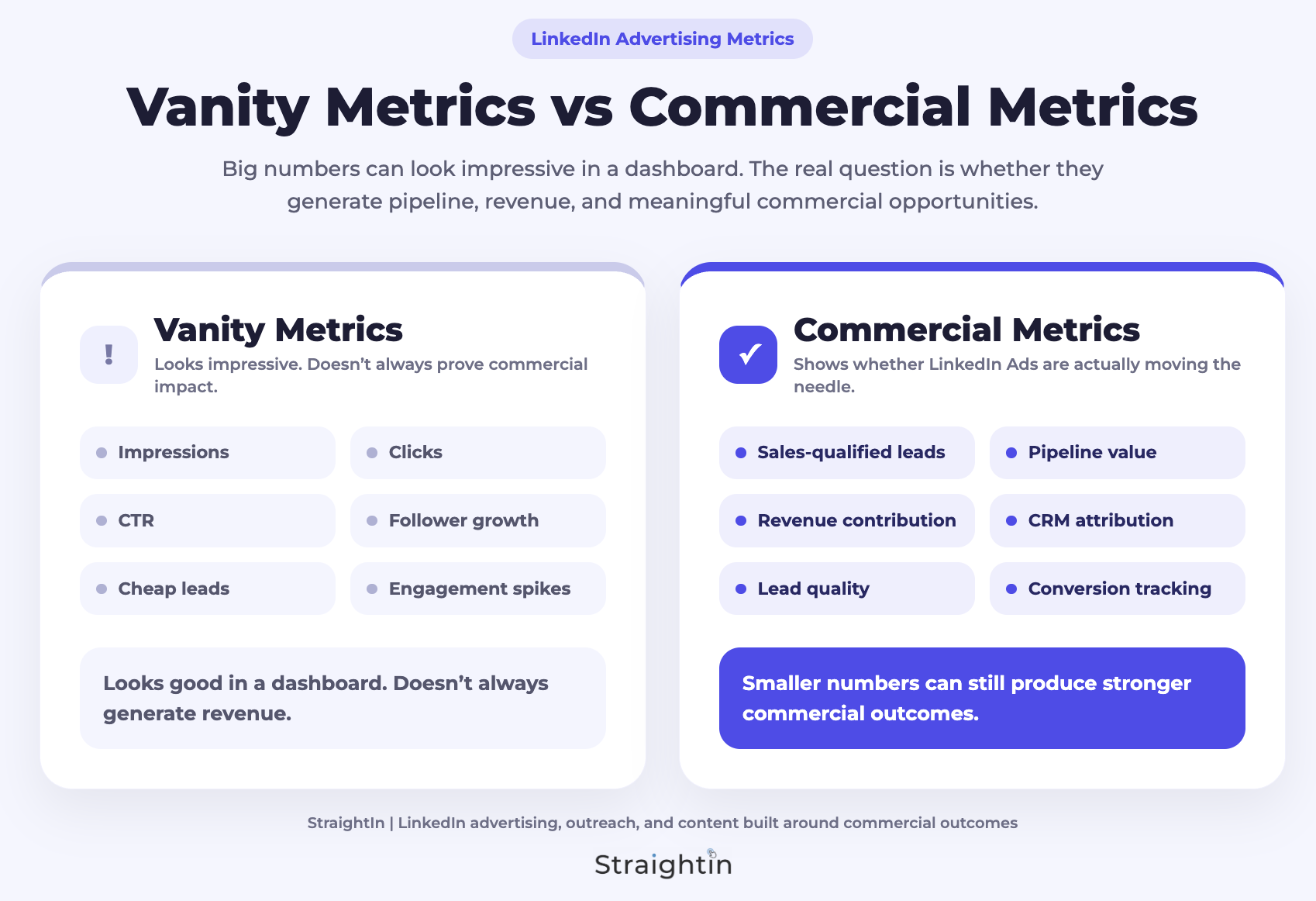
The distinction matters because large visibility numbers do not automatically translate into commercially valuable opportunities. A LinkedIn Ads campaign generating huge reach can still underperform if the audience is poorly targeted or the leads lack genuine buying intent.
Why LinkedIn Ads Often Deliver Better Lead Quality
Unlike broader advertising platforms such as Meta, LinkedIn allows businesses to target users based on highly specific professional data points such as:
- Job title.
- Seniority.
- Industry.
- Company size.
- Department.
- Skills.
- Business interests.
That level of targeting fundamentally changes the purpose of LinkedIn advertising.
LinkedIn Ads may generate fewer leads overall than platforms like Meta, but the leads are often far closer to a business’s Ideal Customer Profile (ICP).
Below is a simple comparison showing why LinkedIn advertising often produces stronger commercial outcomes even when overall lead volume is lower.
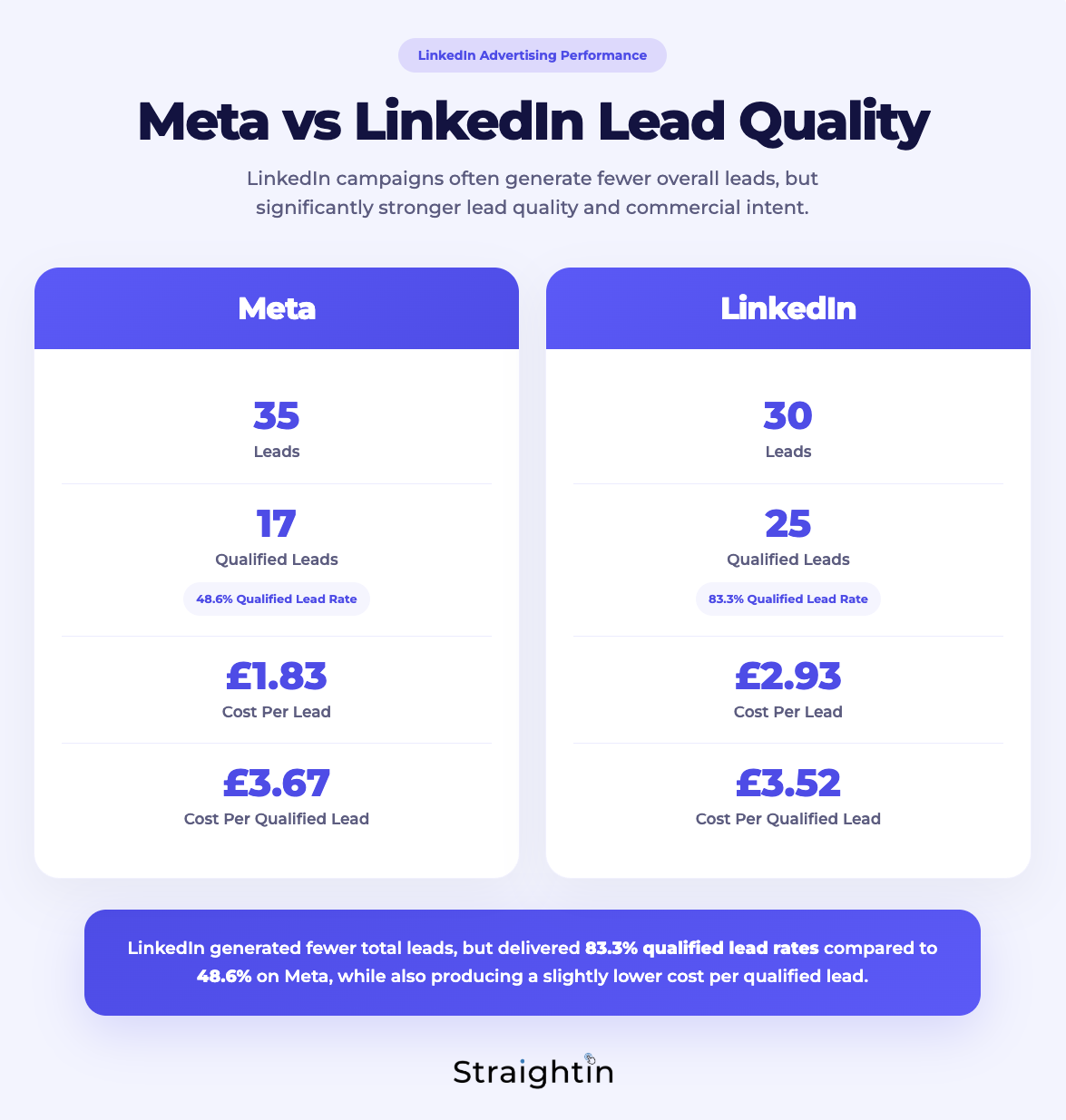
In this example, Meta generated more leads overall at a lower cost per lead. On the surface, that may initially look like the stronger-performing campaign. However, LinkedIn generated significantly more qualified leads at a lower cost per qualified lead. That completely changes the commercial outcome of the campaign.
This is exactly why businesses investing in LinkedIn ads management are increasingly focusing on lead quality and pipeline contribution rather than vanity metrics alone.
In many cases, that means:
- Better-qualified opportunities.
- Stronger sales conversations.
- Higher conversion potential.
- Less wasted sales time.
- Better long-term ROI.
This is why many businesses are now prioritising lead quality over lead volume when evaluating LinkedIn advertising performance.
A campaign generating fewer enquiries can still outperform commercially if those enquiries are significantly more relevant.
Why Trust Matters More Than Click Volume
One of the biggest mistakes businesses still make with LinkedIn advertising is assuming that clicks alone drive conversions.
In reality, LinkedIn often works because it creates repeated exposure over time.
The platform allows businesses to build familiarity gradually through:
- Sponsored content.
- Thought leadership.
- Founder visibility.
- Employee advocacy.
- Organic content.
- Retargeting campaigns.
Together, those touchpoints influence buyer perception long before somebody fills in a form or books a meeting.
That is why joined-up LinkedIn strategies are becoming increasingly important.
LinkedIn Ads no longer operate in isolation. Buyers experience advertising, content, outreach, and company visibility as one connected brand experience.
Businesses treating those activities separately often struggle to understand what truly influences conversion behaviour.
The Problem With Chasing Big Numbers
A campaign generating massive reach or cheap leads may still underperform commercially if:
- The audience is poorly targeted.
- The leads are irrelevant.
- Sales teams waste time filtering enquiries.
- Buyers have little trust in the business.
- The campaign attracts curiosity rather than buying intent.
At the same time, a LinkedIn Ads campaign with lower CTRs or fewer overall leads can still outperform because:
- The audience is highly relevant.
- Buyers already recognise the brand.
- Trust has already been established before conversion.
- The leads are closer to genuine buying intent.
- The campaign supports longer-term pipeline generation.
This is where strong LinkedIn ad management becomes commercially valuable.
The objective is not simply to generate attention. It is to build visibility with the right audience consistently enough that buyers already trust the business before sales conversations even begin.
LinkedIn Advertising Is Becoming More Reputation-Driven
Ultimately, vanity metrics are becoming less useful as LinkedIn itself becomes more reputation-driven.
Buyers are increasingly influenced by credibility, consistency, familiarity, and expertise rather than by a single advertisement.
That means businesses can no longer evaluate LinkedIn advertising performance based solely on clicks and impressions.
Those metrics still matter, but they only represent part of a much larger buying journey.
The businesses generating the strongest commercial outcomes from LinkedIn advertising are rarely the ones chasing the biggest numbers.
They are usually the ones building visibility, trust, and relevance with the right audience long before the conversion ever appears in a dashboard.
If you want to see how LinkedIn Ads compare to Meta Ads in practice, read our full report:
Why LinkedIn Advertising Is No Longer About Vanity Metrics
Ultimately, vanity metrics are becoming less useful because LinkedIn advertising is no longer just about visibility alone.
Modern B2B buyers are more selective, more research-driven, and far more influenced by trust, familiarity, and credibility before they ever convert. That means impressions, clicks, and engagement numbers only tell part of the story.
The businesses generating the strongest commercial outcomes from LinkedIn Ads are rarely the ones chasing the biggest numbers. They are usually the ones consistently building visibility with the right audience, so buyers already recognise and trust the business long before the conversion happens.
That is why effective LinkedIn ad management is becoming increasingly commercially focused. Businesses are shifting away from measuring campaigns solely on reach and CTRs and placing greater emphasis on lead quality, sales conversations, pipeline contribution, and long-term revenue impact.
As LinkedIn continues to evolve into a more reputation-driven platform, the gap between campaigns that generate attention and those that generate actual commercial value will only become more obvious.
The businesses that adapt successfully will not necessarily be the loudest or flashiest. They will be the ones who understand their audience best, build trust consistently, and focus on attracting the right buyers rather than simply the highest number of clicks.
At StraightIn, we help B2B businesses build LinkedIn advertising strategies focused on more than just vanity metrics. Our approach combines ads, LinkedIn outreach, content marketing, and personal branding into one joined-up strategy designed around how modern buyers actually research and make decisions.
If you want to improve your LinkedIn ads management strategy and focus on generating stronger lead quality, better pipeline opportunities, and more meaningful long-term commercial growth, get in touch with the team at StraightIn.
