


Generating a steady flow of qualified leads is one of the biggest challenges facing many B2B technology companies.
LinkedIn gives businesses direct access to senior decision-makers across almost every industry, making it one of the most effective platforms for B2B lead generation. However, consistently turning those connections into conversations and conversations into qualified leads takes much more than sending a few connection requests. The businesses seeing the strongest results combine targeted LinkedIn outreach with valuable content, thoughtful follow-up and a clear understanding of who they want to reach.
At StraightIn, we’ve spent almost eight years helping more than 7,000 B2B businesses generate leads through LinkedIn. During that time, we’ve generated more than 500,000 qualified leads across industries including software, cybersecurity, telecommunications, managed IT services and SaaS. We’ve also seen first-hand what separates campaigns that consistently generate opportunities from those that struggle to gain traction.
In this guide, we’ll look at how B2B technology companies are using LinkedIn outreach, LinkedIn outbound and LinkedIn marketing to generate qualified leads in 2026, along with some of the common mistakes that prevent businesses from getting the results they’re looking for.
Contents
- Why LinkedIn remains one of the best channels for B2B lead generation
- How successful LinkedIn outreach campaigns are built
- The mistakes that prevent technology companies from generating qualified leads
- How LinkedIn outbound, content marketing and advertising work together
- A real-world example of LinkedIn lead generation in action
- What results should technology companies realistically expect?
- Key takeaways
- Frequently asked questions
Why LinkedIn Remains One of the Strongest Channels for B2B Lead Generation
Most B2B technology companies already recognise LinkedIn as an important marketing channel. The challenge isn’t deciding whether to use it. It’s knowing how to use it effectively.
Unlike many other platforms, LinkedIn combines professional networking, audience targeting and content all in one place. Businesses are able to identify the right decision-makers, build relationships with them over time, and continuously demonstrate their expertise before a sales conversation even takes place.
You can even reinforce that visibility through LinkedIn advertising, keeping your business in front of prospects while they research different suppliers and weigh up their options. Very few marketing platforms allow you to combine organic content, proactive outreach and highly targeted advertising in one place.
It’s one of the reasons LinkedIn has become such an important platform for B2B technology companies in particular. Information Technology is LinkedIn’s largest industry category, with an estimated 240–325 million members worldwide working in technology and IT-related roles. Whether you’re targeting software developers, IT leaders, CTOs, CISOs or procurement teams, there’s a good chance they’re already using LinkedIn to stay up to date with their industry and research potential suppliers.
Why does LinkedIn work so well for B2B technology companies?
Unlike most social media platforms, LinkedIn allows technology businesses to identify specific decision-makers, build relationships over time and demonstrate expertise through content, outreach and advertising—all within the same platform. That combination makes it particularly effective for selling complex B2B products and services.
How Successful LinkedIn Outreach Campaigns Are Built
It’s easy to assume that the success of a LinkedIn outreach campaign comes down to writing a great message.
In reality, the message is only one part of the process.
Before any outreach begins, you need to understand exactly who you’re trying to reach. Successful campaigns are usually built around four fundamentals:
The Four Fundamentals of Successful LinkedIn Outreach
- A clearly defined audience – knowing which companies, industries and decision-makers you’re trying to reach.
- Relevant messaging – tailoring your outreach to the recipient’s role, priorities and challenges rather than sending the same message to everyone.
- Consistent follow-up – keeping conversations moving without becoming overly persistent or sales-focused.
- A credible LinkedIn presence – sharing useful content that reinforces your knowledge and gives prospects confidence in your business.
Take a cybersecurity company selling enterprise security software, for example. They may be targeting CISOs, IT Directors and Heads of Infrastructure. Although they’re all involved in the same buying decision, their priorities differ. A CISO may be focused on reducing organisational risk, for example, while an IT Director is more likely to be thinking about implementation, integration and day-to-day management.
Recognising those differences early on makes it much easier to write messages that feel relevant rather than generic.
Audience selection is just as important. We often see technology companies trying to target every business that could potentially use their product. In reality, campaigns tend to perform much better when they’re focused on organisations that closely match your ideal customer profile, whether that’s healthcare providers, manufacturers, financial services firms or another specific sector. Better targeting usually leads to better conversations and a higher proportion of qualified opportunities.
Finally, LinkedIn outreach shouldn’t exist in isolation. If a prospect accepts your connection request and then visits your profile, what they find next matters. An active profile, regular posts, customer success stories and practical knowledge of topics such as cybersecurity, AI, cloud computing and digital transformation all help reinforce your credibility and demonstrate that you understand the challenges technology buyers face.
The Biggest Mistakes That Stop Tech Companies From Generating Qualified Leads
One reason LinkedIn has a mixed reputation as a lead-generation platform is that many businesses never use it to its full potential.
It’s easy to blame the platform when response rates are low or leads start to dry up. In reality, the problem is usually the approach rather than LinkedIn itself.
Tech companies face an extra challenge. They’re often selling products or services that require significant investment, involve multiple decision-makers and take months to buy. That makes the quality of your outreach far more important than the quantity.
Over the years, we’ve seen the same mistakes keep coming up. The good news is that most of them are relatively straightforward to fix.
Treating LinkedIn Like a Cold Email Platform
One of the biggest mistakes is treating LinkedIn like another email database.
The moment someone accepts a connection request, they’re hit with a sales pitch or a request to book a meeting. It’s an approach that rarely works because that’s not why most people use LinkedIn.
This is especially true in the technology sector, where buyers are often researching complex solutions rather than making an immediate purchase. They’re far more likely to engage with businesses that display expertise than those trying to force a sales conversation.
The businesses generating the best results tend to slow things down. They focus on starting relevant conversations first and introducing their services when the timing feels right.
Prioritising Volume Over Relevance
Another common mistake is assuming more activity automatically leads to more opportunities.
Sending hundreds of connection requests every week might make a campaign look busy, but activity doesn’t always translate into qualified leads.
We’ve found that a smaller list of carefully selected prospects almost always performs better than a much larger audience with only a loose connection to your ideal customer.
For tech companies in particular, one meaningful conversation with the right decision-maker is usually worth far more than dozens with people who have no influence over the buying decision. Reaching the right CTO, CISO or Head of IT is far more valuable than filling your pipeline with contacts who were never going to be involved in the purchase.
It also frees you up to focus on what matters most: building better technology and bringing value to your customers.
Forgetting That Prospects Will Check Your Personal Profile and Company Page
Your outreach message isn’t the only thing prospects see.
In many cases, they’ll click on your profile before deciding whether to reply. If they find an incomplete profile, an inactive LinkedIn company page or very little evidence of your expertise, it becomes much harder to build trust.
Technology buyers are naturally cautious. Before engaging with a supplier, they’ll often look for evidence that you understand their industry, solve problems like theirs and have experience working with similar organisations.
Think of your LinkedIn profile as an extension of your outreach. Every post, article, case study and customer success story helps shape a prospect’s first impression of your business.
That’s why LinkedIn content marketing works so well alongside outreach. Outreach gets you in front of the right people, while your content helps answer the questions they’re already asking:
- “Does this company understand the challenges we’re facing?”
- “Have they worked with businesses like ours?”
- “Can they explain complex technology clearly?”
- “Do they understand our industry?”
- “Are they regularly sharing useful insights, or are they just trying to sell something?”
- “Would it be worth spending 30 minutes talking to them?”
If your profile or page answers those questions positively, your outreach has already done half the job before the conversation has even begun.
- If you’d like to learn more about how LinkedIn outreach and content marketing complement each other, read our recent article: Why LinkedIn Outreach and Content Work Best Together to Drive Results.
Giving Up Too Soon
One of the biggest misconceptions about LinkedIn lead generation is that every opportunity comes from the first message. In reality, that’s rarely the case.
Technology buying decisions often move slowly. Internal priorities change, projects get delayed, budgets shift and new stakeholders become involved. A prospect who isn’t ready to talk today may become one of your strongest opportunities several months later.
That’s why persistence matters, but so does patience.
The aim isn’t to chase people until they reply. It’s to stay on their radar so that when the time is right, your business is already familiar.
It’s not just technology companies we see this with, either. One of the most common mistakes businesses make is giving up after the first message doesn’t get a reply. In reality, that’s often when the relationship is only just beginning. As we explored in our recent guide to LinkedIn follow-ups, consistent, well-timed follow-ups are among the biggest factors behind successful outreach. In just two months, our team conducted more than 178,000 follow-ups and generated over 4,500 qualified opportunities for our clients. Those conversations didn’t happen because of a single message. They happened because we stayed visible, remained patient and kept the conversation moving.
Ultimately, successful LinkedIn lead generation isn’t about sending more messages. It’s about reaching the right people, building trust and staying visible throughout the buying journey. Do that consistently, and LinkedIn can become one of your most reliable sources of qualified leads.”
How LinkedIn Outbound, Content Marketing and Advertising Work Together
One of the biggest mistakes businesses make is treating LinkedIn outreach, content marketing and LinkedIn advertising as three completely separate activities.
In reality, they work best when they support each other.
Think about how most businesses buy technology. Whether they’re investing in cybersecurity, cloud infrastructure, AI software or managed IT services, they’re rarely making a decision after one message or one meeting. They spend time researching suppliers, comparing solutions, involving technical and commercial teams, and seeking reassurance that they’re making the right choice.
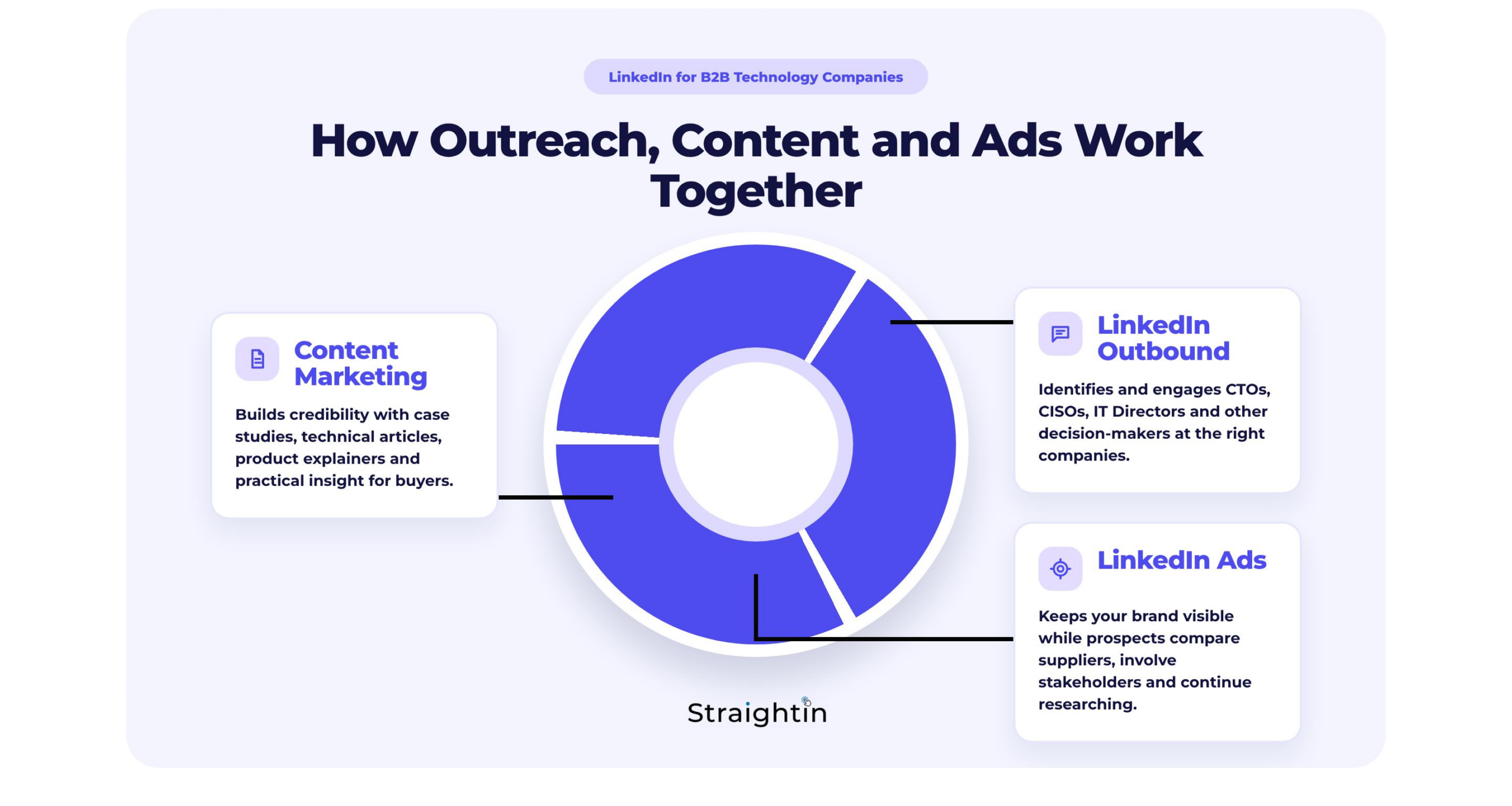
That’s why the businesses seeing the strongest results don’t rely on LinkedIn outbound alone. They use outreach to introduce themselves, content to build credibility and advertising to stay visible while prospects continue their research.
Each activity has a different role to play throughout the buying journey.
The Three Pillars of LinkedIn Lead Generation
The most successful LinkedIn strategies don’t rely on a single tactic. They combine proactive outreach, valuable content and targeted advertising to create multiple touchpoints throughout a much longer buying journey.
- LinkedIn Outbound introduces your business to carefully selected prospects.
- LinkedIn Content demonstrates expertise and builds trust.
- LinkedIn Advertising keeps your business visible while buyers continue researching.
LinkedIn Outbound Starts the Conversation
LinkedIn outbound gives you the opportunity to proactively introduce your business to carefully selected decision-makers.
Instead of waiting for prospects to discover you, you identify organisations that match your ideal customer profile, connect with the right people and start relevant conversations through personalised outreach.
For a software company, that might mean connecting with CTOs at mid-market businesses. A cybersecurity provider may focus on CISOs and Heads of Information Security. A managed IT provider might target Operations Directors or IT Managers whose existing contracts are coming up for renewal.
The goal isn’t to sell immediately. It’s simply to get your business on the prospect’s radar.
LinkedIn Content Marketing Builds Trust
Starting a conversation is one thing. Giving someone confidence to keep going is something else.
Once a prospect visits your profile, they’re looking for evidence that you understand their world.
That might mean sharing:
- Customer success stories showing how you’ve solved similar problems.
- Short videos explaining complex technologies in plain English.
- Carousel posts breaking down common IT or cybersecurity challenges.
- Articles covering topics such as cloud migration, AI adoption, compliance or digital transformation.
- Product demonstrations, webinars or implementation guides.
For technology companies, content often has another important job. It helps simplify products and services that can be difficult to explain in a single outreach message. By the time someone agrees to a meeting, they already have a much clearer understanding of what your business does and how it could help.
LinkedIn Advertising Keeps You Visible
Technology buying cycles can last months.
During that time, buyers often speak with several suppliers, read reviews, download resources and discuss options internally. LinkedIn advertising helps you remain part of that conversation rather than falling down the pecking order.
Rather than promoting your services directly, many technology companies use LinkedIn ads to put valuable content in front of carefully targeted audiences. That might include an industry report, a customer case study, a webinar, a product launch or research relating to emerging trends.
Every interaction makes your business a little more familiar, so when your sales team reaches out—or a prospect is finally ready to buy—they already recognise your name.
Bringing Everything Together
Think of LinkedIn as a series of touchpoints rather than a single campaign.
A Head of IT might first see one of your sponsored posts about cloud security. A few weeks later, they receive a personalised connection request. They click through to your profile, read a customer case study, watch a short product video and then come across another one of your posts discussing a recent cybersecurity threat.
None of those touchpoints closes the deal on its own.
Together, however, they build familiarity, credibility and trust long before a sales conversation begins.
That’s extremely valuable for B2B technology companies, where purchases are often high-value, technically complex and involve several stakeholders before a decision is made.
This is exactly how we approach LinkedIn lead generation at StraightIn. Rather than treating outreach, content and advertising as separate services, we see them as different parts of the same strategy, helping technology companies stay visible from the first interaction right through to the final buying decision.
A Real-World Example of LinkedIn Lead Generation
One example of this approach involved a global IT consultancy specialising in cloud, cybersecurity, AI, networking and digital transformation. Their goal wasn’t simply to generate more leads. They wanted to increase their visibility among senior technology decision-makers while building a more consistent pipeline of qualified opportunities.
To achieve that, we combined several LinkedIn marketing activities rather than relying solely on outreach.
Alongside a targeted LinkedIn outbound campaign, we produced six months of thought leadership content designed to strengthen the company’s credibility and keep it visible throughout the buying journey. During that period, their LinkedIn page grew by 217 new followers, representing a 34% increase compared to the previous six months.
At the same time, our outreach team focused on carefully selected technology leaders across the US and Canada, including CTOs, COOs and Vice Presidents of Information Technology working in sectors such as healthcare, retail and engineering.
Rather than sending generic sales messages, the campaign focused on starting relevant conversations with organisations that matched the client’s ideal customer profile.
What Results Should Technology Companies Realistically Expect?
One of the first questions businesses ask is, “How many leads can we expect to generate from LinkedIn?”
The honest answer is that it depends.
No reputable LinkedIn lead generation agency should guarantee a specific number of meetings or qualified leads each month. Response rates are influenced by a wide range of factors, including your target audience, the competitiveness of your market, your value proposition and how well your LinkedIn marketing supports your outreach.
A company selling managed IT services to SMEs will typically see different results from a software business targeting enterprise organisations with long buying cycles. Likewise, reaching local business owners is very different from engaging CIOs, CTOs or CISOs at multinational organisations.
Rather than focusing on a fixed number of meetings, it’s often more useful to measure whether your LinkedIn activity is moving in the right direction.
Metrics Worth Tracking
Instead of measuring success by activity alone, monitor indicators that demonstrate genuine commercial progress.
- Growth in qualified conversations rather than simply connection requests.
- Connection acceptance and response rates.
- Meetings booked with decision-makers.
- Growth in LinkedIn followers and profile engagement.
- Website visits generated from LinkedIn.
- Cost per qualified lead.
- Pipeline value generated from LinkedIn activity.
It’s also worth remembering that LinkedIn lead generation isn’t an overnight process.
Many of the businesses we work with start seeing conversations within the first few weeks, but the strongest results often come after several months of consistent activity. By that point, prospects have seen multiple pieces of content, received several touchpoints and become familiar with the business behind the messages.
That’s one of the reasons consistency matters so much. Businesses that continue building relationships, publishing useful content and refining their outreach tend to generate stronger results over time than those looking for quick wins.
Businesses that commit to the process rather than chasing quick wins are usually the ones that see the strongest long-term results.
Key Takeaways
If you’re looking to generate more qualified leads through LinkedIn, these are the main points worth remembering:
- LinkedIn remains one of the most effective channels for B2B lead generation, particularly for technology companies selling high-value products and services.
- Successful LinkedIn outreach starts with a clearly defined audience, relevant messaging and consistent follow-up.
- Prospects are likely to research your profile before replying, making LinkedIn content marketing an important part of the buying journey.
- Sending more messages doesn’t necessarily generate more leads. Relevance almost always beats volume.
- LinkedIn outbound, content marketing and advertising produce the strongest results when they work together rather than as separate activities.
- Technology buying decisions often take months, making consistency and visibility just as important as the initial outreach.
- Businesses should measure long-term pipeline growth and qualified opportunities rather than judging success purely by the number of meetings booked.
Get those fundamentals right, and LinkedIn can become far more than just another marketing channel. It can become a consistent source of qualified leads and a driver of long-term business growth.
Turning LinkedIn Into a Consistent Source of Qualified Leads
For many B2B technology companies, LinkedIn has become one of the most effective places to build relationships with potential customers. The challenge isn’t finding decision-makers. It’s creating enough meaningful touchpoints to earn their trust before they’re ready to buy.
That means thinking beyond a single outreach message. When LinkedIn outbound, content marketing and advertising work together, businesses stay visible throughout much longer buying journeys while giving prospects multiple reasons to engage.
Ready to generate more qualified technology leads through LinkedIn?
At StraightIn, we’ve spent almost eight years helping B2B technology companies generate qualified leads through LinkedIn using a combination of targeted outreach, thought leadership content and LinkedIn advertising. Every campaign is built around your ideal customers, your commercial objectives and the conversations that matter most to your business.
Get in touch with the StraightIn team to learn how our LinkedIn lead generation services can help your technology business build stronger relationships, generate more qualified opportunities and create a more predictable sales pipeline.
Frequently Asked Questions
How do you reach CTOs and other senior technology decision-makers on LinkedIn?
Senior technology leaders receive a high volume of connection requests, so relevance matters. Generic sales messages are easy to ignore. The strongest campaigns focus on understanding the recipient’s role, referencing the challenges they’re likely to face and starting a conversation rather than making an immediate sales pitch.
Should software companies and managed IT providers use the same LinkedIn strategy?
Not necessarily. While the principles remain the same, the messaging, target audience and buying journey often differ. A managed IT provider targeting SMEs will usually take a different approach to an enterprise SaaS company selling into global organisations with longer buying cycles and multiple stakeholders.
Is LinkedIn effective for cybersecurity companies?
Yes. Cybersecurity buyers are constantly researching new threats, compliance requirements and emerging technologies, making LinkedIn a valuable place to share expertise and build relationships. Regular thought leadership, combined with targeted outreach, can help cybersecurity companies connect with CISOs, IT Directors and other senior decision-makers.
How do you know if you’re targeting the right people?
A good indication is the quality of the conversations you’re having rather than the number of connection requests you’re sending. If the people replying match your ideal customer profile and have genuine influence over buying decisions, your targeting is probably on the right track. If you’re attracting the wrong job titles or organisations, it’s usually a sign your audience needs refining.
Can LinkedIn help technology companies selling complex or high-value solutions?
Yes. In fact, it’s often where LinkedIn performs best. Enterprise technology purchases rarely happen after a single conversation. Buyers often spend weeks or months researching suppliers, comparing options and involving multiple stakeholders. LinkedIn allows technology companies to support that process by sharing articles, videos, carousels, infographics, newsletters and downloadable resources that make complex products and services easier to understand long before a sales conversation takes place.
How often should B2B technology companies post on LinkedIn?
Consistency is more important than frequency. For most B2B technology companies, two or three high-quality posts a week on your company page are plenty. For individual profiles, one well-written post each week is usually enough to build visibility and credibility over time.
Focus on publishing content that’s genuinely useful rather than posting for the sake of it. LinkedIn’s algorithm is placing increasing emphasis on quality, expertise and relevance. We explore this in more detail in our recent article, How 360Brew Is Reshaping the LinkedIn Feed.
