

Choosing the right LinkedIn lead generation agency can make the difference between filling your pipeline with qualified leads or wasting time on conversations that never turn into sales.
The challenge is knowing which agencies focus on quality and which focus purely on volume.
The best LinkedIn lead generation agencies out there focus on reaching the right people with the right message at the right time. Rather than chasing connection numbers, they use targeted LinkedIn outreach, personalisation, and audience insights to create real sales opportunities.
As a specialist LinkedIn marketing agency, StraightIn has supported more than 7,000 B2B businesses and generated over 500,000 leads globally. That experience has shown us that successful lead generation comes down to targeting, messaging, engagement, and consistent follow-up.
In this guide, we’ll explore what separates an effective lead generation partner from one that simply generates activity.
Contents
- What distinguishes a qualified lead from an unqualified one?
- Why is precise audience targeting crucial for LinkedIn lead generation?
- How does personalised outreach affect lead generation results?
- What role does automation play, and when does it become a risk?
- How do agencies build relationships and engagement on LinkedIn?
- What real-world impact does this approach have?
- What metrics should you track to measure success?
- Why is a full-service LinkedIn marketing agency often a better choice than an outreach-only provider?
What Distinguishes a Qualified Lead from an Unqualified One?
The first thing people need to understand is that not every new LinkedIn connection is a qualified lead. The most valuable prospects show clear buying signals and fit the audience you want to reach.
What is a Qualified Lead?
A qualified lead is a potential customer who matches your target audience and has a realistic likelihood of becoming a paying client.
Rather than simply collecting new LinkedIn connections or enquiries, the goal of lead generation is to identify people who are a good fit for your product or service and are genuinely interested in having a conversation. These are the leads most likely to progress into meetings, opportunities, and ultimately new business.
The difference between a qualified and an unqualified lead often comes down to a handful of key factors:
Buying Intent
Qualified leads show clear signs of an immediate or future need for your solution. These buying signals indicate that a prospect is actively exploring options rather than simply browsing.
Examples of buying intent include:
- Requesting more information about your services.
- Booking a discovery call or meeting.
- Downloading relevant resources or case studies.
- Asking specific questions about pricing, implementation, or outcomes.
- Engaging with content related to a particular business challenge.
Fit with Your ICP
A qualified lead should closely match your ICP. This means they share the characteristics of the businesses or individuals most likely to benefit from your solution.
Factors that often form part of an ICP include:
- Industry or sector.
- Company size.
- Annual revenue.
- Geographic location.
- Job title or seniority level.
- Common business challenges.
Engagement Level
Engagement is often one of the clearest indicators that a prospect is interested in learning more about your business. Qualified leads typically interact with your brand in ways that go beyond a simple connection request.
This could include:
- Responding to LinkedIn outreach messages.
- Commenting on or sharing your content.
- Visiting your website after receiving a message.
- Downloading guides, reports, or other resources.
- Engaging in ongoing conversations with your team.
Decision-Making Authority
Speaking to the right people is just as important as generating interest. A prospect may be highly engaged, but if they have no influence over purchasing decisions, converting them into a customer can be difficult.
Decision-makers often include:
- Business owners and founders.
- Managing directors and CEOs.
- Heads of department.
- Sales and marketing leaders.
- Procurement and purchasing managers.
Defined Timeline and Budget
Qualified leads generally have a clearer understanding of when they want to make a purchase and the budget available to support it. While these details may not always be confirmed during initial conversations, there should be some indication that a project or requirement exists.
Examples include:
- A business looking to generate leads within the next quarter.
- A company planning to replace an existing supplier.
- A team with budget already allocated for marketing or sales support.
- A prospect working towards a specific growth target or project deadline.
Understanding budgets and timescales helps sales teams prioritise opportunities and focus their efforts on prospects most likely to convert.
In the infographic below, we visually breakdown the key differences between qualified and unqualified leads.
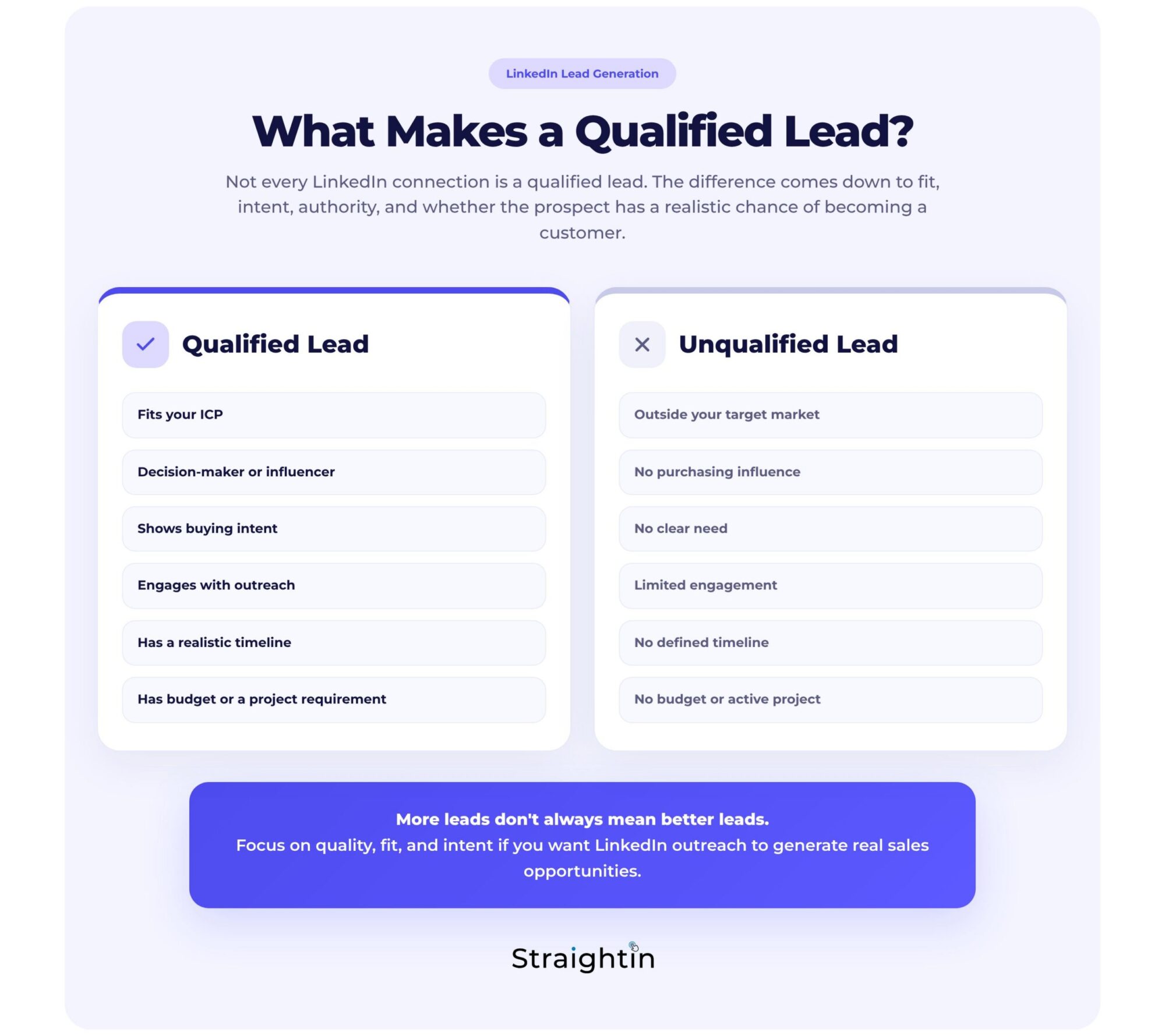
Unqualified leads may show general interest but often lack the budget, authority, or immediate need to move forward. You might have a great conversation with them, but if they’re not in a position to buy, it’s unlikely to lead anywhere.
That’s why focusing on qualified leads is so important. It helps shorten sales cycles, improve conversion rates, and ensures you’re spending your time talking to people who are genuinely likely to become customers.
Why is Precise Audience Targeting Crucial for LinkedIn Lead Generation?
Precise audience targeting ensures your LinkedIn outreach reaches the people most likely to become paying customers. It also prevents businesses from spending time and budget on irrelevant prospects.
Strong LinkedIn lead generation starts with a clear understanding of your target audience and ICP.
Effective targeting usually includes:
- Using LinkedIn Sales Navigator: Businesses can filter prospects by job title, industry, company size, location, and other criteria. A Forrester Consulting study commissioned by LinkedIn found that Sales Navigator delivered a 312% ROI over three years while improving lead quality and sales productivity.
- Developing Detailed ICPs and Buyer Personas: Agencies should work closely with clients to define their ideal customers and understand their challenges, goals, and buying triggers.
- Targeting Decision Makers: More than 65 million decision makers use LinkedIn. Focusing on the people with buying power helps create more productive conversations and qualified opportunities.
At StraightIn, audience targeting begins long before the first message is sent. Every new client goes through a detailed briefing process designed to build a clear picture of exactly who they want to reach.
As Shannon Townsend, Head of Operations at StraightIn, explains:
“A lot of the work happens before the first message is ever sent. Our Account Executives and Account Managers spend time with clients building a detailed picture of their ideal audience, including who they are, what challenges they face, what language they use, and who is involved in the buying process. That information shapes everything from the audience lists we build in Sales Navigator to the messaging used throughout the campaign.”
This level of planning helps ensure that outreach reaches the right people from the start. It also gives the messaging team the insight they need to create conversations that resonate with a prospect’s specific role, priorities, and pain points.
Even the strongest messaging won’t generate results if it reaches the wrong people. Getting audience targeting right lays the foundation for everything that follows.
- If you’d like to learn more about how Sales Navigator works and how it compares to LinkedIn Premium, read our guide: LinkedIn Premium vs Sales Navigator: What’s the Difference?
How Does Personalised Outreach Affect Lead Generation Results?
Personalised outreach consistently outperforms generic messaging because it demonstrates an understanding of the prospect’s role, challenges, and priorities.
Effective personalisation can:
- Increase email open rates by 26-29% to help businesses capture the attention of more relevant prospects.
- Generate double the reply rates of generic outreach, creating more opportunities to start meaningful conversations.
- Strengthen customer relationships, with 95% of B2B marketers believing personalisation improves engagement and trust.
- Increase conversion rates by up to 63%, resulting in more qualified meetings and sales opportunities.
What Role Does Automation Play And When Does It Become a Risk?
LinkedIn automation and automated campaigns can help businesses manage repetitive tasks more efficiently, but they need to be used carefully.
Appropriate uses of automation include:
- Managing Administrative Tasks: Automation can help schedule follow-ups, organise data, and manage workflow processes.
- Supporting Outreach Activity: Automated campaigns can help scale outreach efforts while maintaining consistency across campaigns.
- Improving Efficiency: Sales teams can spend more time speaking with prospects and less time handling repetitive manual work.
Used correctly, automation can support lead generation efforts and improve efficiency without compromising the quality of conversations.
But, and there is a big but, there are important risks to consider when using any form of automation on LinkedIn.
LinkedIn’s Terms of Service
LinkedIn has clear rules around automation and actively discourages the use of third-party software that scrapes data, modifies the platform, or automates activity beyond its approved guidelines. According to LinkedIn, these restrictions are designed to protect member privacy and ensure the platform remains a place for authentic professional interactions.
As LinkedIn states:
“We don’t allow the use of third-party software or browser extensions that scrape, modify the appearance of, or automate activity on LinkedIn’s website.”
This is why it’s important to understand exactly how a lead generation agency approaches automation before launching a campaign.
Account Restrictions
Profiles that breach LinkedIn’s rules risk temporary account restrictions or, in more serious cases, permanent account bans. LinkedIn regularly monitors activity for signs of automation and may restrict accounts that appear to use prohibited tools or exhibit behaviour that doesn’t reflect normal user activity.
A restricted account can quickly bring your lead generation efforts to a halt and make it harder to connect with prospects. It can also put years of work building your network, personal brand, and reputation on LinkedIn at risk, which most businesses are not willing to gamble with.
Loss of Authenticity
Overly aggressive LinkedIn automation can make outreach feel impersonal and transactional. Prospects quickly recognise generic templates, mass messaging, and automated sequences that lack relevance to their role or business challenges.
While automation can help manage repetitive tasks, it should never replace genuine human interaction. The most effective LinkedIn campaigns combine technology with thoughtful messaging, personalisation, and real conversations. When outreach feels authentic, prospects are far more likely to engage, respond, and ultimately become customers.
Finding the Right Balance Between Automation and Personalisation
A good LinkedIn lead generation agency should be open and transparent about its approach to automation. It should be able to explain what tools it uses, why it uses them, and how it balances efficiency with genuine, personalised communication that remains compliant with LinkedIn’s guidelines.
Just as importantly, it should be up front with you about the potential risks. At the end of the day, it’s your LinkedIn profile, your network, and your reputation on the line, so you deserve a clear understanding of how your account will be managed.
At StraightIn, we recognise that different businesses have different requirements. That’s why we offer both fully managed manual outreach campaigns and hybrid campaigns that use intelligent automation to improve efficiency without sacrificing quality.
Our manual campaigns are entirely human-led, with our team managing outreach, conversations, and follow-up activity directly. For businesses looking to scale their activity, our hybrid approach combines intelligent automation with dedicated account management, helping clients reach more prospects while ensuring messaging remains relevant, personalised, and compliant with LinkedIn’s guidelines.
Whichever approach is chosen, our focus remains the same: starting genuine conversations, building relationships, and generating qualified opportunities rather than simply increasing activity.
How Do Agencies Build Relationships and Engagement on LinkedIn?
Successful LinkedIn lead generation campaigns don’t stop after the first message. That is just the first step. The strongest campaigns focus on building relationships through ongoing engagement, relevant content, and consistent follow-up.
Key strategies include:
- Content-Driven Engagement: Sharing valuable content helps position businesses as credible voices within their industry while keeping them visible to prospects over time.
- Meaningful Conversations: Rather than focusing solely on sales, effective outreach explores business challenges and identifies opportunities to add value.
- Consistent Follow-Up: Many prospects require multiple touchpoints before they’re ready to book meetings or enter a sales conversation.
- Active Listening: Understanding prospect feedback makes future messaging and engagement more relevant and effective.
Poor lead nurturing is one of the biggest reasons opportunities fail to convert. Consistent engagement helps turn initial connections into qualified leads and sales conversations.
LinkedIn advertising can also play an important supporting role. While outreach helps start one-to-one conversations, LinkedIn Ads can increase visibility among your target audience, reinforce key messages, and keep your business front of mind throughout longer buying cycles. This can be particularly valuable in specialist B2B markets where prospects may take months to move from initial awareness to a sales conversation.
While outreach starts the conversation, LinkedIn ads help keep your business visible until prospects are ready to engage.
What Can Successful Lead Generation Actually Deliver on LinkedIn?
It’s one thing to talk about targeting, personalisation, and engagement. It’s another to see what happens when those elements come together in a real campaign.
StraightIn recently partnered with a client in the advanced materials manufacturing sector. While the company had strong technical credentials and a compelling product offering, it faced a challenge many B2B organisations will recognise: translating technical expertise into commercial conversations with the right decision-makers.
The business needed to:
- Reach a niche audience of senior technical and commercial stakeholders.
- Communicate a complex value proposition in a way that resonates with buyers.
- Build credibility within a specialist market.
- Generate qualified opportunities despite long and often complex buying cycles.
“In specialist B2B markets, the challenge often isn’t awareness. It’s helping the right people understand the commercial value of what you’re offering. That’s where a combination of outreach, advertising, and educational content can be particularly effective.”
To address this, we combined targeted LinkedIn outreach with LinkedIn Ads. Detailed audience research allowed us to identify the organisations, job titles, industries, and seniority levels most likely to be interested in the solution. We then developed outreach messaging and educational content designed to address common questions, overcome scepticism, and demonstrate value.
Rather than relying solely on direct outreach, LinkedIn advertising was used to increase visibility among the same target audience. This helped reinforce key messages, build familiarity, and keep the business visible throughout a longer decision-making process.
Over a 12-month period, the campaign generated 114 qualified sales opportunities.
The combination of outreach and LinkedIn advertising created meaningful conversations with senior decision-makers while maintaining a steady flow of opportunities into the sales pipeline.
The campaign highlights an important point: generating qualified leads is rarely about sending more messages. It’s about understanding your audience, communicating the value that matters, and staying visible long enough to engage prospects when they’re ready to have a conversation.
What Metrics Should You Track to Measure Success?
- Sales Qualified Leads (SQLs): Leads that the sales team has confirmed are ready for direct engagement. This is often one of the clearest indicators of lead quality.
- Conversion Rates: The percentage of prospects moving from lead to opportunity and ultimately to customer. Strong conversion rates suggest the agency is attracting the right audience rather than simply generating volume.
- Pipeline Value: The total potential revenue generated through agency-led campaigns. This helps demonstrate the commercial impact of lead generation activity.
- Return on Investment (ROI): The revenue generated compared to the cost of the campaign. Ultimately, lead generation should contribute to profitable business growth.
- Cost Per Qualified Lead (CPQL): The average cost required to generate a qualified lead. This can provide valuable insight into campaign efficiency and long-term sustainability.
Why a Full-Service LinkedIn Marketing Agency Often Delivers Better Results
Choosing a LinkedIn lead generation agency isn’t simply about finding a company that can send messages on your behalf. It’s about finding a partner that can identify the right audience, generate qualified opportunities, and support the wider sales process.
That’s why many businesses choose a full-service LinkedIn marketing agency rather than a provider focused solely on outreach. While outreach can start conversations, activities such as content marketing and LinkedIn advertising help build visibility, credibility, and engagement throughout the buying journey.
A successful LinkedIn strategy often combines:
- LinkedIn outreach to start conversations with prospects.
- LinkedIn advertising to increase visibility among target audiences.
- Content marketing to educate and build credibility.
- Personal branding to strengthen trust and authority.
- Audience targeting and Sales Navigator research to improve lead quality.
- Lead nurturing to keep prospects engaged throughout longer buying cycles.
The best agencies understand how these activities work together. Rather than focusing on activity for activity’s sake, they focus on generating qualified leads, building pipeline, and delivering measurable business results.
If you’re evaluating potential partners, look beyond connection numbers and ask how they plan to:
- Reach the right decision-makers.
- Communicate your value proposition.
- Support prospects throughout the buying journey.
- Generate qualified opportunities rather than just activity.
- Contribute to long-term business growth.
Key Takeaways
Choosing the right LinkedIn lead generation agency is about generating qualified opportunities, not simply increasing activity.
- Qualified leads matter more than connection volume.
- Strong LinkedIn lead generation starts with a clearly defined ICP and target audience.
- Personalised outreach generates more engagement, meetings, and opportunities than generic messaging.
- LinkedIn automation should support outreach efforts rather than replace genuine human interaction.
- Consistent engagement and follow-up help turn prospects into sales conversations.
- Sales Navigator can help businesses identify and connect with the right people more efficiently.
- Success should be measured through pipeline growth, qualified leads, conversion rates, and ROI.
- Businesses often achieve stronger results by working with a full-service LinkedIn marketing agency that combines outreach, content marketing, and paid advertising.
The best LinkedIn campaigns focus on reaching the right people, starting meaningful conversations, and generating qualified opportunities.
Choosing the Right LinkedIn Lead Generation Partner
A LinkedIn lead generation agency should do far more than generate connections or send messages at scale. The real value lies in identifying the right audience, starting meaningful conversations, and creating qualified opportunities that contribute to long-term business growth.
The strongest results often come from agencies that combine outreach with wider LinkedIn marketing activities such as content marketing, advertising, and lead nurturing. By taking this approach, businesses can build stronger pipelines and create more opportunities with the people who matter most.
If you’re looking for a LinkedIn marketing agency, StraightIn should be on your shortlist. As a full-service LinkedIn marketing agency, we help businesses generate qualified leads, build stronger pipelines, and connect with decision-makers through LinkedIn. Our services include LinkedIn outreach, LinkedIn advertising, content marketing, and personal branding.
Get in touch with the StraightIn team to find out how we can help you reach more decision-makers, generate more qualified opportunities, and build a pipeline you can rely on.
Frequently Asked Questions
How long does LinkedIn lead generation take to produce results?
LinkedIn lead generation timelines vary depending on your industry, audience, and offer. Many businesses begin seeing conversations and engagement within the first few weeks, but generating qualified opportunities often takes longer, particularly in B2B sectors with complex buying cycles.
Is LinkedIn lead generation suitable for small businesses?
Yes, LinkedIn can be highly effective for small businesses. The platform allows companies to target specific decision-makers and niche audiences, making it possible to generate qualified opportunities without the large budgets often associated with other marketing channels.
Can LinkedIn generate leads for niche industries?
Yes, LinkedIn is particularly effective for niche B2B industries because it allows businesses to target specific job titles, sectors, company sizes, and seniority levels. This makes it easier to reach decision-makers who may be difficult to engage through other channels.
Should LinkedIn lead generation focus on quality or quantity?
LinkedIn lead generation should prioritise quality over quantity. A smaller number of qualified leads that match your ideal customer profile will typically deliver better conversion rates and stronger ROI than a large volume of irrelevant connections.
What tools do LinkedIn lead generation agencies use?
Many agencies use tools such as LinkedIn Sales Navigator, CRM platforms, analytics software, and outreach management tools to support targeting, reporting, and campaign management. Any agency using automation should be transparent about how it works and make sure it remains compliant with LinkedIn’s guidelines.
Does LinkedIn lead generation work for long sales cycles?
Yes. LinkedIn is often well-suited to businesses with longer sales cycles because it allows companies to stay visible through content, advertising, and ongoing engagement while prospects move through the decision-making process.
How quickly can a LinkedIn lead generation campaign deliver results?
Many campaigns begin generating engagement and conversations within the first few weeks. However, qualified opportunities often take longer to develop, particularly in industries with longer buying cycles or higher-value services.
